6.28.2005

Solar Death Ray


Very entertaining website! Check it out! (Also my first post trying out the new Blogger images feature).

Lessons in vegetarianism in the heart of cattle country

Vaughn at Icthus has a very interesting article on vegetarianism. Being a pastor in the heart of cattle country in a community that depends on agriculture I thought it only appropriate to share my thoughts with him. Here's his post followed by my comments.
Lessons in vegetarianism

Today for lunch, steamed vegetables and tofu over brown rice (with a splash of soy sauce). Yummy. So, this got me thinking more about vegetarianism. Why would I eat meat? Well, the answer is mostly because I am tempted to glutony and vanity. I desire to please my appetite and I rationalize that if I eat more protein I will look trimmer and sexy. But are glutony and vanity Christian virtues?

So, I'm beginning to think of vegetarianism as a compelling Christian practice. My recent thoughts on it are that it is a prophetic witness against consumerism, consumption, and capitalism-run-amok. Arguably the food industry has become less about food and more about money. Check this statistic:

In the US, animals raised for food are fed 70% of the corn, wheat, and other grains we grow. The world's cattle alone consume a quantity of food equal to the caloric needs of 8.7 billion people - more than the entire human population on Earth.

Its difficult to think about more food going to cattle than to those (esp. in 3rd world countries) who need it most. But the fact is that there is much money to be made by large corporations connected to the beef council. To be a vegetarian sends a compelling message to society that you will not participate in systems of over-consumption and gluttony (have you ever met an obese vegetarian?) in an age when millions of people live in extreme poverty without food.

Arguably there are other reasons to be vegetarian as well, but for now, lets consider the environment and economics.


Here is my comment:

Hey Vaughn-

Thanks for the interesting statistics. We live in the heart of cattle country out here in the sticks and I must say that the situation is more complex than those statistics suggest.

In Colorado alone, the federal government pays over $38 million a year to farmers to not farm their land! This keeps many farmers from bankruptcy. We have plenty of land to farm for both cattle and human consumption. I thik the greater problem is water.

Colorado, as you know, has experienced terrible drought the last several years. Water consumption to produce food for animals is probably one of the main uses of water in our country.

But to be consistent, growing a lawn in Colorado is extremely poor management of water resources as well.

I believe there are responsible ways to raise animals for consumption. But those days are long gone as we have moved away from the farm to the city. Most people in the city do not know where there food comes from. They do not know how or where or by whom it was raised. The last several cows I've eaten, I've known who raised it, what they fed it, and what it's name was! I also know the butcher.

The issue of beef production is huge in the U.S, but there are also dangers lurking in the resources used for our fruit and vegetables. Some of these questions are very difficult to answer morally. For instance, today because of technology, we have incredible hybrids of corn and other vegetables which are more disease and drought tolerant than ever before. Because of this, the yields we see in these hybrids are greater than ever before using fewer natural resources.

Hybrids can help us feed more people while using less natural resources. Yet the debate around frankenfood is heating up! Are these genetically modified foods safe for the long-term? What are the long-term effects of GMO's?

I think one of the main considerations in food consumption from a Christian viewpoint is to support local, sustainable, ecologically responsible farming practices. That is easy to do out in the sticks but very hard to do in the city! Here we live close to the land and the producers. We know them and how they operate. In the city you have to trust the supermarket or a co-op and their word regarding whether the food product is organic, non-GMO, natural, or what have you.

From this standpoint, should a vegetarian eat a banana or a kiwi or a coconut? These are not local produce (in Colorado) and vast amounts of natural resources are used to provide them for us here.

One last thing that demonstrates the reliance on others we have in our food production: I find it funny that the vegetarian starter kit lists Fritos as an ingredient in one of the recipes. I have heard anecdotal stories that cause me to avoid Fritos like the plaque! (Namely that Frito-lay regularly purchases corn that is unfit for cattle consumption!)

I agree that a Christian's relationship to food and the practices that produce food are very important, but I don't think being a vegetarian is the only moral answer for a thinking Christian.

Grace and peace,
Steve

Everything is Church especially during the summer months!

From Jason Clark's blog here are his thought on an issue I was processing this morning:
I was having a conversation with Fredrik, when I was in Sweden, about the growing popularity, of making 'private god spaces', of being post church, and making church something about not being church.

In this expression, we see a reaction to the idea that the church has so often seen sundays as the only valid space for God to be. In this paradigm, sundays are church, and the kingdom, only the sunday service is church.

So now we regale the congregation, and sundays, and see church as when I play golf, go shopping, play football. In this paradigm everything is church, and I don't need church anymore, I'm post church.

But in the old model where nothing is church, surely it's so restrictive that we have to say no! and find God elsewhere? And in the second model, where everything is church, then ultimately nothing is church, a kind of pantheistic ecclessiology.

A church that does not naturally lead to people connecting to God, in the places they work, and play, and live, isn't church at all. Conversely when church becomes just the place where I chose to connect with people who do just what I want, like football, I have stopped being church, just as completely.

In the reaction to church being so disconnected from the world, we think we are being radical by moving church outside of church, but we can end up not being church at all.

So where do I see church? What about the football guy, who finds God in his football sundays, and the water-skiing woman, who finds her time with God there. When they get together and ask, how are we going to talk about our faith, how are we going to celebrate christianity together - I hate football and you can't water ski - how are we going to connect together outside of our own exclusive narrow spheres of interest...then they get to start being church.

If sundays was all about me, jesus as my girlfriend worship, my blessing, my needs, lets not be fooled and think that church on my terms, on my interests, with fewer people is anything better, or different, it's just the modern church on steroids, hyper modern church.


Here are my thoughts I posted in a comment on his site. (I planned to blog about this today and his post was a great springboard for me!)

Thanks Jason for these much needed thoughts! I have been thinking about this today as my churchs' attendance is horrible in the summer. When I run into members in town they tell me of how busy there are and the many trips they have been on, the many personal projects there are pursuing. One woman today expressed surprise when I recognized her because it had been so long since she had been to church.

Her comment portrayed the bigger issue for me. Church attendance isn't the issue. Gather together in community, with others, with people who are different from us is the issue. How can we love our neighbor as our self (remember how Jesus defined neighbor) if we aren't around long enough to connect?

6.22.2005

CreativePastors Blog: Leadership Uncensored- Break it Up!

Very important reminder! Especially concerning the weekly sabbath for pastors.

Grokker


Grokker
Originally uploaded by hawkenstein.
Here's a fun site that gives you visual search results!

Private Warriors


Private Warriors
Originally uploaded by hawkenstein.
Also watch this fascinating Frontline report on PBS. If you get a chance, watch it!

The Education of Shelby Knox


The Education of Shelby Knox
Originally uploaded by hawkenstein.
I caught this documentary last night. It is excellent and raises many interesting issues. If you get a chance, check it out!

6.20.2005

Emegergent Church: Filled with creative, energetic potential

Here's a quote from a great article by Alan Roxburgh on the emerging church.

At their best, these younger leaders want to challenge the North American church to a conversation about faith and mission in the midst of what they deem a postmodern transition. They want to engage in conversation about the philosophical, theological, methodological, and cultural challenges we face in our fast-changing world. At their worst, they become a new form of seeker-driven churches which use art, music, the digital revolution and the aesthetic pastiche of the moment to create new experiences.

At their best they courageously and joyfully enter the worlds of Goths and tattoo parlors to form Christian life in, with, beside and for people who would never be welcome in most congregations. At their worst they become the purveyors of more experiential, artsy, aesthetic forms of religious goods and services.

6.19.2005

TheBolgBlog: D. A. Carson: Becoming Conversant with the Emerging Church

Some good thoughts on Carson's book by Ryan Bolger a professor at Fuller.

6.17.2005

Monday Morning Insight Weblog: Using Mind Maps to Enhance Preaching

I've been using mind maps in my preaching and teaching for about half a year or so. I use software called Mindmanager and love it! It has revolutionized my preaching, teaching, and organization. To learn more about the use of mind maps read the Mindjet blog.

buzztracker

This website maps the news.

liveplasma

Check this out. Very cool!

Liveplasma is a new way to broaden your cultural horizons according to your taste in music and movies.

Look for your favorite bands, movies or directors to obtain a map that details other potential interests.

6.16.2005

ExChristianDotNet - encouraging ex-Christians Ex Christian Ex-Christian Xtian ExTian ExChristian

Here's a sobering and sad site.

Monday Morning Insight Weblog: Bill Gates on Church Attendance

Here's a quote by Bill Gates on religion in Time magazine:
Just in terms of allocation of time resources, religion is not very efficient. There's a lot more I could be doing on a Sunday morning.

Bill is absolutely right. Religion is not very efficient. It never has been and never will be. Efficiency is not the goal of religion. Efficiency is not the goal of a Sunday morning worship service (at least it shouldn't be!). To focus on efficiency or relevancy or any other thing besides God is to move away from the heart of worship.

I know that our society has gotten further and further from this concept but when Yahweh originally created Sabbath (which most Christians observe on Sunday, in theory) the goal was to move us from a mindset of production (efficiency) to rest (inefficiency).

Sadly, Gates and so many others don't see why religion is worth their time. What is worth Bill's time? What is worth our time? Is worshipping God worth our time despite how irrelevant and mundane it may be?

My two churches are far from being relevant to most in our town. We are far from being professional let alone great in our worship. We struggle to sing hymns with any real musicality. Our services are not powerful experiences were people leave knowing they have experienced God's presence. Yet we come together. We worship. At least we try. And I hope that is worth our time.

6.15.2005

What's your theological worldview? Now that's surprising!

Evangelical Holiness/Wesleyan

79%

Emergent/Postmodern

71%

Neo orthodox

71%

Roman Catholic

64%

Charismatic/Pentecostal

57%

Modern Liberal

54%

Reformed Evangelical

50%

Classical Liberal

43%

Fundamentalist

14%

What's your theological worldview?
created with QuizFarm.com


Thanks to Darrell for the link.

6.06.2005

No Wonder Emergent is Threatening to Evangelicalism!

Critical of the emergent church discussion? Maybe this will point out why.

Theoblogy: Official Response to Critics of Emergent

If you are critical of the emergent church discussion, please take the time to read this official response.

6.02.2005

Jerry Rice


JERRY RICE
Originally uploaded by hawkenstein.
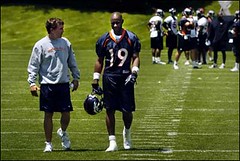
The G.O.A.T. is now playing for the Broncos. I think this is a great move as the veteran will bring a lot of knowledge and experience to share with the young receivers of the Broncos.

He'll also help them out in the red zone where the Broncos struggled last year.

Doubt: A History


Doubt: A History
Originally uploaded by hawkenstein.
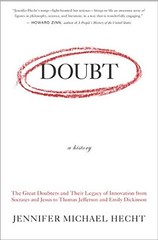
This sounds like a fascinating program and book. There's also a quiz by the author. Here are some interesting quotes from the Speaking of Faith newsletter.

We examine the contribution of skeptics, cynics, and others who have followed the human impulse to challenge given wisdom, and to doubt. Poet and historian Jennifer Michael Hecht has published a sweeping, lyrical history of the world's great doubters, and she shows that the act of questioning, as much as the act of believing, has changed the world.

The joy of creating this program lies, in part, in having my own imagination about "faith" expanded. This week, Jennifer Michael Hecht provides a luminous account of how our common imagination about doubt, and its symbiotic relationship with faith, begs for investigation.

Hecht's subject matter, the history of doubt, is daunting. She defines doubt generously, broadly addressing the human impulse to question what is given in order to invest one's days with meaning. She counts Socrates and Jesus, Thomas Jefferson and Emily Dickinson, among history's great doubters. She loves the ideas her work examines, and recounts their origins and the individuals who championed them as though she is recalling the adventures of friends:

You have to be a little bold and a little brave in most periods of time to be a doubter. And I liked them. I also was surprised by them because the dominant history basically suggests that doubt is very modern and that we have few doubters in the ancient world, but I kept seeing it everywhere. And so I just wanted to tell that story, to sketch it out. I found it was much more cohesive and self-knowing than I had ever dreamed.


How many Christians would acknowledge that there is a symbiotic relationship between faith and doubt?

6.01.2005

TallSkinnyKiwi: The Emergent Heresy Test

Go take the emergent heresy test! Also check out the results.

5.31.2005

Another great quote from Dr. Fernando's article

According to the famous evangelist John Wesley, you have a healthy job when there is a certain percentage of things you like to do, a percentage of things you don’t mind doing and a percentage of things you don’t like to do at all – but you choose to do them anyway!


This is excellent advice for all of us young pastors who want to work our way out of all the "have to's" of ministry.

Panda's Ponderings [Out of this World Dutchman]: Ajith Fernando: Servant Leadership

Tertullian wrote, 'It is our care for the helpless, our practice of loving-kindness, that brands us in the eyes of many of our opponents. 'Only look,' they say, 'how they love one another.'

The Body grows not only through preaching but through kindness in and outside the church. So this is a leader’s role: foster a joyful and patient community where people tolerate each other and are kind to each other.


This is a powerful article by a wonderful disciple and scholar. I thoroughly enjoyed his commentary on Acts and find these thoughts especially challenging as a pastor. The quote above is what I am finding to be the number 1 challenge of pastoring in a small town. The lack of joyful, patient community is destroying so many small churches.

5.24.2005

Tornado warning


Tornado warning
Originally uploaded by hawkenstein.
Wray is in the center of that big red spot on the radar! We are under a severe tornado warning this evening!

Megachurch google sightseeing: First Presbyterian Church


First Pres Colorado Springs
Originally uploaded by hawkenstein.
This is First Presbyterian Church (PCUSA) in Colorado Springs, Colorado. Here's a little from their website:

Welcome to First Presbyterian Church located downtown at the corner of Nevada and Bijou Streets in the heart of Colorado Springs.

Our Church is committed to being more than the geographic heart of the city. We want to be Christ̢۪s heart as well.

Since the founding of the Church in 1872, God has blessed this congregation with the presence of His Holy Spirit and has called this congregation to serve Him in a unique way—challenging us to provide a Christ-centered, biblically energized witness to Colorado Springs and the surrounding area.

An abundance of people-oriented ministries and programs are provided here to meet human need in whatever form it takes.

Whatever your age or circumstance in life, we have a place for you in the family of God at First Presbyterian Church.

The doors of our Church and the doors of our hearts are open to you.

Brian McLaren: A Brotherly Critique and Response to "A Generous Orthodoxy"

Here's a great but brief discussion concerening "A Generous Orthodoxy". One thing I greatly admire in the emerging church movement is the willingness and desire to dialogue about issues. Too often in the church we are tempted to say "my way or the highway" without allowing people to process the issues openly and honestly.

5.23.2005

4 Ways Blogging Can Change Your Church

This is an idea I have had for some time:
Blogging will help to develop sermons and classes
Now, a preacher will be able to post a sermon idea at the beginning of the week and have the congregation respond so that when he delivers the sermon he will have brought many along for the ride. They will be actively engaged in the process and be able to share ideas and thoughts. Soon a preacher that does not blog with his congregation will be out of touch and behind the pack. Just note: blogging will change how preaching is done!

I would love to experiment with this. Sadly most of my congregation doesn't know what a blog is! Would any of you enjoy participating in something like this?

Crosswalk.com - United States Has More Megachurches Than Previously Thought

It's going to take me much longer than I thought to Google sightsee all of the megachurches in the U.S!

Westling in church for outreach


Wrestler
Originally uploaded by hawkenstein.
St. Philip's Anglican Church in Winnipeg has some guts!

St. Philip's Anglican Church hosted its first post-service match on Sunday, hoping to attract new members with a more hip program that included a two-match show with six local wrestlers, most of them Christians.

The colourfully clad wrestlers presented a WWE-style program complete with smackdowns and headlocks.

Many in the congregation of about 40 regular members find wrestling a natural fit with religion because of the theme of good versus evil.

Yet when I read it was "Christian-themed wrestling matches" I was hoping for something along the lines of MTV's Celebrity Deathmatch with pairings of biblical characters or even modern day Christians. Next up Jerry Falwell vs. Pat Robertson. I bet more people would come to see that then a bunch of WWE style wrestlers who are mostly Christians!

5.19.2005

A Generous Orthodoxy


A Generous Orthodoxy
Originally uploaded by hawkenstein.
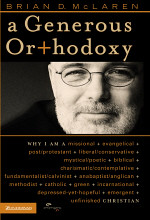
I finished this book yesterday. In my opinion it is a great read.

Yes, it is provocative. Yes, many will find it troubling.

But if we are truly generous with the author and seek to understand his intentions (which I believe are to make us think rather than answer every question we might have) then I think we can all greatly profit from this book.

Coming from an evangelical background (and still making a transition to a post-evangelical understanding) many of his remarks concerning evangelicals and their relationship to the world and sinners stung particularly bad.

Also helpful are McLaren's discussion of the Bible, missional/incarnational theology, and the environment.

In seminary I took an excellent class from Dr. Danny Carroll called Reading the Bible from the 2/3rds World. This class was the first time someone ripped the lenses I read the Bible with out from in front of my eyes. I found that my interpretation of Scripture and what I believed to be biblical where greatly influenced by my presuppositions, tradition, culture, gender, and so on.

McLaren's book, if you will allow it, will do the same for you. It will remove the spectacles you see Christianity, Jesus, liberals, conservatives, God, the Bible, etc. from your face. And though it may seem scary or impossible now, you may actually like the view better.

Creativity, Innovation, Team Building, Leadership, Brainstorming, Idea Champions


homepage-graphic-left
Originally uploaded by hawkenstein.
This is a great website full of content to get you thinking. I've got to go to lunch and get some visitation done today, but I hope to do more with this tomorrow.

ICTHUS: Calvin College Faculty to George Bush - NO

Vaughn at Icthus has posted a great letter written by the Calvin College Faculty to George Bush. Check it out.

Wray Eagles


Wray Eagles
Originally uploaded by hawkenstein.
The joys of small town life...our high school baseball team and track teams are participating in the state tournaments this weekend. Here's a sign of support as you enter town heading east on HWY 34.

5.17.2005

Megachurch google sightseeing: Faith Bible Chapel


Faith Bible Chapel
Originally uploaded by hawkenstein.
This is a large church with a couple of campuses. They also have a school (K-12 I think). Here's a little about them in their own words:
We are a family of faith with a single purpose; we want to honor God.

The purpose of Faith Bible Chapel is to honor God by:

Acknowledging the Holy Spirit in all we do -
We value prayer and continually ask God to lead us in our planning. He shows us the needs of people, the opportunities for service to Him and gives us specific ideas to keep our church active and fresh. It is His church and we want Him to shepherd us all.


Bringing people to Jesus and to membership in His family -
We have been blessed by God. God loves us and will give us His life! We work to share the good news with our next door neighbors and with people around the world. We want to be a blessing to others and to help people find a relationship with Him for themselves.


Celebrating His presence through worship -
It is refreshing and energizing to express joyful praise to God together. We encourage active participation in singing and other expressions of worship to God as a key part of each of our meetings as a church family.


Developing people into Christ-like maturity through the Word of God -
The highest goal for a person is to grow continually into the character of God Who made us to be like Himself. We study the Bible for practical advice on how to continue to change so that we fulfill His purposes more completely. We want to be fresh in our experience of His life in us.


Equipping people for their ministry in the church and life mission in the world -
We each have unique gifts that we can offer to enrich the experience of God by every member of our church family. We share a common mission to reach others with a clear message of God's love and power so that they can enjoy being in God's family also. Training and opportunities for everyone to serve God actively are always present.

Frodo the leader


Frodo
Originally uploaded by hawkenstein.
This is a great article on leadership in the emerging postmodern world. I must say that this is so refreshing for me to read. I have been involved in megachurches with corporate, top down leadership, clear vision, hierarchy, the whole nine yards. I always felt I fell far short compared to these men (and I do!). But there is hope for the Frodo's and Dorothy's!
The leadership style that once dominated our culture is becoming passe. Instead of the Lone Ranger, we have Frodo: the Clint Eastwoods and Sylvester Stallones are replaced by ordinary men. Frodo, Aragorn and Neo (the Matrix) are self-questioning types who rely on those around them for strength, clarity and purpose. Indeed, while they have a sense of the need and a willingness to sacrifice themselves, they may not even know the first step on the journey.

5.16.2005

Jean-Luc Picard was my favorite!

Picard
Captain Jean-Luc Picard- You are the thinking
person's captain. You contemplate everything
before putting it into action. While you are
indecisive at times, you do so to insure an
equatable solution no matter what the cost.


Which Star Trek Captain are you?
brought to you by Quizilla

Reverend Mike's House of Homiletic Hash: Yet Another Thing I Wish I'd Said First

This is a great quote I found at Mike's blog. I think this is the issue the emerging church is pushing for us to deal with.
I don't claim to have a full understanding of all of these transitions, but I am convinced that as one moves toward such an understanding, one begins to see that postmodernism is not merely an epistemological shift from objectivity to subjectivity, from reason to emotion, from certainty to probability. Much more is involved, more than I can relate here. But what I must note here is the fact that insofar as postmodernism is more than a shift in epistemology, it is not exactly a set of ideas that one can choose for or against. [Emphasis added.] The issue before us is not whether or not we agree with postmodernism. That is like asking whether or not we agree with the year 2004. The question before us is the same question that faces Christians in every age: how should we then live? Given the fact of the postmodern cultural transitions of the last half-century, how should we live out our Christian faith? Answering this question will of course involve critically agreeing or disagreeing with the responses to our cultural context put forward by others, but it will also require serious self-criticism and a willingness to think creatively in directions not explored by Christians in previous eras. Doubtless, this is a task fraught with difficulty and danger, but I take it to be central to a life of faith that is lived out in truth and love in its actual context.

5.12.2005

Megachurch google sightseeing: Woodman Valley Chapel


Woodman Valley
Originally uploaded by hawkenstein.
Woodman Valley Chapel is in Colorado Springs, Colorado the hub of the evangelical community in many a person's mind. Here's a description from their website:

Woodmen Valley Chapel was founded in 1980 as a nondenominational, evangelical fellowship of believers.

Today, we strive to be an authentic community where people can experience God, be encouraged in their spiritual journey and empowered for service as they entrust a legacy to others. Located in northwest Colorado Springs--not far from the U.S. Air Force Academy--our campus highlights a spacious and modern worship center, designed in true local mountain style and surrounded by a 500-seat chapel and small prayer chapel. Our western architecture blends well with the backdrop of the rugged foothills of the Rocky Mountains' Front Range and majestic Pikes Peak. As we work together to become fully developed followers of Jesus Christ, Woodmen Valley Chapel strives to reach out to believers and non-believers who are single, couples, families or retired. Each weekend, we serve nearly 6,000 worshipers who attend one of the four services (one Saturday, two Sunday). A comprehensive education program is available for children of all ages on WVC's worship campus and in the spacious Windchime Center nearby.

Our strong global commitment sends many members of WVC and more than 10% of our budget to support God's work beyond the walls of the church. Our missionary partners are at work across the world in countries including South Africa, Russia and Brazil and include affiliations with such organizations as New Hope International, Habitat for Humanity and many others.

Woodmen Valley Chapel is a member of the Evangelical Council for Financial Accountability (ECFA) and the Willow Creek Association.

5.11.2005

Megachurch google sightseeing: Cherry Hills Community Church


CHCC1
Originally uploaded by hawkenstein.
This is the church I grew up at (though I never attended it at it's current location). My parents still attend this church and Dr. Jim Dixon is a wonderful speaker.

Here's a blurb from their website:

At Cherry Hills Community Church, we’re committed to serving the greater Denver community. And we’re a true community of Christian faith, including people from a variety of backgrounds—Presbyterian, Catholic, Lutheran, Baptist, Methodist, Pentecostal and those who are exploring Christianity for the first time.

5.10.2005

Megachurch google sightseeing: New Life Church


New Life Church
Originally uploaded by hawkenstein.
The Google Sightseeing blog has inspired me to find satellite images of megachurches throughout the world. Here's the first: New Life Church in Colorado Springs, Colorado pastored by Ted Haggard.

Here's a little blurb about the church from their website:

It has been said that New Life Church is the smallest big church in the country.

Though we number 11,000, we are a close family. We don't just meet together on Sundays -- we spend the whole week together, too. Through small groups that meet all over the region, New Lifers get together each week to have meals, pray, study, play, and serve the city of Colorado Springs.

New Life Church services occur four times each weekend in our sanctuary, called the Living Room. Our weekend gatherings are our lifeblood -- they are more like a family reunion than a traditional church service. We worship God and study the Bible in a lively but relaxed atmosphere. We catch up with each other and talk and laugh. We take care of one another. We give life to one another, and we learn what it really means to be a church.

Google Sightseeing


stealthb2
Originally uploaded by hawkenstein.
That's a B2 stealth bomber courtesy of Google Sightseeing. Check out this great fun blog! Lots of cool satellite images!

5.05.2005

Phil Mitchell and CU - The outing of a conservative

Dr. Mitchell spoke at our National Day of Prayer breakfast. Perhaps you have heard or read about him. If not, start here with this article from the Denver Post written by David Harsanyi who is according to Dr. Mitchell a Jewish Republican.

Betsy Hoffman's self-serving and phony warning about 'McCarthyism' at CU - in the middle of what should be an impartial investigation of Ward Churchill - was disgraceful.

But if the University of Colorado president needs a genuine case of discrimination at her school, here's one:

Beyond Foundationalism


Beyond Foundationalism
Originally uploaded by hawkenstein.
Wow! This is quite the book.

It took me quite awhile to get through this one as it is written for the academy.

In this book, Grenz and Franke attempt to create a model for doing theology that is non-foundational. This is necessary because of the influence of postmodernism on our philosophy and world. Many people in a vast array of disciplines are questioning foundationalism and many modernist notions concerning how we know what we know.

One of the most convincing arguments in the book concerns the supposed objectivity we have as a result of foundationalism. We are finite beings often times incapable of ture objectivity. Our readings of scripture are influenced by our traditions, our backgrounds, our education, etc.

Though I found the book to be interesting and helpful, I can't say that I am convinced that the author's have truly moved beyond foundationalism. In some ways it felt like they are arguing for a new foundationalism. Perhaps this is my misunderstanding.

Most helpful in the book is the historical discussion concerning many of the developments in theology, the critique of modernism, the reminder of how much tradition and culture influence our theologizing, and the desire to do theology in the context of community, the trinity, and eschatology.

I'd love to hear what my cousin Phil has to say about this book if he's read it.

Richard Foster on SermonCentral.com


Nathan
Originally uploaded by joshaidan.
Here's a great quote from Richard Foster on preparing to preach for spiritual formation.

Studying with our head. Studying with our heart. Studying with our life. All three are essential approaches to Scripture if we are to preach the Bible for spiritual formation.
For my preaching, I ususally begin meditating on the scripture passage. I quiet myself with a Taize style service, listening to music from Taize and John Michael Talbot. After quieting myself, I practice Lectio Divina with the text that I will be preaching from. I have found that this time often is the best time for me in my sermon preparation. There have been numerous times the Spirit has spoken to me through the word as I meditate on the text I am preaching. Sadly, I did not learn this in seminary. After this meaningful time, I turn to the mind and studying commentaries and asking further questions of the text. Following this, I create a mindmap of what I am going to say. For those of you who preach how do you prepare your sermons?

5.04.2005

Rice and beans and National Day of Prayer


almoco
Originally uploaded by heliascheppa.
Tomorrow is the National Day of Prayer here in the states. This is the National holiday of confusing Christianity with America.

Hopefully this picture will give us some of the least of these to keep in mind as we pray tomorrow for our national security, our leaders, baseball, and apple pie.

5.01.2005

Worship set and what music does to your body


Worship Set
Originally uploaded by Godverbs.
This article shares how researchers have recently discovered that music acts as a painkiller. "Music can help us transcend pain."

The article also says:
What music does: It makes listeners more optimistic, joyful, friendly, relaxed, and calm, and helps vanish feelings of pessimism and sadness.

Perhaps this is why music is such an important part of worship for most people. And it seems the key to the effectiveness of the music is based on the individual's preference.

It seems it would be safe to assume that worship music functions the same way, helping us manage the pain in our lives and altering our moods. Sadly, many churches don't offer music that provides this for people. Many people are stuck with a style of worship that has been baptized as the correct or right style of worship. It would appear that someone's clamoring for a musical style in worship that is one which they prefer is valid. Worship is suppose to be an endurance test. It is not meant to test our character or our ability to stick with something that is boring, out of touch, and meaningless. It is meant to connect us with God, focus our attention on him, help us through the pain in our life. Is it an overstatement to say that only when we enjoy what we are hearing and singing do we truly reap the benefits of worship?

4.22.2005

Christians leaving the church


Billy
Originally uploaded by hawkenstein.
Here's a quote from an article from Charisma Magazine Online
But even those with serious concerns about the results of so many Christians bailing on church commitment see a potential silver lining in it--if, rather than just deciding that they don't like what church is, those leaving get serious about what they think it should be.

'I'm happy that people are asking the questions,' Hunter says. 'I'm sad that it is keeping them away from church.'

Many people are disenfranchised with the institutional church. And for good reason.

Many churches are dead. Others are all show and no substance. Still others are all tradition and no relevance. Some are intolerant to the point of sin and others are so open-minded that their brain falls out.

I often struggle with my place in the current church landscape. I find I am a mutt when it comes to polity and doctrine. I feel that no category fits me or maybe I don't fit any categories.

My spirituality is contemplative and studious, contemporary and ancient, congregational and hierarchial, liturgical and free, incarnational, missional, relational, relevant.

Maybe that's why I pastor yoked congregations that are very different in polity and practice. I would feel cheated if I only pastored one and not the other.

Yet at the heart of the church is to be love. Love for the Father, Son, and Holy Spirit. Love for others. Remember these are the two greatest commandments.

Yet many times lack of love, not polity or doctrine or worship styles, is what drives a wedge between my churches. And sometimes that makes it so I want to leave...

But where would I go? Maybe I'll stay home.

The Mindjet Blog


2 Timothy 3.14-4.5 10.17.04
Originally uploaded by hawkenstein.
I recently received a request from a pastor asking about my mindmapping sermon practice. I am hoping to write about this more in the coming weeks but I haven't been able to lately as I have been too busy. To help wet your appetite let me steer you to the Mindjet blog. Mindjet is the software that I use to create my sermon mindmaps. Check it out, it's full of lots of great information on mindmapping and the Mindjet software.

4.21.2005

Wind power in Wray


Jay
Originally uploaded by hawkenstein.
Found this great story from the Denver Post today about a teacher in our church who is working hard to use the windpower to generate electricity for our local school and community.

4.20.2005

Columbine High School massacre

Columbine, friend of mine.

We remember.

4.16.2005

Young Adults Search Spiritually

Check out some stats and quotes from a recent study regarding spirituality among young people. No wonder the Disciples of Christ and the Presbyterian Church (USA) are in decline!
While 44 percent of respondents called themselves 'religious,' 35 percent said they are 'spiritual but not religious' and 18 percent said neither.

At Roanoke College, in Salem, Va., where he has been chaplain for more than 20 years, Paul Henrickson said he is quite familiar with the 'spiritual but not religious' phenomenon.

'You have a lot of kids that understand in their hearts that there is a mystery about life that is larger than they are and larger than they understand, and they would call that 'spiritual.' And they are very interested in that,' Henrickson said.

But, he added, 'they pursue that in private ways' and 'in kind of a shotgun approach. They'll look at all kinds of things from Eastern religions to yoga to New Age stuff to the standard Christianity. But they are unlikely to have that solid commitment to a religious institution (like) church membership.'


Check out this quote:

The survey's authors challenged American colleges and universities to be more responsive to the spiritual hunger of their students. They said previous studies have indicated older college students are disappointed with how infrequently they have been challenged to think about "meaning of life" issues in class.


Is this criticism true of our churches as well? And finally:

Previous research by Chris Smith, a University of North Carolina sociologist and adviser to the UCLA study, found 13-17 year-olds are highly conventional in their religious practices, following how they were raised. But just 9 percent of the UCLA respondents said they felt compelled to follow their parents' religious practice. While 42 percent described themselves as "secure" in their spiritual and religious views, 10 percent said they were "doubting," 23 percent "seeking" and 15 percent "conflicted" (respondents could choose more than one response).


So kids are often not continuing in the religious practices of their parents. I wonder why that is? I know that my spirituality and relationship with God looks rather different than my parents. And my sister, who is Catholic, also has a very different experience.

Bethel Church of San Jose - Pastor's Page

I haven't blogged in quite some time as I have been really busy. Here's a quick link to a tribute page for my aunt and uncle, Don and Loretta Steiger. They are leaving their ministry at Bethel in San Jose and moving back to Colorado. Don and Loretta, we are praying for you! If you ever get the chance to come out to Wray, we'd love to have you!

4.08.2005

50 people see the Eiffel Tower


50 people see the Eiffel Tower
Originally uploaded by brevity.
Check out these great averaged "photos" from flickr. The creator wrote code that grabbed 50 different photos tagged with in this case the Eiffel Tower.

This got me thinking about interpretation and religious tradition. I am currently reading Grenz's book, Beyond Foundationalism and find that much of the book resonantes with me.

Maybe this series of photos is an illustration of what happens with reading and hermenuetics. Each person "sees" the truth in the text but when compared to what others "see" we find that the images can be very different. Yet, the original concept is still there.

I'm just playing around with this idea but for some reason this concept is resonating with me today.

Perhaps the "truth" does lie there somewhere within the readings and interpretations however varied they may be just as the true image of the Eiffel Tower is in this rendering.

Blogs give us an opportunity to do this; in a sense "50 people see...God, Jesus Christ, the Holy Spirit, truth, culture, whatever.

Yet the "norming norm" is still there. In this picture the norming norm is the Eiffel Tower. In interpretation the norming norm is the Holy Spirit speaking to us through the biblical text.

Wray from space


Wray from space
Originally uploaded by hawkenstein.
Here's a picture of Wray from space thanks to Google maps new satellite feature. So that's what a town of 2000 looks like from space!

4.05.2005

4.04.2005

TallSkinnyKiwi: Are We A Threat to the Gospel? (Restored)

Here's an excellent response to D. A. Carson's recent pronouncement that the emerging church is a threat to the gospel.

New Scientist :13 things that do not make sense

I took astronomy in college and it has lead to some of the most fascinating questions I have ever pondered. Here is a list of 13 things that do not make sense. Many of them come from astronomy. Enjoy the list!

3.31.2005

Banner of Truth : The Emerging Church

This is a very interesting article on the emerging church. In all I have read about the emerging church, I must say that I am both encouraged and concerned. Many of the churches and those within the dialogue I believe are raising great questions and coming up with intriquing ideas. One of the most interesting aspects of the emerging church dialogue is the notion that the church is for the most part uncritically married to modernism.

I am concerned that the emerging church doesn't interact critically enough with the culture, only the church. Read this article. It is fair for the most part and has excellent thoughts on both the positive and negative aspects of the emerging church.

3.25.2005

si johnston: 'Icons of Easter' Exhibition

Check out the this exhibit online.

I really am enjoying seeing what other churches are doing this Easter.

A List to Post Beside Your Computer

Here's a handy guide to keep in mind before you forward an email.

Christian Myths and Urban Legends

Are you tired of receiving goofy stories in your email inbox, especially stories that are somehow Christian in nature? If so, check out this site and spread the news that not all you think you know is true!

The sturdy, reliant, self-destructing pastor

Very interesting article! I know I have found pastoral ministry to be incredibly taxing on me and my family. What's even more crazy is that I often feel exhausted even when I feel like I didn't accomplish very much!

One aspect that the article doesn't mention (perhaps because of bias?) that I am becoming more aware of in my own life and experience is spiritual warfare. I think the demonic is "gunning" for Christians and particularly pastors and their families.

3.22.2005

The Stations of the Cross 4 : Ghislaine Howard

Ghislaine Howard's powerful art in the Stations of the Cross.

3.17.2005

Church uses "Purge Sundays" to send non-committed elsewhere

Now there's a crazy idea! Check out the church's website as it is very cool.

This works perhaps when you attract a crowd. What are the majority of small churches throughout the world suppose to do to encourage commitment? As the old 80/20 thinking says, 80% of the work is done by 20% of the people. I wouldn't be surprised if it's more like 90/10 today!

Small churches are no different. It's just that the pastor is a larger part of that 20%!

3.16.2005

God at War: The Bible & Spiritual Conflict by Greg Boyd


God at War
Originally uploaded by hawkenstein.
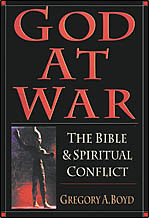
I finally finished this excellent book! I have been working through it for the better part of a month and a half! It is quite a book.

Greg Boyd makes a very compelling case for a "warfare worldview". The first half of the book argues from the Old Testament seeking to demonstrate a warfare worldview is the primary worldview represented in the Old Testament.

The second half of the book examines the New Testament and its foundations in a warfare worldview.

It is a powerful new way of thinking in my opinion. Obiously to hold to this worldview is to be a minority in current evangelical and protestant circles. But after reading this book I must say that I am comfortable and intellectually encouraged to move this way.

One of the most convincing features is the warfare worldview's handling of the problem of evil.

The traditional view is that God is in control of everything. Sovereignty is understood as omnicontrol. Therefore the question "why does an all-powerful, all good God allow bad things to happen" is legitimate. Boyd argues that the Bible does not conceive of God's sovereignty in the sense of omnicontrol. Because of this, God's will can and reddily is thwarted by spirits and humans who have freewill. Thus, when these beings chose to disobey God, they enter into warfare against their Creature.

If you're at all interested in a very stimulating and thoroughly biblical book (meaning, Boyd is constantly engaged in biblical exegesis throughout) dealing with theodicy and spiritual warfare, pick up this book. But don't plan to try to read it in a week like I did! This is a book that you will need to live with for awhile.

3.15.2005

The Lord of the Rings: Exploring a Holy Trilogy

This looks like a cool resource. Too bad $150 is too much for my churches to afford to show movies!

3.12.2005

next-wave > church & culture: Engaging our postmodern culture: An Interview with Stanley Grenz (1950-2005) by Rogier Bos

Stanley Grenz passed away today. Shocking news. Here is a quote from an interview posted today in honor of him. I really respect his critical engagement with postmodernism and think there is much to learn from him.
Christians tend to fall into two opposite and equally unhelpful responses to cultural expressions such as postmodernism. Some simply 'baptize' every new development. They jump on the latest bandwagon thinking that this is the way to stay relevant. Others 'demonize' what they see happening around them. In their estimation, the 'new' is always dangerous or evil, whereas the 'old' is safe and good.

I seek to promote a third response, critical engagement with culture. I believe that like the modernism that emerged from the Enlightenment the postmodern ethos is a mixed bag, containing much useful material, but also harboring certain potential pitfalls. Our task as Christians, therefore, is neither to hail the arrival of postmodernism as the savior of humankind nor to fight against it in the name of a return to modernism. Rather, our goal ought to be to understand how we can bring the gospel to postmodern people in ways that communicate meaningfully to them.

3.04.2005

Lost Valley Ranch

I can't wait! Tomorrow my wife and I head to Lost Valley Ranch for a retreat! It's a wonderful dude ranch and I am looking forward to getting lost for a week. I need to let my soul catch up with me!

Since I'll be gone and internet access will not be available, I won't be able to blog for a week or so.

So let me encourage those of you who read this blog to leave a comment while I'm gone. Introduce yourself!

Grace and peace,
Steve

Busy, tragic week

I haven't been able to keep up with my messy Scriptures posts lately. There are several reasons. This week primarily because I have been very busy with the tragic death of a young man in our community. His memorial service is today at 2:00pm. He fell to his death last Friday working on a communications tower. This is my first truly tragic funeral here.

3.03.2005

Recoverd tsunami photos

Horrifying! Thanks Jordan for pointing this out.

Haddon Robinson on current preaching models

From PreachingNow enewsletter:
During a discussion following his lectures on preaching at Beeson Divinity School some time ago, Haddon Robinson expressed concern that, "The model for the preacher has changed. Up through the 1940's into the 50's — at least among evangelicals — the model for the preacher was the evangelist . . .

"In the late 50's and 60's, the model in many circles became the Bible teacher . . . [corresponding to the emergence of the Bible church movement]

"In the 80's to 90's, the model of the preacher (became) the therapist — the task of the preacher is to meet the needs of the converted people who are still secular . . . Sermons today are much more likely to be topical than expository . . . and many of the materials in the sermon come out of the behavioral sciences . . .

"The aim of most sermons today is not to explain the biblical text. The aim of most sermons is to connect with the listeners' felt needs . . . The Bible is used as a way to get a divine imprint on what is simply good advice."

postmodern preaching

The postmodern era rejects the idea of authority. For us to preach with authority, it is not by being an authority ourselves. It is by trusting in the authority of God to speak through the scriptures. We believe that scriptures are a means of grace whereby we can encounter the living God.

In the modern era, many preachers were enamored with their own reasoning ability. Many sermons, especially in mainline churches, only briefly touched on the scripture de jour. In the postmodern era, this will not be tolerated. Postmodern people want the real thing, not some preacher's essay on life. They crave to encounter the living God through the scriptures.

This suggests that the best of postmodern preaching will be expository in nature. Expository preaching explains the scripture and builds from there. The particular form of the sermon does not matter —logical presentation, story, drama or role playing. The important thing is that we allow the listener to be involved in the world of the text before we draw out the implications.

Quite a quote! And I agree. My preaching is expository. Since becoming a pastor a little over two years ago I have been following the lectionary choosing one passage to preach. It has been a good way to get use to the relentless cycle of preaching every Sunday. Know that my text is chosen each week simplifies the process for me.

Then I study the text and seek to allow the text to speak and form my subject for the message. I want my hearers to enter into the text, interact with it, and leave transformed. I don't want to just give them a bunch of information or knowledge. I want the preaching experience to be transformational!

That's why I spend a lot of time coming up with my introductions. I feel that I have to connect what the Bible says to their everyday life in some way. They have to be hooked in order to want to expend the mental energy to stay with me for the next 25 minutes or so.

Some call this felt needs preaching. But the Bible must meet us at our point of need and it is the task of the preacher to show how that intersection happens, where that intersection is. I want to explain the biblical text and point us to how it intersects with our lives!

Again, this is partly why I love the messy Scriptures series. Where does our everyday lives intersect with the story of the patriarches? Does it intersect with the story of the patriarches? How is this passage useful for teaching, rebuking, correcting, and training in righteousness? That is the exchange that I am seeking in preaching.

2.25.2005

ALLELON Ministries - Worlds in Collision: The Fallen Powers - Part 1

Worship is a furnace of transformation because it is there we learn to know Him who is beyond our knowing.

Wonderful quote. Yet is this what is happening in worship in our churches? In any of our churches?

ALLELON Ministries - The Scandal of the Evangelical Conscience

Another great quote from Sider's article.
Unfaithful evangelical lifestyles are a blatant denial of Jesus’ Gospel. If the Gospel were merely the forgiveness of sins, then we could accept the Gospel and go on living in the same racist, adulterous, materialistic way. But if the Gospel is the Good News of the kingdom, as Jesus taught, and if that means that part of the Gospel is that right now a new redeemed community of transformed persons living in the power of the Holy Spirit is breaking into history, then whenever so-called Christians live like the world, their very lives are evidence against Jesus’ teaching that the kingdom is now breaking into history.

ALLELON Ministries - The Scandal of the Evangelical Conscience

One of the greatest scandals today–at least as devastating as the “scandal of the evangelical mind” that Wheaton historian Mark Noll has lamented–is that vast numbers of evangelicals do not practice what they preach. The polling data is clear. “Gallup and Barna hand us survey after survey,” Michael Horton says, “demonstrating that evangelical Christians are as likely to embrace lifestyles every bit as hedonistic, materialistic, self-centered and sexually immoral as the world in general.” One wonders if the central evangelical belief in a new birth through personal faith in Christ who sends the Holy Spirit to transform us into the very image of Christ is really a farce, fraud or false promise.

This is a powerful, sobering article. Sadly as a pastor, I think his right. And I think this in part is why the emerging church is, well...emerging. Younger evangelicals (post-evangelicals?) are tried of playing church. They want true community, true reconciliation, true transformation.

Before coming to these small rural churches, I worked at 3 large churches. Two of these churches had attendance of over 1000 each Sunday morning and the 3rd was in the neighborhood of 600 to 700. Often I struggled with how much of an impact we were really making on people's lives. We're people really changing, really transforming, really morphing? Sadly often the answer was no.

And it doesn't appear to be any better for small churches either. Many times because we live so close to each other we tend to get sideways with one another. And then we handle the conflict that results horribly! We are passive agressive, we gossip, we deceive, we get even.

This is why I am currently preaching the Sermon on the Mount following Dallas Willard's excellent book, The Divine Conspiracy. In this sermon, Jesus makes it clear that transformation is the rule rather than the exception. Kingdom subjects will change!

The research sited in this article appears to show what Willard calls "barcode" theology. Many believe that if we just get the right belief, the right knowledge, believe the right theory of the atonement, regardless of how we live our lives, then we will avoid hell and go to heaven. Many think that when God scans the barcode, as long as it is right on the outside, it doesn't matter what is on the inside. But even if a sack of manure has a barcode for perfume on it, it's still a sack of manure!

Do we really think God would set up a system, a barcode system that we could beat?

2.24.2005

Younger pastors ask: Is preaching out of touch?

Very interesting article on preaching. Includes thoughts from Doug Pagitt, Tim Keel, Rudy Carrasco, Karen Ward, Chris Seay, Fred Craddock, Charles Bugg, and George Mason. Very thought provoking regarding preaching styles.

I like the comparison of preaching to jazz improv. I played the trumpet in high school and college in jazz bands and greatly enjoyed the creativity and freedom of improv. Yet to be a good improv player you really had to know music. You had to know the piece you were playing, you had to know the instrument.

Preaching is like this as well. I try to preach the same sermon twice each week, once at each of my churches. Yet I am often amazed, as is my wife who listens to my sermons at both churches (she's a saint and a glutton for punishment!) how differently the sermons turn out. I think this is because of the community I am preaching to at each church is so different. In the exegesis of my audience I realize that different parts of the sermon will need to be emphasized. Actually, I probably don't know this, but God does!

Naked in the Pulpit - LeadershipJournal.net

I am trying to describe the kingdom, life, and God honestly so exchange can happen. To do that, I've got to be willing to be vulnerable, to get naked at some level.

This is a great article by Tim Keel on preaching. Be sure to listen to some of his sermons and hear it in action.

Why messy Scriptures, part 2

Do you ever allow yourself to read the Bible and be bothered by what you read? Permission to not like what you are reading? Do you ever leave the Bible feeling disturbed? There is a lot of disturbing, confusing, and upsetting things in Scripture.

To do this is to interact with the Bible as a human being. Again, that's part of my purpose for posting Messy Scriptures. I want to give myself permission to be disturbed and confused and upset by what I read. This allows me to be deeply moved and challenged by what I read.

This doesn't mean that my view of Scripture is questionable. It doesn't mean that I think the Bible is not inspired by God. It just means that I am trying to be honest with the Scriptures and my reactions to what I read.

I think Christians often feel obligated to like what they read in Scripture. This in a sense is a lens we have when we come to the text.

So give yourself permission to be disturbed, confused, upset, or joyful. Pay attention to your emotional, intellectual, and spiritual response to the Scriptures.

I'm a Wizard!

My Inner Hero - Wizard!


I'm a Wizard!


There are many types of magic, but all require a sharp mind and a cool head. There is no puzzle I can't solve, no problem I can't think my way out of. When you feel confused or uncertain, you can always rely on me to untangle the knots and put everything back in order for you.


How about you? Click here to find your own inner hero.

Just for fun!

2.23.2005

Postmodernism Youth Ministry in Adolescence: A Look at the Culture of Youth Ministry : Youthworker Journal

Obsessed with cool. Trnedy. Impulsive. Self-focused. Caught up in the moment. Probably sounds like a description of some of the kids in your youth group.

But, actually, um....well...this is not an article about youth culture, or the world of today’s teenagers. This is an article about us—those of us in the youth ministry culture, those of us who work with teenagers—and how we seem to be sliding into an adolescent approach to our faith and mission. Look at our “must read" books, listen to our conversations, go to our seminars, and measure our values. Even a quick survey of the current youth ministry culture tells the story: we’re not just working with teenagers; we’re starting to think like them.

This is a very good article and critique of the Emergent church/postmodern thing.

Calvin College on U2

But why a class on U2, one of the world's most adored rock bands, at a conservative Christian college?

I wish I could have studied U2 for credit!

2.17.2005

Messy Scriptures #5 : Genesis 29

Twice in this narrative we are told that Jacob loved Rachel. This becomes the crux of this messy Scripture passage.

Jacob works for seven years for Laban to get Rachel as his wife. On completing this, Jacob is given Leah as his wife by Laban. After sleeping with Leah, Jacob realizes that he has been tricked by Laban. Laban appeals to tradition and says that after a week Jacob can also have Rachel in exchange for another seven years of work.

So after seven years and one week, Jacob is finally married to his true love, Rachel and her older sister Leah. Jacob is an unintentional polygamist. Obviously by the standards of his culture this is not that bad of a thing. But clearly this challenges much of what we understand love to be.

In our culture, those who espouse abstinence encourage young people to wait to have sex, at the very least, until they find someone they really love and at the very most, until they are married.

But what are we to do with passages like this and the following story in chapter 30? Jacob apparently does love Leah (v. 30) but he loves Rachel more. Yet to compound the problem, God opens Leah’s womb because he “saw that Leah was unloved” (v. 31). (So was she loved or not?! Guess I’ll take God’s word for it that she wasn’t loved. This just makes the issue all that more vexing!) Rachel is barren perhaps, reading between the lines, because she is loved. Strange.

So what’s poor Jake to do? He’s married to Leah who he apparently doesn’t love but she’s his wife so according to all proponents of abstainence he can have sex with her. Yet he loves Rachel so for her sake and for the sake of their love shouldn’t he abstain from sexual relations with Leah? Confused? I am!

To further complicate things, Rachel is envious of her sister and gives her maid Bilhah to Jacob so she can have children through her. Once Bilhah has two children by Jacob, Leah, who isn’t bearing children anymore at this point, gives her maid Zilpah to Jacob to keep up with Rachel and Bilhah. Zilpah bears two children.

The narrator never tells us how Jacob feels towards Bilhah and Zilpah. It is very clear though that he has sex with them. By today’s Christian moral standards, derived from the Bible, Jacob is a moral disaster! Yet God blesses this moral disaster. Laban says that “I have learned by divination that the Lord has blessed me because of you” (Genesis 30:27).

Clearly this messy passage of Scripture presents some troubling issues for Christians. Today many assume that God does not bless moral disasters. In fact, many argue that God judges people who are immoral. Some have said that this is the explanation for AIDS, the tsunami, 9-11, and so on and so forth.

But here, one of the patriarchs of Israel, clearly acting in a way that would get his membership revoked from most churches (let alone disqualified for leadership in the church), experiences God’s blessing. What a mess! It makes you wonder if God sees these things quite differently from us.

2.16.2005

Messy Scriptures #4 : Genesis 27

Genesis 27

Here we find Jacob lying to his father Isaac about his identity. Clearly it is Rebekah’s idea. She eavesdrops on Esau and Isaac’s conversation and comes up with a plan.

Look at how far they go with the plan. She prepares the meal and covers Jacob’s smooth skin with goatskins. She dresses Isaac in Esau’s clothing. Jacob lies to his father three times, each time asserting to his blind, questioning father that he is Esau.

Three times he lies. Three times! Isn’t this troubling? This is far from commendable behavior! Children shouldn’t lie to their parents! Parents shouldn’t scheme with their children against one another! A parent should never cause their child to lie! Talk about a dysfunctional family!

What are we to make of this?

You’d expect, according to common Christian theology that God would work against injustice, side with the victimized, and seek to right this wrong. You’d think he would discipline the liars, the deceivers, the schemers.

But he doesn’t. When God finally says something in chapter 28, he does not speak condemnation against Rebekah or Jacob. He does not seek to consol Esau or Isaac. He sides with Jacob and Rebekah. “…the land on which you lie I will give to you and to your offspring; and your offspring shall be like the dust of the earth, and you shall spread abroad to the west and to the east and to the north and to the south; and all the families of the earth shall be blessed in you and in your offspring. Know that I am with you and will keep you wherever you go…”

Isaac’s blessing of Jacob is ratified by God! God doesn’t even hint at the idea that the means in which the blessing was attained was wrong, evil, or deceitful!

Rebekah has accomplished God’s will, right? In Genesis 25:23 The Lord told Rebekah, “Two nations are in your womb, and two peoples born of you shall be divided; the one shall be stronger than the other, the elder shall serve the younger.” Rebekah was justified in her mind to deceive Isaac. But was it justified before God?

2.15.2005

Why messy Scriptures

I am often disgusted by the poor thinking I see coming from many Christians today. Christian radio, TV, books, magazines, and the like are often poorly thought through. The Bible is seen as one big answer book with every story and passage functioning much like a fable with a nice little moral at the end.

To counter this, I present Messy Scriptures. Don’t get me wrong. I believe that the Bible is the unique Word of God. I believe it is useful for teaching, correcting, rebuking, and encouraging. But the Bible presents many difficult and challenging issues if you read it slowly, carefully, and deliberately enough.

For those of us who grow up in the church (myself included) we forget what this book sounds like. We have heard the stories over and over in church. But we forget the moral dilemmas, the challenges, the R-rated Scriptures, the troubling behavior of the “heroes” which often goes unchecked and unchallenged in any real sense.

We have developed a lens with which we see Scripture through. I like chipping away at that lens. I like pointing out that lens. I like trying to remove the lens. And when you remove the lens, you sometimes find a mess. Messy Scriptures. Reading Scripture without a lens (well, at least a different one!).

This idea comes from many classes I enjoyed with Dr. Danny Carroll at Denver Seminary and from some ideas from Dr. Steven Sample’s book “The Contrarian’s Guide to Leadership”.

These readings will prove to be challenging to many, unorthodox maybe even heretical to some, scary to others, unprofitable to still others, but really fun to me! The readings are intended to push our thinking, to challenge our assumptions, to push the envelop, and to foster discussion.

Finally, I reserve the right to contradict and disagree with myself. This gives me freedom to push my thinking, challenge my assumptions, and push the envelop. After all, I’m trying to remove a lens I’ve worn for the better part of my life!

2.13.2005

Messy Scriptures #3 : Genesis 22


Scary picture, isn't it? Think about this incident from Isaac's perspective. "What on earth is dad doing? He's bound me, he's raising the knife! He's going to kill me?!"

I'm sure social services would have taken Isaac away from Abraham. Here is an abusive, mentally ill father, doing what God told him to do; sacrifice his son.

So why did God ask Abraham to do such a thing? Passages such as Psalm 44:21, Luke 16:15, Acts 15:8, Romans 8:27, 1 John 3:20 tell us that God knows our hearts. If God knows our hearts, why does he test Abraham? Wouldn't he already know what he appears to discover about Abraham? "I know that you fear God, since you have not withheld your son, your only son, from me" (Genesis 22:12). What is the point of the test? Who is the test for?

I know that Hebrews 11:17-19 gives us some insight into this passage, but if we read it canonically (in the order in which it is written, without reading the New Testament back into the passage just yet), what image appears for us? There is no mention in this text that Abraham believed God would raise his son from the dead. It is clearly a test of Abraham and his willingness to obey God. Quite honestly, a canonical reading of Genesis to this point reveals a rather different picture of God than the classic philosophical-theological view. Perhaps more on this in another post.

How do we square this passage with the classic philosophical-theological understanding of who God is? Merciful, loving, omniscient, unchanging? Perhaps this is where Greg Boyd and open theism can help us:
If the classical understanding of foreknowledge is true, God’s statement “now I know” seems disingenuous. The meaning of God’s explanation for this knowledge—+dqo/since you have...”—is also obscured. Indeed, if the future is exhaustively settled there would be no point in his test of Abraham, because God would never have to find out anything.

2.11.2005

Messy Scriptures #2 : Genesis 22

1 Some time later God tested Abraham. He said to him, 'Abraham!'

'Here I am,' he replied.

2 Then God said, 'Take your son, your only son, Isaac, whom you love, and go to the region of Moriah. Sacrifice him there as a burnt offering on one of the mountains I will tell you about.'

Here in Genesis 22 we find the story of Abraham being asked of God to sacrifice Isaac to him.

This is a fascinating story. Let us read and think about this s-l-o-w-l-y. Evangelicals focus on the result of this story, that Abraham obeyed God and God blessed him. It is correct to focus on this as it is the point of the story. But let's stop and think about this s-l-o-w-l-y.

God asks Abraham to sacrifice his son Isaac as a burnt offering. It is a rather problematic request, isn't it? Consider Deanna Laney:

Dr. Park Dietz said Deanna Laney believed God ordered her to kill her children last Mother’s Day weekend. “She struggled over whether to obey God or to selfishly keep her children,” Dietz testified.

Laney, a 39-year-old stay-at-home mother who homeschooled her children, has pleaded innocent by reason of insanity to charges of capital murder and serious injury to a child in the deaths of 8-year-old Joshua and 6-year-old Luke and severe injury to then-14-month-old Aaron.

Dietz said that Laney, who is deeply religious, had a series of delusions on the day of the killings. He said she saw Aaron with a spear, then throwing a rock, then squeezing a frog and believed God was suggesting she should either stab, stone or strangle her children.

Laney at first resisted, but she felt she had to do what she perceived to be God’s will to prove her faith, he said.

There is no question that today Laney is at the least a really poor listener to God and at best mentally ill. But might God ask someone to sacrifice their children to him? He did it once before. Why not again?

Interestingly, Laney was said to struggle over whether to obey God or not and that at first she resisted. Our narrator in Genesis 22 does not give any hint as to whether or not Abraham struggled or resisted. Yet in Genesis 21 when Abraham sent Ishmael away, the narrator tells us that Abraham was distressed. Why not a narrative comment here in this distressing passage?

Would struggle or resistance on Abraham's behalf indicate disobedience?

Does the lack of struggle or resistance raise questions as to Abraham's love for his son?

Once again, we have stumbled upon a text that just doesn't work too well as a proof text for family values. But I'll keep reading. I'm sure it's in here someplace!

2.10.2005

MP3tunes.com

Good looking new service to download music!

Read the TNIV Online Bible

Cool. Looking forward to diving into this new translation!

Messy Scriptures : Genesis 21

8 The child grew and was weaned, and on the day Isaac was weaned Abraham held a great feast. 9 But Sarah saw that the son whom Hagar the Egyptian had borne to Abraham was mocking, 10 and she said to Abraham, 'Get rid of that slave woman and her son, for that slave woman's son will never share in the inheritance with my son Isaac.'

11 The matter distressed Abraham greatly because it concerned his son. 12 But God said to him, 'Do not be so distressed about the boy and your maidservant. Listen to whatever Sarah tells you, because it is through Isaac that your offspring will be reckoned. 13 I will make the son of the maidservant into a nation also, because he is your offspring.'

Family values. They are thrown around today by all sorts of people. Many who use these words appeal to the Bible as the basis for family values. But if we read the Bible carefully, we will find that the Bible paints a rather distressing picture of "family values."

As quoted above, the story of Sarah having Hagar and Ishmael sent away cannot possibly be held up as a story stressing family values. Yet God counsels Abraham to do as Sarah requests!

Isn't this counsel the breaking up of a family? Isn't this counsel the separation of a young boy from his father? This can't be right! So much for Genesis 21 being a proof text for family values!

Don't misunderstand me. I'm all for the family. But Christians tend to argue from the Bible that the perfect family is one husband, one wife, 2.5 kids, and a dog. Yet we rarely encounter that kind of family in Scripture.

I would suggested that much of what is argued for as "family values" in America is "chronocentrism--our tendency to assume that the worldview we hold at the present time is the ultimately true worldview." (God at War, Boyd, p. 18).

Throughout Scripture we see many families and few of these families can be held up as models of American family values (1 husband, 1 wife, 2.5 kids, a dog).

2.03.2005

Dr. Dobson's a "Wacky Evangelical"

Dr. Dobson has made more headlines last week attacking Sponge Bob. Here's some of Phil Vischer's, the creator of VeggieTales take on it.
I doubt if this specific incident will amount to anything more than another 'look at the wacky evangelicals' sidebar.
Here are Phil's thoughts concerning the video and whether it promotes homosexuality or not...
Do you think the We are Family video promotes homosexuality?

Sorry, I haven't seen it. I heard Ernie & Bert were standing very close, though so, you know … that's concerning.

Do you think that the website (and tolerance pledge) does?

Boy, that's a thorny one. Does pledging to "respect people whose … sexual identity or other characteristics are different from my own" promote homosexuality? We're supposed to love everyone. I'm pretty sure that's biblical.

At the same time, we certainly can't endorse behavior that the Bible labels as sinful. So is "respecting" more like "loving," or more like "endorsing"? Are they encouraging grade school kids to accept homosexuality or to accept homosexuals? I'm not sure I'm qualified to parse that sentence.

And what's the inverse of that pledge? To disrespect people of differing sexual orientations? Jeepers, that doesn't sound biblical.
As far as I am concerned, Vischer does a great job of dissecting this whole issue.

Sadly, I believe that most of the church's response to this issue is not one of love but one of disrespect.

Like the song says, "They will know we are Christians by our disrespect, er...love!"

Church Structure and Leadership

Issues of structure apply to the church as well. Most churches have a constitution or bylaws which govern its structure, its officers, and basic operational schema. When a church’s bylaws are poorly conceived, or non-existent, watch-out! In such instances, when people can make up the rules as they go along, a steady stream of conflict and behind-the-scene power plays inevitably follow. One long-time minister who pastored such a church (with no bylaws) reflected, “those were the 20 most miserable years of my life.” Indeed, when an outside consultant was brought in to evaluate the conflict a subsequent pastor was experiencing at the same church, the consultant declared, “the most perfect pastor in the world could not have pastored this church.”

One of my churches is currently experiencing this. To complicate matters, the yoke relationship needs structure but the structure is being resisted because I think those in power at the one church recognize that they have much to loose if the yoke relationship and how the churches will get along with each other is clarified.

This is so utterly frustrating! Why can't we be about advancing God's kingdom instead of our own little kingdoms? Honestly, these little kingdoms don't amount to much! But we protect that turf like our lives depended on it!

Sadly, this dysfunction is really casting a dark shadow over these churches.

1.26.2005

Gender-Accurate Bible's Release Triggers Renewed Debate

Theologian J.I. Packer, James Dobson of Focus on the Family, and SBC seminary presidents R. Albert Mohler Jr. and Paige Patterson, were just a few of the religious leaders who argued vociferously against the new NIV revision.

So glad to see that Dobson has decided to throw his weight around on this issue! Not! Why James, why? Let the Bible scholars discuss this! The sad thing is Dobson has a huge platform for shaping opinion whereas the informed Bible scholars do not.

This issue is so frustrating that I don't even know were to begin commenting.

I think Dr. Craig Blomberg in his endorsement of the new translation puts it best,

The TNIV avoids the overly free translation of certain texts that previous gender-inclusive translations have included, while rendering gender-inclusive uses of "man," "he," "brothers," and the like with appropriate, contemporary English exactly corresponding to the meaning of the original Greek or Hebrew. Not to do this leaves a Bible that increasingly misleads the modern reader; as the father of two daughters I know first hand how this works!

1.21.2005

ononion: Artwork by Jack Chick...

Great spoof! What if we are wrong? ;)

QuestionsAboutGod - Freethought Media Library

I think its a good idea to read what people who are hostile to the idea of God and the church think. Here's a list of questions. How would you answer these? Would you try?

Family Scuffles, Pastor Says Jeans a Demon

'You're not wearing pants in my church, you demon'

This is ridiculous.

Homosexuality and the Bible

...without proper knowledge of the original language and context of biblical content, these passages can easily be taken to mean something quite different than was originally intended

Sorry Derek, I'm not convinced. At the very least the Bible is negative toward homosexuality and at the very most the Bible labels it a behavior that is outside of righteous behavior (sin).

The real problem I have with contemporary evangelicalism is the making of one's view and treatment of homosexuality an issue of orthodoxy.

Yet to single out one sin among many as a test for orthodoxy seems strange to me. What if we singled out gossip or gluttony as the litmus test? So much for church potlucks!

I still believe the acting out of homosexual desires is sin. But so is acting out heterosexual desires with someone other then a spouse.

Obviously the real difference is that a homosexual person then has no legitimate arena in which to act upon their desire. But is this all that unique? I would say no. Does an alcoholic have a legitimate arena? Does a single heterosexual? People experience all sorts of desires which cannot and should not be acted upon. There is always something restraining us be it culture, morals, religion, or others.

Isn't that what being finite is about...limitation? There is only one who is infinite, without limit, and last I checked you and I are not that one.

That being said, I don't think God has it out especially for homosexuals. I don't think God is out to get anyone. Actually, come to think of it, God is out to get us just not in the negative sense of that phrase. God is out to get us, to reconcile us to himself through the person of Jesus Christ. The infinite pursuing the finite. Unlimited grace to the limited.

I don't have all of this figured out, I just know that I am limited, finite, sinful and in desperate need of an infinite, unlimited, perfect God to help me, redeem me, rescue me, love me.

Westboro Baptist Church FAQ : On the tsunami

Please keep your mouth shut! Sadly this is just more fodder for those opposed to Christianity and belief in God. Can you blame them?

This is the end result of Calvinism applied to situations without any pastoral heart! Is it even possible to apply Calvinism with a pastoral heart?

1.20.2005

Beware of 'Free' Services

I have concerns about blogging companies as well. For example, who really owns the content and can a blog be easily moved from one provider to another? Not a huge deal, but if your private blog suddenly becomes public because some vendor screws up or the company suddenly fails and you can't get your content back, then you'd have a problem.

Interesting thoughts. Though I'm not terribly concerned about this, it is a good question. Especially for many of those power bloggers out there.

Lately, my blog has been pretty lame. Mostly links to other articles with very little comment or original thought. Hopefully, I will find the time and discipline to change this in the coming weeks. But if I start writing some really good stuff (and that's a big IF) who really owns the content? Now that's a question worth asking!