6.30.2004

Poor Preaching

Another great quote from the Relevant Magazine interview with Dallas Willard.
As intelligent men they were capable of addressing issues clearly and that is what you do not hear today. The level of intelligence in our sermons, the abysmal story telling that you hear constantly is just hopeless. The power that comes through the Bible itself, which is the most intelligent book ever written, is lost.

I have read many blogs bemoaning the role of the sermon in the future church. But maybe many are so critical of the sermon because so many sermons are done so poorly.

I am a rather inexperienced preacher. I have only been preaching weekly for the last 20 months or so. I am constantly amazed at the excitment of my parishioners when it comes to my preaching. They are regularly extremely complimentary. I find this surprising and sad as many of these folks are in their 60's, 70's, 80's and 90's and have gone to church faithfully throughout their lives. Shouldn't I not be one of the best preachers, with my relative inexperience, that they have had at their church?

Yet, I fear that I am one of the better preachers from their point of view. The only reason I can give for this is that many of their previous pastors were going through the motions and not faithfully and diligently working at the task of preaching.

I don't mean to be overly critical but in the two denominations I serve (the PCUSA and the Christian Church (Disciples of Christ) I haven't been very impressed with much of the preaching that I have been exposed to. If I had to endure some of the preaching I have heard week in and week out I'd have long ago left the church. Fortunately, I grew up sitting under some wonderful preaching at Cherry Hills Community Church and Dr. Jim Dixon.

I believe their is a bright future for preaching in the church. But great preaching doesn't just happen, you must work at it and cooperate with the Holy Spirit as you prepare each week.

6.25.2004

A9 hits

I received my first hit from the new A9 search engine and my first hit from Altavista. The A9 hit was for "Groothius" my Philosophy of Religion professor at Denver Seminary. The Altavista hit was for "Eintein's General Theory of creativity". It's always fun to see how people end up Out in the sticks.

Fourth of July Syncretism

From Open Source Theology:
I lived for two years in the Netherlands as an “expatriate” - someone who lives as a non-citizen in a country not their own. I learned a lot of things, but most of all, through the homesickness I sometimes felt, even in the midst of loving my experience of living abroad, I learned an excellent model for our time here on earth. We are, all of us who know Christ, expatriates- living for a time in a foreign country. We can enjoy it, but if we ever stop feeling homesick, we are in trouble.

So, next Fourth of July, go ahead and light off some fireworks, thank God for the freedoms you have, enjoy a nice parade or picnic… but maybe leave the Star-Spangled Banner out of the worship set, okay?

I really appreciate Bob's thoughts in this article and yet I know that to not have any patriotic songs in my churches on July 4th would be seen as anathema to my church members.

Part of the issue is that my churches are full of WWII, Korean War, and Vietnam vets. They take their patriotism seriously! And since my generation has never been to war, I can't easily stand in judgment of them, speaking prophetically to them. Yet I feel the "God and Country" view does need to be challenged. (Sorry dad!) So how do we challenge this attitude with gentleness and respect for our Veterans of Foreign Wars?

It feels to me that when we include "God and Country" themes we are delving into syncretism. We are fusing worship of our country to worship of God in our churches. This is a dangerous practice indeed. It is dangerous to our souls. It is dangerous to our understanding of the Kingdom of the Heavens. We must gently challenge this idea with the old war veterans and fervent patriots in our midst. Ultimately, all disciples must be called to allegiance to the Kingdom of God.

6.23.2004

Books & Culture's Book of the Week: Insect Theodicy - Books & Culture

Books & Culture's Book of the Week: Insect Theodicy - Books & Culture:
Perhaps what most weighed upon my mind as I read Lockwood's book was his diagnosis of religious responses to the locust plagues. On the American frontier, farmers who faced the oncoming cloud of ruin were forced to ask for aid. At first, they asked the church, and the church responded with prayers. But when it came time to ask for more than prayer, the church shut its doors. As Lockwood states, 'Offering up prayers was one thing--giving up wages was quite another.'

In the end, the destitute turned to the federal government for their subsistence, eventually raising a series of fundamental political questions that would set precedents for agricultural policy, natural disaster, and federal relief into the present time. Today, we wait for the government to pronounce a 'natural disaster'--where 'natural' means precisely that.

This sounds like a fascinating book. I hope to pick it up someday soon! The comment from this review that caught my attention was the idea that farmers turned to the church for help with the locust plagues and the church had little to offer other than prayers. I'm sure that this is a gross over-generalization. I would imagine that some churches and some Christians responded in very tangible ways for the needs of the farmers. And yet there is little a small, rural church could offer if the community's corps were wiped out in one plague.

As a small, rural church pastor, I often feel like all I can offer are prayers. Yet many do ask for more than prayers from the church and the pastor. How should the church repond? What should the church do?

6.22.2004

Google, visual poetry, and the emerging church

Here's a fun Google Hack that's called Visual Poetry. Enter the words "Emerging Church" into the search field and here are the images that you get:

6.21.2004

Book Meme Redux

Here's another look up in a book thingy making its way around the blogs...
Reviving a meme borrowed from my cousin a couple months back . . .

1. Grab the closest book.
2. Turn to page 64.
3. Find third complete sentence.
4. Print sentence in comments here or on your own site (a trackback would be nice).

Here's mine from Dallas Willard's The Divine Conspiracy:
Now, Jesus himself was and is a joyous, creative person.

Now that's a great quote and a great thought to ponder!

Dallas Willard Interview

Here's a great quote from the interview:
The greatest challenge the church faces today is to be authentic disciples of Jesus. And by that I mean they’re learning from Him how to live their life, as He would live their life if He were they. So that means, whatever I am, whoever I am, I take Him into my whole life as my Lord. Lord means that He’s my teacher. Another way of putting this is to say that our greatest challenge is to recover Jesus the Teacher. You know, if you don’t have a teacher you can’t have a disciple. Disciples are just students. Unfortunately, it’s a long and convoluted story, but roughly over the last two hundred years, Jesus as Teacher has simply disappeared. Whether Liberal or Conservative, it doesn’t make any difference. This is the unfortunate fact, and it lies at the foundation of the efforts of many people today to find a different form for the Church.

I am currently reading The Divine Conspiracy by Willard and this is a theme that he continues to emphasize. So how do we do this? How do we create new forms of church where people become "authentic disciples of Jesus"? As a pastor, I am often frustrated by the lack of authentic discipleship and yet I often feel powerless to change or challenge much of it.

This is one reason why I believe that prayer is so important to the pastoral calling. Eugene Peterson discusses this extensively in Working the Angles. Pastors must be people who pray...yet I so often neglect this. Why? Because much of the time it isn't urgent. It doesn't call me, setup an appointment with me, end up in the hospital, or show up in my inbox. Prayer is the essential non-urgent task that all pastors must diligently engage in.

CNN.com - Wi-Fi farming expected to catch on - Jun 18, 2004

CNN.com - Wi-Fi farming expected to catch on - Jun 18, 2004:
Pocknee's lab has created a boxy contraption that has rubber tires, a jumble of wires and hoses, a GPS system and several computers. It can be guided by GPS signals or a human with a joystick through a wireless network.

I know several farmers who already use GPS to guide there trackers through the field. With robotic tractors, there will be even fewer people living in the rural areas. Wow, now we can all go live in the cities and add to the congestion, pollution, traffic, noise, violence...

6.15.2004

Prostitutes love Jesus too

Continuing in the vein of Nouwen's book here's Dallas Willard's thoughts on the relationship between love and faith from his excellent book The Divine Conspiracy:

"Then he turned to the woman and said to Simon, “Look at this woman kneeling here. When I entered your home, you didn’t offer me water to wash the dust from my feet, but she has washed them with her tears and wiped them with her hair. You didn’t give me a kiss of greeting, but she has kissed my feet again and again from the time I first came in. You neglected the courtesy of olive oil to anoint my head, but she has anointed my feet with rare perfume. I tell you, her sins—and they are many—have been forgiven, so she has shown me much love. But a person who is forgiven little shows only little love.” (Luke 7:44-47, NLT)

“Loved me much!” Simply that, and not the customary proprieties, was now the key of entry into the rule of God.

Jesus went on to say to the woman, “Your sins are forgiven. Your faith has saved you. Go with peace in your heart.” Here is God’s rule in action.

We must not overlook the connection between faith and love. The woman saw Jesus and recognized who he was and who dwelt in him. That vision was her faith. She knew he was forgiving and accepting her before he ever said, “Your sins are forgiven.” She knew because she had seen a goodness in him that could only be God, and it broke her heart with gratitude and love.

I find this passage fascinating! She hadn't attended a new members class or a confirmation class. She hadn't been instructed as to what the correct propositions concerning Jesus were that she needed to believe. She didn't pray the "sinner's prayer." She simply observed Jesus, was attracted to him, and fell in love with him. She just loved Jesus.

This is of vital importance for us today. Acts 1:1 says,
In my former book, Theophilus, I wrote about all that Jesus began to do and to teach.

I thought it was finished? But no, Christ's work continues through his followers! Therefore, the question for us is, do our lives attract people or repel? Do they observe us, are attracted to us, and fall in love with Jesus who dwells in each of us who are now in Christ?

Sadly this is often not the case in my life...forgive me Father, let me fall more and more in love with you so others can too.

6.14.2004

Relevance and the Emerging Church, part 2

Nouwen in his book In the Name of Jesus states that the discipline to overcome the temptation for relevance is contemplative prayer.
The question is not: How many people take you seriously? How much are you going to accomplish? Can you show some results? But: Are you in love with Jesus? Perhaps another way of putting the question would be: Do you know the incarnate God?...

To live a life that is not dominated by the desire to be relevant but is instead safely anchored in the knowledge of God's first love, we have to be mystics. A mystic is a person whose identity is deeply rooted in God's first love.

If there is any focus that the Christian leader of the future will need, it is the discipline of dwelling in the presence of the One who keeps asking us, "Do you love me? Do you love me? Do you love me?" It is the discipline of contemplative prayer. Through contemplative prayer we can keep ourselves from being pulled from one urgent issue to another and from becoming strangers to our own and God's heart...

It is not enough for priests and ministers of the future to be moral people, well trained, eager to help their fellow humans, and able to respond creatively to the burning issues of their time. All of that is very valuable and important, but it is not the heart of Christian leadership. The central question is, Are the leaders of the future truly men and women of God, people with an ardent desire to dwell in God's presence, to listen to God's voice, to look at God's beauty, to touch God's incarnate Word and to tates fully God's infinite goodness?

Wow! Challenging stuff! So let's ask the question...Are we truly men and women of God?

6.11.2004

Relevance and the Emerging Church

A few days ago Maggi Dawn referencing a few posts from for the time being made the point that we should regard attempts at relevancy with adequate suspicion. Geoff states:
I want to explore the significance of replacing the project of relevance with the project of identity. Let us not seek to be relevant but to express our identity as follows of Christ, as Christians within the particular cultures that we are in.

As I mentioned last week, I re-read Nouwen's excellent book In the Name of Jesus. In this book Nouwen looks at the temptation of Jesus Christ in the wilderness and the reinstatement of Peter by Christ following his denial as helps in shaping Christian leadership. Christ's first temptation was relevance. "Turn these stones into bread." Nouwen states:
Jesus' first temptation was to be relevant: to turn stones into bread. Oh, how often have I wished I could do that! Walking through the "young towns" on the outskirts of Lima, Peru, where children die from malnutrition and contaminated water, I would not have been able to reject the magical gift of making the dusty stone-covered streets into places where people could pick up any of the thousands of rocks and discover that they were croissants, coffee cakes, or fresh-baked buns, and where they could fill their cupped hands with stale water form the cisterns and joyfully realize that what they were drinking was delicious milk...

The leader of the future will be the one who dares to claim his irrelevance in the contemporary world as a divine vocation that allows him or her to enter into a deep solidarity with the anguish underlying all the glitter of success and to bring the light of Jesus there.

Clearly relevancy is an issue and even a temptation in ministry.

The solution for this, according to Nouwen is the discipline of contemplative prayer. Tomorrow I'll write about Nouwen's ideas concerning contemplative prayer.

6.05.2004

In the Name of Jesus: Reflections on Christian Leadership

Amazon.com: Books: In the Name of Jesus: Reflections on Christian Leadership
This weekend, I am re-reading this excellent book by Nouwen. I'll post some quotes and comments when I get a chance.

We are in Breckenridge this weekend as I am officiating at a friend's wedding. It is so beautiful here! And performing weddings for friends in beautiful places is one of the best perks of pastoral ministry!

6.02.2004

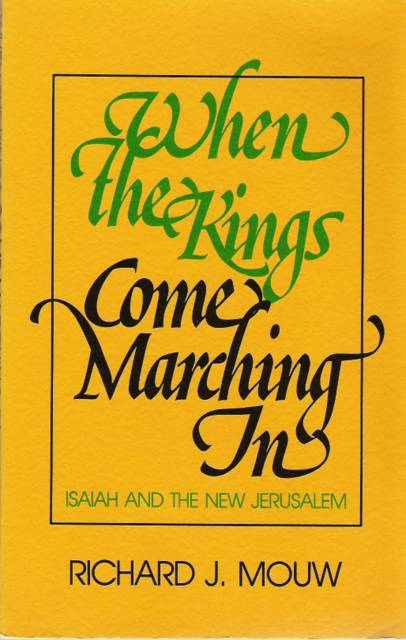
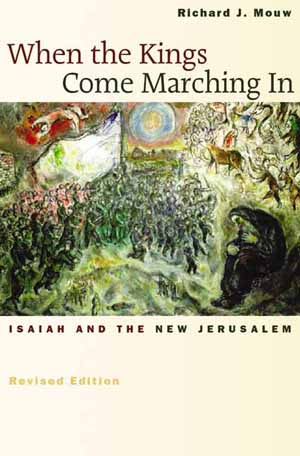
Finished "When the Kings Come Marching In"


When the Kings Come Marching In
I thoroughly enjoyed this book! I have an earlier version of the book. I am tempted to buy the updated book! Much of Mouw's discussion is relevant for the emerging church discussion. Here's a quote to wet your appetite (gleaned from pages 61-63):
This fact, then, (that Jesus is the light of the Celestial City) must first of all be pointed to for the benefit of those who have professed to honor Jesus as the Lamb of God but who have paid little attention to the cultural dimensions of his atoning work. Some Christians have greatly emphasized the individual benefits of the redemptive ministry of Jesus Christ. They have viewed the work of the Cross almost exclusively in terms of a transaction that took place to effect the salvation of individuals...

We ought not to belittle this important emphasis in any way. It is an emphasis that has come to be associated with an "evangelical" type of faith; indeed, it expresses something of the very heart of the Protestant Reformation. Jesus died to cancel debt of our individual sins, and the believer is justified by faith in this atoning sacrifice. Every person who trust in Jesus as the one who has "paid it all" can live in the confidence that he or she has been granted an everlasting pardon form the penalty of sin...

Some Christians have expressed suspicions about this emphasis on the salvation of individuals; some have even ridiculed those who have insisted that this is a central emphasis in the Gospel. They have feared that a strong pattern of "individualism" lurks just beneath the surface of "I-centered" expressions of Christian faith.

We cannot deny that dangerous tendencies manifest themselves in this kind of piety...

There is nothing that is intrinsically inappropriate, then, about an understanding of the Gospel which strongly emphasizes the individualizing love of God. Indeed, properly understood, this emphasis can express a profound comprehension of the Gospel.

The dangers arise when this element is emphasized to the exclusion of other important dimensions of the work of the Lamb. Jesus died to save sinners--but he is also the Lamb who serves as the lamp in the transformed City. As the Lamb of God he will draw all of the goods, artifacts, and instruments of culture to himself; the kings of the earth will return their authority and power to the Lamb who sits upon the throne; Jesus is the one whose blood has purchased a multi-national community, composed of people from every tribe and tongue and nation. His redemptive ministry, as the ministry of the Lamb, is cosmic in scope.

Let me encourage you, in the words of Augustine to "pick up and read" this excellent book.

6.01.2004

Postmodern Community and The Colonial House | PBS

I was reading an interview of Stanley Grenz by ginkworld on Stanley Grenz's site. The interview includes a discussion about community. Here's a quote from Grenz:
Postmodern people do indeed "crave" community, but unfortunately they so often settle for "lifestyle enclaves," largely because the only way they know how to relate to others is as "consumers."

I agree with Grenz that we are greatly shaped by our culture as consumers. Consumerism informs so much of our lives. So the question in my mind was what does community look like that is not radically shaped by consumerism?

Enter Colonial House, a wonderful PBS program documenting the efforts of twenty-first century westerners to live like 17th century American colonists.

Colonists around the campfire. Posted by Hello

These individuals experienced community in terms that few in our modern age ever will. They had to depend greatly upon one another for food, shelter, and companionship. Their experiences included shared grief, mutual suffering, celebration, intense conflict, and a common mission. Sounds like koinonia doesn't it?

Yet how much of our current communities even church communities are based on consumption?

5.29.2004

National WWII Memorial


Finally! Posted by Hello
National WWII Memorial
Finally, the veterans of WWII have a powerful memorial to their incredible sacrifices. Unfortunately millions did not live to see this day. 1,100 die each day.

5.28.2004

Homeland Security


 Posted by Hello
I saw this t-shirt when we were in Santa Fe, NM. Very profound statement. Why don't we think of our colonies as terrorism? Is the US truly a morally superior nation like so many wish to believe?

Audioscrobbler :: User :: Hawkenstein


The Man! Posted by Hello
Audioscrobbler :: User :: Hawkenstein
Here's what I'm listening to. All of the information is uploaded using the Audioscrobbler plugin for iTunes for Windows. Cool stuff! So what have I learned? I am Phil Keaggy's biggest fan!

5.27.2004

Floods kill 270 in Dominican Republic, Haiti

HoustonChronicle.com - Floods kill 270 in Dominican Republic, Haiti
We sponsor a Compassion child named Johan who lives in the Dominican Republic. He is only 5 soon to turn 6 in August. Please keep him and his father and mother and his 7 brothers and sisters in your prayers!

Johan, may God bless you and keep you, may his face turn toward you and be gracious to you, may he smile upon you and give you peace. Amen.

Passion: Hymns Ancient & Modern


Excellent new CD I picked up today in Greeley. Yes I have to drive 3 hours to get to a retailer that carries new CD's like this one! Posted by Hello

5.26.2004

THEOOZE - ETREK >>> a learning journey

THEOOZE - ETREK >>> a learning journey
This sounds like a great venture! I hope I can attend someday though I am afraid that my learnings may not help much in my current ministry setting; a rural, modern culture and mindset.

5.24.2004

Astronomy News - Cosmos 'A Billion Years Older'

Astronomy News - Cosmos 'A Billion Years Older'
Oh great! Now the young earth creationists have another billion years to explain!;)

PoMoMuSiNgS: ec04: A New Theology for a New World

PoMoMuSiNgS: ec04: A New Theology for a New World:
it seems to me for now that this is a pretty good way of understanding

This is a great quote from Doug Pagitt on Pomomusings. I use to struggle with my lack of certainity when I was in seminary. I felt that a pastor needed to know with certainty everything that he/she discussed, especially in a sermon. But I have given myself the freedom to change my mind even week to week at times. This is a phrase I know I will be using quite often in my preaching and teaching!

Denying the eucharist to pro-choice Catholic politicians

The New York Times > Opinion > Hustings and Pulpits:
But any attempt to make elected leaders toe a doctrinal line when it comes to their public duties raises multiple risks.

Though I don't agree with the Catholic bishops on this one, I don't understand the dichotomy that so many want to place between one's beliefs and one's practices. Shouldn't our politicians doctrinal beliefs influence their public duties?

The question of censoring "renegade" belief in the church is a sticky issue. On the one hand, should we not submit ourselves to the community of which we are a part? I strongly believe in a communal hermeneutic because the imput from others as they read the biblical text helps me better understand the text and keeps me from cocooning with too many like-minded readers. Yet on the other hand, were would the church be without those who challenged the churches teaching and sought to reform it?

Seems to me we need both. The difficulty for us in the discussion surrounding the emerging church is walking this fine line. I for one believe that we should submit our thinking to the scrutiny of the wider church community while at the same time continue to push the envelop for reform, rethinking, and re-imagining. Perhaps this is why blogging about these issues feels so relevant.

Glavine's near no-hitter


Glavine nearly throws a no-hitter against my Colorado Rockies. Ouch! Posted by Hello

When The Kings Come Marching In by Richard J. Mouw


Posted by Hello
I started reading this book this morning. It has sat on my self for years. I bought it when I was in seminary and Douglas Groothius recommended it in a class discussion concerning Christ and culture and our understanding of heaven. So far it's a great read. Here's a quote that stuck with me today:
God's Word is a unity--although the unity is often more like that of a symphony than of a geometry textbook.

5.23.2004

Martin B. Copenhaver - A Story and Song for Every Occasion

Martin B. Copenhaver - A story and Song for Every Occasion:
And the stories that fill our lives are not just ways to pass the time, mere diversions. They have a meaning and power beyond anything we usually recognize. All stories reveal underlying assumptions about the way the world works, what is important in life and what is not.

This is an excellent reflection on Acts 16:16-34 and the power of stories in our lives.

5.22.2004

Why the 'Lost Gospels' Lost Out - Christianity Today Magazine

Why the 'Lost Gospels' Lost Out - Christianity Today Magazine
A good article on the bad history related in The Da Vinci Code.

2004 ChristianityToday Book Awards

Church Central home - church growth and church health resources, research and news:
Among the books recognized were Dan Kimball's book, "The Emerging Church: Vintage Christianity for New Generations" (Zondervan). The judges commented that Kimball, "thinks biblically about the nature of authentic church life -- including worship, evangelism, and discipleship -- and helps us to understand the church of the next generation."

Way to go Dan!

5.21.2004

Rock of Ages - Music has power

The New York Times > Opinion > Op-Ed Contributor: Rock of Ages:
Youth is a quality not unlike health: it's found in greater abundance among the young, but we all need access to it. (And not all young people are lucky enough to be young. Think of those people at your college who wanted to be politicians or corporate lawyers, for example.) I'm not talking about the accouterments of youth: the unlined faces, the washboard stomachs, the hair. The young are welcome to all that � what would we do with it anyway? I'm talking about the energy, the wistful yearning, the inexplicable exhilaration, the sporadic sense of invincibility, the hope that stings like chlorine. When I was younger, rock music articulated these feelings, and now that I'm older it stimulates them, but either way, rock 'n' roll was and remains necessary because: who doesn't need exhilaration and a sense of invincibility, even if it's only now and again?

My two aging churches could definitely use this! But alas, we are saddled with the worship wars here and they want the hymns on the organ. No wonder there is so little life and energy and vitality! The music we choose zaps it out of us! Perhaps this is in part why music in church is such a difficult issue. Music has power. It creates a feeling. What is the feeling we want to create in a worship service? What is the mood of a worship service?
For more fun, what are moods and feelings that the music of modern worship services produce versus postmodern worship services? I am glad to see the emerging church working diligently to delight the senses. It is wonderful to see the emerging church incorporating art, music, poetry, visual loops, computers, technology, etc. into worship. It is great to see the emerging church working to understand how our entire being is involved in worship, that the facilitators of worship (liturgists) create a mood, an environment, an atmosphere for worship.
And yet, I have experienced powerful worship with an organ and some old hymns. Why was it powerful? Because it was authentic. Because it fit. Because it brought God to bear on my reality.
So why doesn't the organ and hymns work in my churches? Because we are going through the motions! We do it because we have to do it, because we are told to do it. No one is even close to loosing themselves in the worship, giving themselves totally in free expression to God. No one would dare to dance like David!
Let's be passionate worshipers of God in spirit and in truth! Start this Sunday! Don't just go through the motions but be aware that God has called you to this place at this time to focus on him. So do it. It just might change you.

5.20.2004

The Church of England Newspaper

The Church of England Newspaper:
Church as we know it is past its sell-by date, says Chris Neal, Rector of St Mary's, Thame. And it seems that people all over the Western world think so, too. Neal goes on to quote a figure of 53,000 who leave church every week - leave church, but do not abandon faith...

Five years ago we developed three statements which have informed what we’ve done since then: from programmes to people; from organisation to organism; from grind to gifting...

"I believe we are going through a big cultural and social paradigm shift and that we should be aware of that," Neal suggests. "The cultural shift is about community, it’s about open-ended questions, it’s about discovering the answer for ourselves."

Very good thoughts on ministry!

unlearning Church

unlearning Church:
If we continue to copy the models of the 1980s and 1990s, we're going to miss the next generation. I'm now learning to take my cues from the age group that's under thirty-five.

Good article on the emerging church.

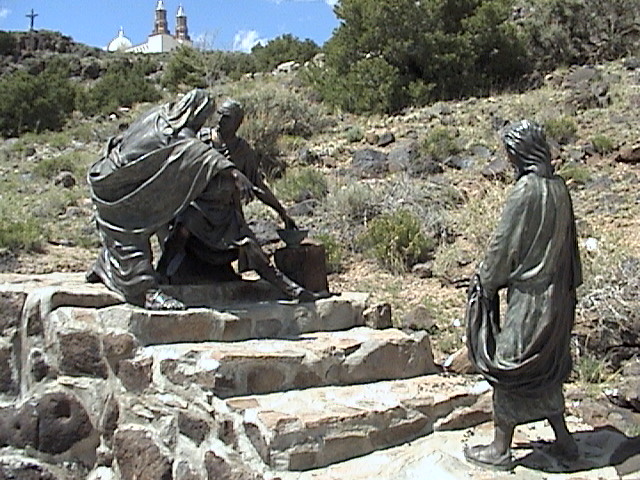
The First Station - Jesus is condemned to die


The First Station. Jesus is condemned to die. Posted by Hello
I thought I'd share more of the Stations of the Cross shrine from San Luis, Colorado.

Christ and Culture


Fun book, bad history. Posted by Hello

I am amazed at how some Christian's interact (or rather don't interact) with culture.

Tonight, I presented a seminar on The Da Vinci Code. We had a pretty good turn out for our little community. Knowing that the audience would be moderns, I was comfortable presenting a very modern, foundational view of the New Testament (you must exegete your audience!) while throwing in plenty of post-evangelical comments and thought for them to chew on. The seminar went really well and I had a lot of fun doing it.

Afterward a person from one of the non-denominational charismatic churches asked me alot of questions. "Why would we 'stoop down' to reading something that isn't God's truth? Why should we engage the culture with these secular books?"

I remember when I was afraid of the culture. I remember when I believed in guilt by association. I am so glad that I have moved beyond that! And I hope this person can and will too!

I am becoming more and more sensitive to just how intolerant and close-minded evangelical and especially fundamentalist Christians are. And most just don't get it!

May the emerging church continue to work toward open and healthy dialogue with people of all beliefs. May we humbly seek to share Jesus Christ faithfully, trusting that the Holy Spirit is already at work in the lives of those around us, even if it is through those secular books like The Da Vinci Code.

W.W.J.D. What would Jesus do?


What would Jesus do? Posted by Hello

A comedian on Leno told a very funny joke tonight:

I was wearing one of those W.W.J.D. bracelets and I was at the movies. One guy's cell phone starts to ring, you know, one of those obnoxious rings that's a song. But he won't answer it because the good part of the movie is coming. Finally he answers it like nothings going on, "Hey, what's up? Nothin'. Just sittin' in the movie theater.

I say, "Hey would you please hang up the phone, please."

The guy turns around and says, "Shut up pal. It's none of your business, punk!"

I'm a man and I'm about to stand up to this guy when I look at my W.W.J.D. bracelet and think what would Jesus do?

So I set him on fire and sent him to hell!

5.18.2004

My blog went on a diet!

Out in the sticks
With the recent improvements in the blogger experience, I decided to streamline my blog and lose a lot of the superflous stuff. Hope you like the new look.

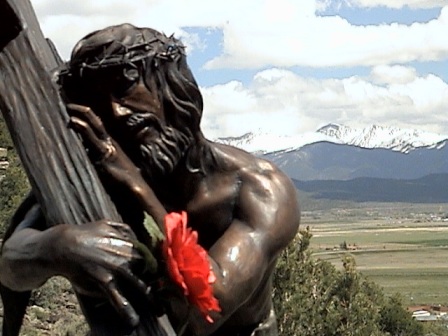
Jesus and the mountains


Jesus and the mountains, Posted by Hello

Stations of the Cross

On our way home from New Mexico we stopped in San Luis, Colorado which has a wonderful Stations of the Cross trail on a mountain side. It was a powerful hour or two praying the stations of the cross and marveling at the beauty of God's creation.

It is truly a mystery that the creator of the mountains came and gave his life for us!

If you ever get a chance to go to San Luis, be sure to do the Stations of the Cross!
The New York Times > Science > Space & Cosmos > Venus Returns for Its Shining Hour
A once in a lifetime event. Don't miss it!

5.16.2004

Dangerous Religion

Dangerous Religion, Sojourners Magazine/September-October 2003:
The real theological problem in America today is no longer the Religious Right but the nationalist religion of the Bush administration--one that confuses the identity of the nation with the church, and God's purposes with the mission of American empire.
America's foreign policy is more than pre-emptive, it is theologically presumptuous; not only unilateral, but dangerously messianic; not just arrogant, but bordering on the idolatrous and blasphemous. George Bush's personal faith has prompted a profound self-confidence in his 'mission' to fight the 'axis of evil,' his 'call' to be commander-in-chief in the war against terrorism, and his definition of America's 'responsibility' to 'defend the--hopes of all mankind.' This is a dangerous mix of bad foreign policy and bad theology.

Amen.

5.15.2004

What's Going On? Starting a Conversation with Rural America: "They hoped their pastors and people would be vigilant about caring for one another--especially that member or family whose regular pattern of worship attendance has suddenly changed."

Good advice from farmers for pastors.
Caleb Ministries Home Page
This looks like a good resource for rural pastors. Brian is speaking at a conference on church growth. His topic is the Emerging Rural Church. Sounds interesting.
American Society for Church Growth - Conference: "Brian McGaffigan, pastor Alberta, Canada
Presentation: 'The Emerging Rural Church'"

Sounds interesting.
TheSubversive Art - LeadershipJournal.net:
Two weeks ago I sponsored a 'Doubt Night.' I said, 'I want to talk about my own doubts about God, Jesus, the Bible, salvation, faith. And if you have some, bring them. Write them down and pass them forward, we'll read them and we'll see what happens.' We had a huge box--you would not believe--and I just started going through them, reading them and discussing them. It was so awesome.


Great idea!
TheSubversive Art - LeadershipJournal.net:
A lot of Christian preaching isn't really seriously about story. I don't want to conquer mystery. I want to celebrate it. And in the modern era we have 'Seven Steps to Prayer,' 'Four Steps to Financial--whatever.'' Those all, I assume, have their place.
But what often happens is God gets shrunk down in the process. In the effort to boil things down, God gets boiled down. And there have to be spaces where mystery is simply celebrated.
The true orthodox faith is deeply mysterious, and every question that's answered leads to a new set of questions. A lot of preaching tries to answer everything. At the end of the sermon, people walk out with no more questions. But if it's truly proclamation of truth rooted in God--
The rabbis believe that the text is like a gem: the more you turn it the more the light refracts. I heard a guy one time say, 'Oh yeah, I got a sermon on that verse. I got it pretty much nailed.' What? Are you out of your mind? You have that nailed? I just endlessly turn it.

Wow great stuff! So how do I apply this to tomorrow's sermon...a text and a sermon that I am not all that excited about?

There is some mystery in this text...let the mystery speak.
TheSubversive Art - LeadershipJournal.net
Great article.
The New York Times > Opinion > Op-Ed Columnist: Columbine: Parents of a Killer:
My instinct is that Dylan Klebold was a self-initiating moral agent who made his choices and should be condemned for them. Neither his school nor his parents determined his behavior. Now his parents have been left with the terrible consequences. I'd say they are facing them bravely and honorably.

Powerful story about Dylan Klebald's parents trying to rebuild and go on with their lives.

5.12.2004

My wife and I are currently attending theWee Kirk conference in Glorieta, NM. It is a great idea for a conference. It is geared to small churches (Wee Kirks) and it is sponsored by Presbyterians for Renewal. So far the conference has been okay. Nothing earth shattering for me. My wife has really enjoyed it.

My frustrations with the poor preaching led to a discussion between her and I about pride. I must say that having attended seminary I am now rather critical of sermons.

Is it prideful to be critical of sermons? This question stimulates my thoughts on the entire emerging church question: is it prideful to be critical of the modern church?

In general I don't feel that it is prideful to criticize poor sermons or be critical of the modern church. But I do believe that the spirit in which we do so is important. What is a healthy spirit for criticism?

Perhaps if our criticism is in an effort to make others better, to make the church more effective, rather than to place ourselves above others, to make ourselves better than others.

A fine line but an important line. What are your thoughts?

5.07.2004

The New York Times > International > Africa > Hundreds Die in Attack on Nigerian Village:
"An attack by a Christian militia"

Isn't this an oxymoron?
[Listening to: Between You and Me - dc Talk - Jesus Freak (4:59)]
Yesterday was a frustrating and difficult day. It was frustrating because it was The National Day of Prayer and I am sick of hearing American's pray that God would heal our land via 2 Chronicles 7:14. Newsflash - THIS DOES NOT APPLY TO AMERICA! Sorry, I feel like yelling!

Couple that with several diatribes concerning liberal judges, abortion, and homosexuals I felt very frustrated.

It was a difficult day because most if not all of my churches parishoners whole-heartedly and unquestioningly agree with these things. It was difficult because my post-evangelical convictions are not terribly welcome in this small town. In some respects I feel it is even dangerous to post this.

Yet despite any potential misunderstanding, I feel the need to challenge much of what is seen as "Christian" by evangelicals.

My frustration yesterday began at a prayer breakfast I attended. Now let me commend the men's non-denominational Thursday morning prayer group that organized this event without the assistance of any church in town. It was great to see laity who are passionate about something from several different churches and denominations work together on this event.

However, the speaker offended me by describing non-Christians as long-haired, pierced, tattooeed, raggedly dressed people. He did acknowledge that some Christians look like this but that they are not fully conformed to the likeness of Christ yet. WHAT?! Since when was the likeness of Christ equal to middle-class American values?

It is amazing the walls the church puts up. Ironically and probably unknown to the speaker, the restaurant that catered the event is owned by a tattooed, pierced, openly gay woman. I wonder what she heard in that statement! I bet she made huge strides to coming to embrace Jesus Christ yesterday!

I could go on and on about this but I won't. I love the folks in my town and churches. And that love and concern is what fuels my frustration. I so desperately want the Christians in our community to be reached for Christ as Brian McLaren explains so well in his book, More Ready Than You Realize.

Here's a quote from his book on the Lectionary reading from Acts 11:1-18 for this week. I can't wait to preach on Sunday!

But even better than reading a book is engaging in spiritual friendship with [postmoderns], because their stubborn refusal to be content with our modern depiction of God will pus us better than any book could to realize that God is not limited to our modern conceptualizations. In this way, engaging in spiritual friendship will not only help others become Christians, it will help us become better Christians, who love God more than ever. This occurs because our concept of God is expanding, deepening, and growing more glorious through conversation with our seeking friends. In essence, the Christians are "converted" first in authentic spiritual friendships.
There is a wonderful story in the New Testament that prepares us for this kind of profound transformation in ourselves as "converted" people who seek to help our as-yet "unconverted" friends. As you read the story found in Acts 10:1-11:18, be careful not to reconfigure it to fit into your preexisting categories. Try to let it stretch or even deconstruct your current categories.

Several pages later, still discussing this passage, McLaren writes,
When we become spiritual friends as Peter did with Cornelius, we similarly become sensitive to issues of language. We become uncomfortable labeling people. Whether it's "impure or unclean" or more contemporary labels like "unsaved," "non-Christian," "lost," or "pagan," we become increasingly sensitive to the way that such in-grouping and out-grouping can itself be sub-Christian behavior. On the one hand, by using such language we can unintentionally elevate ourselves to a superior category; on the other hand, such language can degrade others--in our minds or to their ears or both. Either way, careless language sabotages spiritual friendship.

For more, I'd encourage you to pick up the book. It gives me great hope as I struggle to emerge as a new kind of Christian, neither liberal nor conservative nor evangelical, rather like someone without a home or country to call their own at this point of the journey.
[Listening to: When I Stand With You - Charlie Peacock - Love Life (5:14)]
The New York Times > Opinion > Op-Ed Columnist: The Oil Crunch:
"So what should we be doing? Here's a hint: We can neither drill nor conquer our way out of the problem. Whatever we do, oil prices are going up. What we have to do is adapt."

Human nature is so short-sighted.
[Listening to: Landslide - Dixie Chicks - Home (3:50)]

5.06.2004

When Mother's Day is Hard - Christianity Today Magazine

Powerful article for pastor's to consider for Mother's Day written by a woman who attends Solomon's Porch.

5.05.2004

The New York Times > Business > Average U.S. Car Is Tipping Scales at 4,000 Pounds:
"Average fuel economy peaked at 22.1 miles to the gallon in the late 1980's, according to the agency, but has eroded since then to 20.7 miles for the 2003 model year."

Why? I imagine that this even takes into consideration the new hybrids. How discouraging.

5.04.2004

Go Figure - Christianity Today Magazine:
14 million - AIDS orphans in the world today
25 million - AIDS orphans expected by 2010

Sobering statistic. Does anyone know what the church is doing about this?


[Listening to: Echoes of Eden - Steven Curtis Chapman - All About Love (5:04)]

5.03.2004

"Being controlled by the opinions of others is a guaranteed way to miss God's purpose for your life." - Rick Warren
[Listening to: Sweet Nadine - Arc Angels - Arc Angels (4:31)]
Rick Warren's Ministry Toolbox:
Scripture is filled with stories of captivating characters whose lives help us better understand God's truth. What must it have been like to be Joseph, alone and abandoned in an Egyptian jail, yet still clinging to faith? What was it about Joshua and Caleb that allowed them to stand against the majority when they returned from spying in the Promised Land? What would it have been like to be Hosea, with an unfaithful wife and a call from God to take her back again and again? Those are the images that will stay with our congregations long after they have forgotten the points of our homiletical outlines.
Don?t be afraid to take time to tell their stories, and allow your listeners to be pulled into their lives.

If preaching has a future in our culture it is the telling of the great stories in scripture.
Great storytellers have always used detail to make their tales come to life. Why shouldn't those of us who proclaim the greatest story ever told take advantage of every tool available? The great African-American preachers are masters of this art; they use words to paint a picture that grabs our attention and makes us see.

5.02.2004

Doubting the Doomsayers - Christianity Today Magazine:
I have learned not to believe everything I read on the Internet, and not to believe everything I hear from doomsayers.

Great article from Yancey. Very encouraging news.
[Listening to: Like It, Love It, Need It - dc Talk - Jesus Freak (5:23)]

5.01.2004

PC(USA) - Evangelism and Church Development -
From the PCUSA.
[Listening to: Missin' You - Chris Rice - Past The Edges (9:57)]
Regional Congregations Network
Another article about rural churches.
[Listening to: Missin' You - Chris Rice - Past The Edges (9:57)]
The Rural Church: Its Future Challenges by Lance R. Barker
I am starting to list articles that deal with rural churches. Here's one that is interesting.
[Listening to: The Last Of The True Believers - Nanci Griffith - The Last Of The True Believers (2:53)]

4.30.2004

eBay item 4146756343 (Ends Apr-28-04 15:37:01 PDT) - SIZE 12 WEDDING DRESS/GOWN NO RESERVE
This guy has gotten a lot of attention lately. This is one of the funniest things I have read in a long time! He needs to be a blogger!
[Listening to: Jesus Is For Losers - Steve Taylor - Squint (4:18)]

4.29.2004

Leadership Network - Archives:
The New Sunbelt

Beyond the old north to south migration, Frey calls the New Sunbelt ?the American suburbs.? It has 13 states and while it contains only about 20% of the population, it includes the states growing the fastest by domestic migration. These areas are particularly growing in young adults and retiree populations. Also in this region, the fastest growing areas are suburbs, exurbs and smaller metro areas. States in the New Sunbelt include AZ, CO, DE, GA, ID, NC, NV, OR, SC, TN, UT, VA, WA...

Each region has different predominant characteristics. Don’t assume that an approach that works well in one region will work equally well in another.

New Sunbelt States
As Frey suggests, these states are the most “suburban” in mindset. Churches using the strategies pioneered over the last 20 years in suburbs could do well.


Additionally there is opportunity to plant churches targeting seekers, gen-x adults, and retirees.


An opportunity may exist to plant new churches in smaller metro areas. In many cases, the largest churches in smaller metro areas are relatively new churches.

Very interesting article. Find your region and think through the implications for you and your church.
[Listening to: Who Needs Sleep? - Barenaked Ladies - Stunt (3:44)]
The New York Times > Opinion > The President's Testimony:
The strangest of the president's conditions is that he will testify only in concert with Vice President Dick Cheney.

I don't understand what Bush is thinking on this one!

I am an independent. In many ways, like many postmoderns, my politics feel like they transcend the traditional categories of republican/democrate and liberal/conservative. One of my elders said he couldn't figure me out whether I am liberal or conservative. Cool. Keep 'em guessing and keep challenging them in the process.
[Listening to: The Finish Line - Steve Taylor - Squint (5:28)]
The New York Times > Technology > Circuits > Playing Catch-Up on the Console:
To topple Sony from its No. 1 position any time soon would be a 'titanic event, up there with the fishes and loaves on the all-time miracle list,' he said.

From the random biblical allusions file.
[Listening to: When I Believe It - Dogs of Peace - Speak (5:00)]

4.28.2004

Found some fun plug-ins for posting what I am listening to on my blog. I'll play with it a few days and see how I like it.

[Listening to: Apple A Day - David Wilcox - Into The Mystery (3:40)]
From Final Gifts

Respond to anything you don't understand with gentle inquiries. "Can you tell me what's happening?" is sometimes a helpful way to initiate this kind of conversation. You might also try saying, "You seem different today. Can you tell me why?"

Pose questions in open-ended, encouraging terms. For example, if a dying person whose mother is long dead says, "My mother's waiting for me," turn that comment into a question: "Mother's waiting for you?" or "I'm so glad she's close to you. Can you tell me about it?"

Accept and validate what the dying person tells you. If he says, "I see a beautiful place!" say, "I'm so pleased. I can see that it makes you happy," or "I'm glad you're telling me this. I really want to understand what's happening to you. Can you tell me more?"

Don't argue or challenge. By saying something like, "You couldn't possibly have seen Mother, she's been dead for ten years," you could increase the dying person's frustration and isolation, and run the risk of putting an end to further attempts at communicating.

Remember that a dying person may employ images from life experiences like work or hobbies. A pilot may talk about getting ready to go for a flight; carry the metaphor forward: "Do you know when it leaves?" or "Is there anyone on the plane you know?" or "Is there anything I can do to help you get ready for takeoff?"

Be honest about having trouble understanding. One way is to say, "I think you're trying to tell me something important and I'm trying very hard, but I'm just not getting it. I'll keep on trying. Please don't give up on me."

Don't push. Let the dying control the breadth and depth of the conversation-they may not be able to put their experiences into words; insisting on more talk may frustrate or overwhelm them.

Avoid instilling a sense of failure in the dying person. If the information is garbled or the delivery impossibly vague, show that you appreciate the effort by saying, "I can see that this is hard for you; I can see you're getting tired/angry/frustrated. Would it be easier if we talked about this later?" or "Don't worry. We'll keep trying and maybe it will come."

If you don't know what to say, don't say anything. Sometimes the best response is simply to touch the dying person's hand, or smile and stroke his or her forehead. Touching gives the very important message, "I'm with you." Or you could say, "That's interesting, let me think about it."

Remember that sometimes the one dying picks an unlikely confidant. Dying people often try to communicate important information to someone who makes them feel safe-who won't get upset or be taken aback by such confidences. If you're an outsider chosen for this role, share the information as gently and completely as possible with the appropriate family members or friends. They may be more familiar with innuendos in a message because they know the person well.

This is a great book for anyone who works with dying people or if you have someone you love suffering from a terminal illness.
Rick Warren's Ministry Toolbox:
How does God want us to deal with intimidating people?
2 Timothy 1:7 (Good News) gives us the answer: 'For the spirit that God has given us does not make us timid. Instead his spirit fills us with power, love, and self control.'
That's the way God wants you to deal with people. He wants you to deal with them in power (confidence), in love (focusing on their needs), and in self-control. God's Spirit doesn't make us timid. It doesn't turn us into weaklings.
The Phillips translation of this verse says, 'God has not given us the spirit of cowardice.' The Living Bible version says, 'God doesn't want you to be afraid of people.'
Yet, I know Christians all the time who unconsciously think, 'I have to be afraid of people in order to be spiritual. I just have to let people have their own way.' If you'll look at the Bible, you'll see that's not the case.
You won't please everyone. That's a fact. So stop trying! When those difficult people come along, hold your ground, pray for those who persecute you, and leave the rest to God.


In light of some difficult things going on recently in my ministry and our town, this is a very helpful article for me today!

In many ways, I wish I could be more open and transparent in this blog. Yet I am fearful. I am fearful of people. I pastor in a small town (pop. 2000) and word gets around quickly. Plus it is a very old school, modern mindset that doesn't welcome openness, struggle, journeying. Everyone would rather be seen as having it all together. So what if everyone discovered that the pastor doesn't have it all together? In fact you could read the same statement this way: So what if everyone discovered that the pastor doesn't have it all together!

The funny thing is, I seek to debunk this idea each week. Most Sunday's in my sermons, I put myself in my place. I think this is important in all communication and especially for church leaders. We need to be put in our place; fellow strugglers, fellow sinners, fellow humans. After all the church is the only organization that our membership is dependent upon our failure and our admission of that failure.

I think the emerging church understands this better than many modern churches. As the associate pastor at the church I grew up at used to say: "we're all bozos on this bus."
The New York Times > Opinion > Those Illegal Farm Subsidies
This is not going to be popular out here!

Yet the practice of farm subsidies is a huge problem and a very disturbing practice.

However, even with huge subsidies, farmers are regularly "going out of business" here in our county. We are in the midst of a severe drought and many farmers are unable to make a go any more. Here in Wray, there used to be a family farmer on every section. Now, most of those families are gone. The population of our town is aging and the entire town is in a slow decline.

So far we have been unable to bring some light manufacturing jobs to the area. Something is going to have to give.
The latest works
Cool optical illusions! Check it out.

Pointed to by Marc's Productivity Blog.

4.23.2004

Our county has 25 churches in it. Our county's population is around 9700. Therefore, each of our churches in our county would need to have nearly 400 people attending for everyone in our county to go to church. Yet the largest church in our county can seat about 250-300.

I know church attendance isn't THE measurement for spiritual growth or spirituality. Yet I can't help but to feel a little discouraged by these statistics.

Especially sad is the amount of young people attending church. I recently read a statistic that 4% of those born after 1982 attend church. WOW! The writing is on the wall. Are we bothering to read it?
Tomorrow we will be going to Denver for a couple of days. I haven't had to put gas in my car since March 9! This small town living has its advantages!

The Executive Presbyter came out last week and met with me. We had a good visit. Yet it was discouraging in some ways. Our Presbyterian Church has 58 active members. We aren't experiencing many new faces either. Apparently, statistics show that churches like this will decline by 40% every decade.

My math is horrible but I think that means that in 10 years the membership will be down to 35 and in 20 years the membership will be down to 21! Ouch!

Maybe we aren't doing something right. Maybe our culture is changing. Maybe it's both!

4.20.2004

4.20 We remember. God give us peace.
The New York Times > Science > Vast and Deadly Fleets May Yield Secrets at Last:
The Persian Wars may be famed in history, but few artifacts and material remains have emerged

The opening line from this article caught my eye this morning because I am currently working on a seminar discussing The DaVinci Code. One comment that always fascinates me is that the Bible is not a historically accurate document.

Now I know postmodern apologists (is there such a thing?) are not terribly concerned with the historicity of the Bible. This concern smacks of foundationalism. Yet at some point we must argue that there is some historical integerity to the Bible.

And the evidence for the historical reliability far out paces the evidence for the Persian Wars. Yet who would doubt the reality of the Persian Wars?

4.19.2004

Rhythms of Contemplative Prayer
Great post and thoughts on contemplative prayer.
The New York Times > National > A Memorial for Columbine Hits a Snag:
Columbine will not hold classes on Tuesday, but parents who lost children will be allowed into the building as they have been on past anniversaries

Five years ago on Tuesday, I was a youth pastor at Centennial Community Church just a few miles from Columbine. Our youth program had 20 or so students who attended Columbine. I was attending Denver Seminary finishing my last semester on my MDiv. program when it happened.

The scene that day was surreal. And the impact of that dreadful day is unfathomable.

Fortunately, our church did not lose a single kid that day. But two churches on the same corner did. West Bowles Community Church is where Cassie Bernall went to church. Foothills Bible Church also lost a student in the massacre.

I am thankful that we didn't loose any kids that day. But I also know that many of them will be haunted by the memories from that day. One young girl from our youth group was in the room were Dave Sanders bled to death. Several others hid in the choir room until the SWAT team came in and rescued them several hours later.

At summer camp that year, several of the kids were running and playing, doing what high school kids do. I was outside talking to a girl who had survived Columbine hiding in the choir room. Then a group of kids came running out of the building chasing one another yelling and having a good time. The girl I was speaking to, fell to the ground. She was terrified. Kids running from a building screaming had triggered her memories of that day.

There are so many more stories I could tell. Waiting for kids at Leawood Elementary. The sheriff's announcement to the waiting parents that there are fatalities. The coroner asking parents to give a description of their child and to give them dental records. The feeling of leaving the school knowing that so many parents were going home knowing that their child lay dead in a high school building. So many stories from that day...

My prayers are with all of the survivors, their families, and the victim's families this week. May the Lord bless you and keep you, may he turn his face toward you and give you peace. Amen.

4.16.2004

This week's sermon passage is really challenging when it comes to evangelism. I am still trying to get my mind around what evangelism will look like in a postmodern church context. Brian McLaren's character Neo, from A New Kind of Christian encourages us to count conversations rather than conversions. Yet the urgency I see in the book of Acts with the apostles witnessing seems to be more intense than I see in much of postmodern/emerging church thought.

Here is a quote from the NIVAC commentary on Acts by Ajith Fernando:
This whole passage pulsates with the urgency of the evangelistic task. The apostles are arrested for evangelizing (Acts 5:18). But after their miraculous release the angel tells them to go to the center of Jewish religion, the temple, and proclaim "the full message"; they are not to give in to the temptation to compromise it (Acts 5:20). The divine encouragement to persist in witness in spite of threats is a recurrent theme in Acts (Acts 4:31; Acts 18:9, 10; Acts 23:11). This not only shows how important witness is, but also that people need constant encouragement, for it is easy to lose passion for evangelism, especially in the face of opposition.

When the apostles are rearrested and asked to explain their actions, they use the opportunity to proclaim the message, not try to secure a release (Acts 5:29-39). This method of witness has been used throughout history. Christianity is a religion with a message, a message so important that it simply must be shared to all who live on earth. God's salvation in Christ is the answer of the Creator of the world to its basic problems. If it is that urgent, then every human being should be told this good news. Thus, when people bring us to trial for preaching, we must explain God's message. Both Stephen and Paul did this when they were brought to trial (Acts 7:2-53; Acts 24:25; Acts 26:2-29).
Is the postmodern, emerging church urgent enough in its aproach to evangelism? Are we passionate enough about the Good News of Jesus Christ?

I know that we must be sensitive to our audience. I am turned off by much of evangelicalism's attempts at evangelism. I am deeply troubled by the reductionistic approach to the gospel which often misses the point and fails to change lives. But one thing that is true of much of evangelicalism is the sense of urgency.

Fernando goes on to say this:
Evangelism also influences our attitude toward success on earth. From Acts it is clear that suffering is an essential feature of effective evangelism. In this passage the suffering of shame (flogging is a humiliating experience) because of faithful witness is an honor worth rejoicing about (Acts 5:41). What the world considers as failure we may consider as success if it furthers the cause of evangelism and, as here, demonstrates our loyalty to Christ. We must always look at life with evangelistic eyes and be incessantly involved in evangelism. Even if we are brought to trial, we must use it as an opportunity to witness for Christ. If we are dishonored because of evangelism, we can view that dishonor as a great honor.

I agree that suffering is clearly to be expected by Christians and often our culture of pain avoidance influences what we followers of Christ deem as success. Our churches often define success by bodies, bucks, and bricks. Suffering is not part of the equation.

Yet I struggle with the reductionistic idea that "we must always look at life with evangelistic eyes." Here is the crux of my struggle. To look at life this way will cause one to be urgent. But is evangelism the end all be all of life? Don't get me wrong; my evangelical upbringing is still strong and I feel that evangelism is of great importance. But I also think that God is very concerned with my spiritual growth. Perhaps this is the answer to my dilemma. Perhaps greater spiritual maturity brings extra urgency to witness. What I mean is that witness becomes a natural outgrowth of spiritual maturity. And the lack of spiritual maturity in so many Christians today leads the modern church to create programs to entice conversions.

Let's go and make disciples not programs!

4.15.2004

MSNBC - Girl, 6, recovering from 10-day crash ordeal:
A 6-year-old girl who survived 10 days in a crashed car, nourished only by dry noodles and Gatorade, was recovering from dehydration as her family marveled at her resilience and mourned the death of her mother.

Having a five year old son and a four year old daughter, this story is gut wrenching for me.

4.14.2004

OnlineRev - Partnering With Pastors:
New Job Descriptions for the emerging Church

by Leonard Sweet

This isn't an easy time to pastor a congregation. I have utmost sympathy for those who are having trouble making the transition to ministry in the emerging culture.

Once something sinks into the skull, it's hard to get it out and embrace a contrary idea. New modes of worship come easier for some than others. This suggested list of “worship positions” in the emerging church is no doubt old hat to those of you who've been moving in these directions for years. But for some of us, it will be a stretch to transition our ministry to embrace these possibilities:

Ushers—an usher used to escort people to their seats, where they were enjoined to sit down, be still, and keep silent. But a true usher has the sacred role of ushering people into the presence of God. An usher is the name of every member of the worship design team. The “head usher” is who used to be called the worship leader, who's now less a moderator of order or a human metronome keeping everybody together than a participation artist.
Curators—a new position which is already manifesting itself in what the English call alt.worship (alternative worship) circles. A curator is a servant of the people who curates (not leads) worship by functioning as an “installer of art and creator of an environment that is conducive to experiencing God” (see Andrew Jones, “Is This the Next New Worship?” FaithWorks).
Concierges—experts in the art of hospitality, replacing what used to be called the church host or hostess. George Hunter's right when he says that the presence of church visitors is “the most misperceived signal in local churches today, and the church's most neglected opportunity” (The Celtic Way of Evangelism). But concierges need to be employed for members as well, resolving problems, handling complaints, and managing “moments of truth.”
Servers—people who put the service in “worship service.” Instead of bringing people to their pews, servers bring coffee, handouts, artworks, and other necessary instruments to the people, who are increasingly at tables or in other conducive seating arrangements to fit the worship experience. Servers build a service culture in the church at every point of contact (starting in the parking lot), and mentor others in service training.
Sommelier—more than a fancy name for “wine steward,” this is a person whose ministry is to know each member of the congregation intimately, and find creative and original ways to personalize the church's ministries and make people feel at home.

Instead of lumping everyone together as nameless “volunteers” (how I hate that word) or “unpaid servants” or even “ministers,” the church needs a vocabulary of respect and nuance that names people's ministries. What other ones would you suggest?


Great article! I like the position of liturgist that Brian McLaren has often discussed. Good Friday services are a great example of the opportunity and need for liturgists.

Here in Wray, we had a Good Friday service at the Presbyterian church. We included readings from Jesus The Son of Man by Kahlil Gibran. It's a great book with fictionalized readings from the perspectives of people who witnessed Jesus and Good Friday. We incorporated these readings with Scripture readings which introduced each character. Then we sang one verse and the chorus responsively to "Were You There". It was a powerful service. I will try to post the entire service soon.

The New York Times > Opinion > Op-Ed Contributor: You Are What You Tax:
Take a break as you fill out your 1040 form, and play this game: suppose you could choose which government entities your tax dollars support - and in what proportion. Since it's a thought experiment, let's assume that local and state government functions are part of the list. What percentages will you assign to which departments, agencies and programs?
Some people will split their taxes between the local police and national defense and leave it at that. Some will assign it all to the Environmental Protection Agency. Taxpayers from red states will choose differently from taxpayers from blue states. But polling data tells us enough about the government services people value to permit reasonably confident predictions about the national results.
Police, fire, water and sewage, courts and prisons and national defense will get far more money than they would ever have the nerve to request. The allocations for national parks, environmental protection, air-traffic control and highways will probably be many times their current budgets. But my first point (match my prediction against your own choices) is that almost all the choices will be for tangible services. Most of them will be for services that fall under the classic understanding of a 'public good' - something that individuals cannot easily provide on their own and that is shared by all (police protection, clean air).

Fun thought experiment! How would you answer the question?

In a similar question, if you specified what your tithe or giving to the church paid for, what would you want to fund? In denominations with a "head tax" I would bet that much of the church bureaucracy would be left unfunded. Is that really such a bad thing?

And the local church may find that people are willing to volunteer more than they are willing to pay professionals to do ministry. I imagine that most people would pay for those things that they receive the most benefit from. So what are those things in the church that people typically think they receive the most benefit from?

4.12.2004

I'm currently having trouble with my Amazon links to what I'm reading and listening to. I have been tempted in the past to switch to Typepad but I am cheap. Hopefully I can get this sorted out.
The New York Times > Movies > Holy Week Pilgrims Flock to 'Passion':
"The Passion of the Christ,' Mel Gibson's unflinching film of the Crucifixion, drew crowds last week during Holy Week, the most sacred period of the Christian calendar. Attendance grew steadily through the week and reached its highest on Good Friday, the commemoration of the Crucifixion

The film finally made it to our one screen movie theater this weekend. Several people from the Presbyterian church had a potluck supper before going to the movie together. We read Luke 22:14-23:65 before going. It was a very moving, yet difficult film to watch. But it was extremely powerful to see on Good Friday.
The New York Times > National > Drought Worsens Across West and Threat of Wildfires Grows:
The mountains of Colorado and northern New Mexico got more than a foot of snow this weekend, and meteorologists said the Albuquerque area could be looking at record rainfall this month. But this is only a start toward recovery.
'It'll help,' said Larry Palser, a farmer in Colorado's Washington County. 'It'll buy us some time.'
The United States Natural Resources Conservation Service says there could be water restrictions and widespread crop and pasture losses in central Nevada, southern Idaho, most of south-central Montana and eastern and southwestern Utah.
Most of southern Idaho and parts of southwest Montana are in 'exceptional drought,' the Department of Agriculture said. That's a step worse than 'extreme drought,' which the department said best described the situation in other parts of Montana and in Utah, Wyoming, Arizona, New Mexico, Nevada, Oregon and Colorado.
With dry trees raising the risk of wildfires, it is not just farmers who will be hurting. Already this year, 10,000 acres have burned in Arizona, along with 8,500 acres in Colorado.
'In terms of fire, I think everybody is real nervous,' said Chris West, vice president of the American Forest Resource Council in Portland, Ore.

we definitely are in extreme drought here in eastern Colorado. Pastoring two small churches out here and many of the farmers are hurting. Many are looking for jobs in town or with the USDA. All of the dry land farmers will be making insurance claims on their wheat crops this year.

4.08.2004

What I Need from PoMonasticism // Radical Congruency.com
Great thoughts!
TheOOZE - Articles: Viewing Article:
Have you ever heard of a church or ministry that teaches anyone a scripturally based criterion for decisions about real estate and where and how we should live our lives?

Challenging article! I was first exposed to Sine's ideas on housing in his excellent book Mustard Seed Vs. McWorld: Reinventing Life and Faith for the Future. Very challenging and countercultural thinking!
LivingRoom >> A space for Life: Stations of the Cross:
With Easter fast approaching I thought I'd post a link to a great collection of images by Australian Artist Geoff Todd. They are an interesting collection that go through the 14 Stations of the Cross. They make a great reflection time in preparation for the weekend.

I hope to be able to do this in the next day or two.
The New York Times > Business > Oman's Oil Yield Long in Decline, Shell Data Show:
Perhaps more ominously for the world's oil outlook, he added that the failure of Shell's horizontal drilling technology in Oman suggested that even advanced extraction techniques 'won't bring back the good old days.'

I have never been much of an environmentalist. This is largely due to my evangelical "left behind" theology upbringing. But this is changing. More and more I am understanding the gospel to include all of creation and not just a "free-get-out-of-jail-card."

My reflections started changing on this topic as I was preaching through the book of 1 Corinthians and especially chapter 15. One of the most interesting questions I wrestled with from that chapter was "Why is a physical resurrection of Jesus Christ so important and necessary? Why is a spiritual resurrection not enough?"

I believe that part of the answer to that question is that God is working to redeem (put right) all of creation. All of the physical creation. Clearly we have made quite a mess of it.

4.06.2004

Essay: The Altered Human Is Already Here:
To look at it in another way, Americans take so many drugs that some researchers - Dr. Christian G. Daughton of the Environmental Protection Agency's National Exposure Research Laboratory in Las Vegas, for example - are worried about the effects on the environment. What does it mean if the sewers run rich with Zoloft? Or to be more precise, what might happen to fish eggs if the rivers soak up waste water with discarded and excreted pharmaceuticals and personal care products, like shampoo?
No one has the answer yet, but the idea that what runs through our collective bloodstream is a potential environmental hazard makes you look at your medicine cabinet in a different way.

No kidding!
In Math, Computers Don't Lie. Or Do They?
<
'I don't like them, because you sort of don't feel you understand what's going on,' said Dr. John H. Conway, a math professor at Princeton. But other mathematicians see a major boon: just as the computers of today can beat the grand masters of chess, the computers of tomorrow may be able to discover proofs that have eluded the grandest of mathematicians.

Is this a non-native response to the emerging new technological culture?

4.05.2004

Op-Ed Contributor: The Fog of War:
These accounts may seem perplexing given the momentous nature of the unfolding events. One might even wonder whether one of the parties has engaged in willful distortion. But these conflicts need not involve bad faith on the part of either person.
Indeed, conflicting recollections are neither unfamiliar (recall the testimonies of Clarence Thomas and Anita Hill in 1991) nor surprising. The way the brain stores and retrieves information, research shows, can sometimes lead people to hold different memories of the same event.
Memory errors can be classified into seven categories (sometimes called sins). Three are especially relevant to conflicting recollections: transience, misattribution and bias. Transience is the term for the well-known fact that memories tend to fade over time (unless we rehash and discuss them frequently). Experiments show that specific details of an experience are lost more quickly than general information about it.
In one such study, 12 people were asked to summarize their activities during a 'typical day' at work; they also were asked to recount exactly what they did the day before and a week before. The study confirmed what some researchers suspected: the day-old memory was a nearly verbatim record of what actually happened, but a week later memory was closer to a generic description of what usually happens. With the passage of time, memory shifts from a reproduction of the past to a reconstruction that is heavily influenced by general knowledge and beliefs.
Similar considerations almost certainly apply to what Mr. Clarke and Mr. Miller remember. Of course, 9/11 was not an ordinary day at the office. Shocking experiences like the terrorist attacks or the explosion of the space shuttle tend to be better remembered than mundane occurrences. But studies show that with the passage of time, people can forget and distort details of even these experiences.

Such errors are sometimes associated with the memory sin of misattribution, where we remember aspects of an experience correctly but attribute them to the wrong source. For instance, a college student recalled that she first learned of the Challenger explosion in 1986 from television, when the actual source was a group of friends. Misattribution errors can occur for traumatic experiences, as in the case of a rape victim who accused a psychologist of assault based on her vivid memory of his face. In reality, she had seen the psychologist on television just before she was raped.

Because parts of misattributed memories are accurate, people can maintain high confidence in such mistaken recollections. Both Mr. Clarke's and Mr. Miller's accounts are probably correct in some respects, but either one may have fallen victim to misattribution, leading to different claims about who said what to whom.

Bias, a third memory sin, occurs when current knowledge, beliefs or feelings distort the past. For example, studies have shown that we often inaccurately recall political attitudes we held in the past. Our recollection ends up reflecting our current attitudes instead. Research also reveals an egocentric bias, meaning we remember the past in ways that reflect positively our current self — a bias from which government officials are not likely to be immune.

Transience, misattribution and bias occur even when we do our best to recollect the past accurately. Without external corroboration, we cannot know for certain which aspects of Mr. Clarke's or Mr. Miller's account are off the mark — but we do know enough about memory's sins to implicate the likely culprits. It's something the commission, and the country, should keep in mind when Ms. Rice testifies as well.

Could these memory "sins" explain the different accounts of Christ's resurrection in the Gospels? This may make some evangelicals uncomfortable seeing how a view such as this may conflict with the idea of inerrancy and possibly infallibility.
False Promises on Gas:
The sad part about this squabbling is that it drives the debate toward short-term fixes of dubious value and away from the heart of the matter, which is getting the country to cut consumption while embarking on a serious program of alternative fuels. Tweaking the petroleum reserve, jawboning foreign leaders, even increasing refining capacity - none of these ideas have ever provided sustained protection against the volatility of world oil prices. A better approach would be to wean the nation from its profligate use of oil. In that context, a 50-cent gasoline tax is not a ridiculous idea; had such a tax been imposed a decade ago, consumption might well be less than it is now.

Tired of energy shaping so much of our political debate? Me too! Why didn't we make the difficult changes during the '70's and the energy crisis? I guess we don't want it to hurt too much. Eventually it's going to hurt a lot!
A Heretical View of File Sharing:
"But what if the industry is wrong, and file sharing is not hurting record sales?
It might seem counterintuitive, but that is the conclusion reached by two economists who released a draft last week of the first study that makes a rigorous economic comparison of directly observed activity on file-sharing networks and music buying."

This is a very interesting article. One conclusion reached by the researchers is the that many people who download music would have never bought the album in the first place. I know I fall into this category in many respects. Fortunately, we now have iTunes and MusicMatch that allows you to legally download individual songs without purchasing the entire album.

4.04.2004

A Bridge Over Troubled People - Christianity Today Magazine:

'The church has got to rediscover its purpose in a postmodern culture, when absolute truth is no longer accepted by the mainstream,' Dorrell says. 'Unchurched people are looking for something that speaks genuineness to them.'
Church Under the Bridge, he says, serves as a call for renewal for the church in America to be about the Father's business.

This sounds like a very powerful ministry.
Our Sprawling, Supersize Utopia:
You don't have to travel very far in America to see radically different sorts of people, most of whom know very little about the communities and subcultures just down the highway.

Fascinating article on urban sprawl and the growing distance between people in American culture.
The Quest to Forget:
All of us have done things in our lives we'd rather not have done, things that flood us with remorse or pain or embarrassment whenever we call them to mind. If we could erase them from our memories, would we? Should we? Questions like these go to the nature of remembrance and have inspired films like ''Memento'' and, most recently, ''Eternal Sunshine of the Spotless Mind,'' in which two ex-lovers pay to erase their memories of each other. We are a long way from the day when scientists might be able to zap specific memories right out of our heads, like a neurological neutron bomb, but even the current research in this area ought to make us stop and think. Aren't our memories, both the good and the bad, the things that make us who we are? If we eliminate our troubling memories, or stop them from forming in the first place, are we disabling the mechanism through which people learn and grow and transform? Is a pain-free set of memories an impoverished one?


Pain avoidance taken to an entirely new level.

4.02.2004

I always find that my first full week back from vacation or study leave is difficult. I think it's because my soul needs to catch up with my body!

My wife and I had a wonderful talk on our way home from Brownsville, TX. We discussed the difficulties in her family and how it seems that none of her "Christian" friends have ever been able to or wanted to walk with her through the difficulties in her family. Many Christians give cheap, formulaic advice. "Forgive and forget."

But aren't Christians suppose to come alongside fellow strugglers? Yes, we are to exhort each other and encourage one another but how can we effectively do that if we are not walking alongside one another?

When it comes right down to it, most Christians are too afraid or too selfish to really get their hands dirty with the business of truly loving someone else.

I hope and pray the emerging church challenges this!