This is a very interesting article on the emerging church. In all I have read about the emerging church, I must say that I am both encouraged and concerned. Many of the churches and those within the dialogue I believe are raising great questions and coming up with intriquing ideas. One of the most interesting aspects of the emerging church dialogue is the notion that the church is for the most part uncritically married to modernism.
I am concerned that the emerging church doesn't interact critically enough with the culture, only the church. Read this article. It is fair for the most part and has excellent thoughts on both the positive and negative aspects of the emerging church.


3.25.2005
si johnston: 'Icons of Easter' Exhibition
Check out the this exhibit online.
I really am enjoying seeing what other churches are doing this Easter.
I really am enjoying seeing what other churches are doing this Easter.
A List to Post Beside Your Computer
Here's a handy guide to keep in mind before you forward an email.
Christian Myths and Urban Legends
Are you tired of receiving goofy stories in your email inbox, especially stories that are somehow Christian in nature? If so, check out this site and spread the news that not all you think you know is true!
The sturdy, reliant, self-destructing pastor
Very interesting article! I know I have found pastoral ministry to be incredibly taxing on me and my family. What's even more crazy is that I often feel exhausted even when I feel like I didn't accomplish very much!
One aspect that the article doesn't mention (perhaps because of bias?) that I am becoming more aware of in my own life and experience is spiritual warfare. I think the demonic is "gunning" for Christians and particularly pastors and their families.
One aspect that the article doesn't mention (perhaps because of bias?) that I am becoming more aware of in my own life and experience is spiritual warfare. I think the demonic is "gunning" for Christians and particularly pastors and their families.
3.22.2005
The Stations of the Cross 4 : Ghislaine Howard
Ghislaine Howard's powerful art in the Stations of the Cross.
3.17.2005
Church uses "Purge Sundays" to send non-committed elsewhere
Now there's a crazy idea! Check out the church's website as it is very cool.
This works perhaps when you attract a crowd. What are the majority of small churches throughout the world suppose to do to encourage commitment? As the old 80/20 thinking says, 80% of the work is done by 20% of the people. I wouldn't be surprised if it's more like 90/10 today!
Small churches are no different. It's just that the pastor is a larger part of that 20%!
This works perhaps when you attract a crowd. What are the majority of small churches throughout the world suppose to do to encourage commitment? As the old 80/20 thinking says, 80% of the work is done by 20% of the people. I wouldn't be surprised if it's more like 90/10 today!
Small churches are no different. It's just that the pastor is a larger part of that 20%!
3.16.2005
God at War: The Bible & Spiritual Conflict by Greg Boyd
I finally finished this excellent book! I have been working through it for the better part of a month and a half! It is quite a book.
Greg Boyd makes a very compelling case for a "warfare worldview". The first half of the book argues from the Old Testament seeking to demonstrate a warfare worldview is the primary worldview represented in the Old Testament.
The second half of the book examines the New Testament and its foundations in a warfare worldview.
It is a powerful new way of thinking in my opinion. Obiously to hold to this worldview is to be a minority in current evangelical and protestant circles. But after reading this book I must say that I am comfortable and intellectually encouraged to move this way.
One of the most convincing features is the warfare worldview's handling of the problem of evil.
The traditional view is that God is in control of everything. Sovereignty is understood as omnicontrol. Therefore the question "why does an all-powerful, all good God allow bad things to happen" is legitimate. Boyd argues that the Bible does not conceive of God's sovereignty in the sense of omnicontrol. Because of this, God's will can and reddily is thwarted by spirits and humans who have freewill. Thus, when these beings chose to disobey God, they enter into warfare against their Creature.
If you're at all interested in a very stimulating and thoroughly biblical book (meaning, Boyd is constantly engaged in biblical exegesis throughout) dealing with theodicy and spiritual warfare, pick up this book. But don't plan to try to read it in a week like I did! This is a book that you will need to live with for awhile.
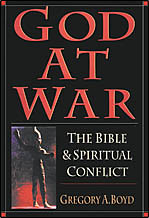
Greg Boyd makes a very compelling case for a "warfare worldview". The first half of the book argues from the Old Testament seeking to demonstrate a warfare worldview is the primary worldview represented in the Old Testament.
The second half of the book examines the New Testament and its foundations in a warfare worldview.
It is a powerful new way of thinking in my opinion. Obiously to hold to this worldview is to be a minority in current evangelical and protestant circles. But after reading this book I must say that I am comfortable and intellectually encouraged to move this way.
One of the most convincing features is the warfare worldview's handling of the problem of evil.
The traditional view is that God is in control of everything. Sovereignty is understood as omnicontrol. Therefore the question "why does an all-powerful, all good God allow bad things to happen" is legitimate. Boyd argues that the Bible does not conceive of God's sovereignty in the sense of omnicontrol. Because of this, God's will can and reddily is thwarted by spirits and humans who have freewill. Thus, when these beings chose to disobey God, they enter into warfare against their Creature.
If you're at all interested in a very stimulating and thoroughly biblical book (meaning, Boyd is constantly engaged in biblical exegesis throughout) dealing with theodicy and spiritual warfare, pick up this book. But don't plan to try to read it in a week like I did! This is a book that you will need to live with for awhile.
3.15.2005
The Lord of the Rings: Exploring a Holy Trilogy
This looks like a cool resource. Too bad $150 is too much for my churches to afford to show movies!
3.12.2005
next-wave > church & culture: Engaging our postmodern culture: An Interview with Stanley Grenz (1950-2005) by Rogier Bos
Stanley Grenz passed away today. Shocking news. Here is a quote from an interview posted today in honor of him. I really respect his critical engagement with postmodernism and think there is much to learn from him.
Christians tend to fall into two opposite and equally unhelpful responses to cultural expressions such as postmodernism. Some simply 'baptize' every new development. They jump on the latest bandwagon thinking that this is the way to stay relevant. Others 'demonize' what they see happening around them. In their estimation, the 'new' is always dangerous or evil, whereas the 'old' is safe and good.
I seek to promote a third response, critical engagement with culture. I believe that like the modernism that emerged from the Enlightenment the postmodern ethos is a mixed bag, containing much useful material, but also harboring certain potential pitfalls. Our task as Christians, therefore, is neither to hail the arrival of postmodernism as the savior of humankind nor to fight against it in the name of a return to modernism. Rather, our goal ought to be to understand how we can bring the gospel to postmodern people in ways that communicate meaningfully to them.
3.04.2005
Lost Valley Ranch
I can't wait! Tomorrow my wife and I head to Lost Valley Ranch for a retreat! It's a wonderful dude ranch and I am looking forward to getting lost for a week. I need to let my soul catch up with me!
Since I'll be gone and internet access will not be available, I won't be able to blog for a week or so.
So let me encourage those of you who read this blog to leave a comment while I'm gone. Introduce yourself!
Grace and peace,
Steve
Since I'll be gone and internet access will not be available, I won't be able to blog for a week or so.
So let me encourage those of you who read this blog to leave a comment while I'm gone. Introduce yourself!
Grace and peace,
Steve
Busy, tragic week
I haven't been able to keep up with my messy Scriptures posts lately. There are several reasons. This week primarily because I have been very busy with the tragic death of a young man in our community. His memorial service is today at 2:00pm. He fell to his death last Friday working on a communications tower. This is my first truly tragic funeral here.
3.03.2005
Haddon Robinson on current preaching models
From PreachingNow enewsletter:
During a discussion following his lectures on preaching at Beeson Divinity School some time ago, Haddon Robinson expressed concern that, "The model for the preacher has changed. Up through the 1940's into the 50's — at least among evangelicals — the model for the preacher was the evangelist . . .
"In the late 50's and 60's, the model in many circles became the Bible teacher . . . [corresponding to the emergence of the Bible church movement]
"In the 80's to 90's, the model of the preacher (became) the therapist — the task of the preacher is to meet the needs of the converted people who are still secular . . . Sermons today are much more likely to be topical than expository . . . and many of the materials in the sermon come out of the behavioral sciences . . .
"The aim of most sermons today is not to explain the biblical text. The aim of most sermons is to connect with the listeners' felt needs . . . The Bible is used as a way to get a divine imprint on what is simply good advice."
postmodern preaching
The postmodern era rejects the idea of authority. For us to preach with authority, it is not by being an authority ourselves. It is by trusting in the authority of God to speak through the scriptures. We believe that scriptures are a means of grace whereby we can encounter the living God.
In the modern era, many preachers were enamored with their own reasoning ability. Many sermons, especially in mainline churches, only briefly touched on the scripture de jour. In the postmodern era, this will not be tolerated. Postmodern people want the real thing, not some preacher's essay on life. They crave to encounter the living God through the scriptures.
This suggests that the best of postmodern preaching will be expository in nature. Expository preaching explains the scripture and builds from there. The particular form of the sermon does not matter —logical presentation, story, drama or role playing. The important thing is that we allow the listener to be involved in the world of the text before we draw out the implications.
Quite a quote! And I agree. My preaching is expository. Since becoming a pastor a little over two years ago I have been following the lectionary choosing one passage to preach. It has been a good way to get use to the relentless cycle of preaching every Sunday. Know that my text is chosen each week simplifies the process for me.
Then I study the text and seek to allow the text to speak and form my subject for the message. I want my hearers to enter into the text, interact with it, and leave transformed. I don't want to just give them a bunch of information or knowledge. I want the preaching experience to be transformational!
That's why I spend a lot of time coming up with my introductions. I feel that I have to connect what the Bible says to their everyday life in some way. They have to be hooked in order to want to expend the mental energy to stay with me for the next 25 minutes or so.
Some call this felt needs preaching. But the Bible must meet us at our point of need and it is the task of the preacher to show how that intersection happens, where that intersection is. I want to explain the biblical text and point us to how it intersects with our lives!
Again, this is partly why I love the messy Scriptures series. Where does our everyday lives intersect with the story of the patriarches? Does it intersect with the story of the patriarches? How is this passage useful for teaching, rebuking, correcting, and training in righteousness? That is the exchange that I am seeking in preaching.
2.25.2005
ALLELON Ministries - Worlds in Collision: The Fallen Powers - Part 1
Worship is a furnace of transformation because it is there we learn to know Him who is beyond our knowing.
Wonderful quote. Yet is this what is happening in worship in our churches? In any of our churches?
ALLELON Ministries - The Scandal of the Evangelical Conscience
Another great quote from Sider's article.
Unfaithful evangelical lifestyles are a blatant denial of Jesus’ Gospel. If the Gospel were merely the forgiveness of sins, then we could accept the Gospel and go on living in the same racist, adulterous, materialistic way. But if the Gospel is the Good News of the kingdom, as Jesus taught, and if that means that part of the Gospel is that right now a new redeemed community of transformed persons living in the power of the Holy Spirit is breaking into history, then whenever so-called Christians live like the world, their very lives are evidence against Jesus’ teaching that the kingdom is now breaking into history.
ALLELON Ministries - The Scandal of the Evangelical Conscience
One of the greatest scandals today–at least as devastating as the “scandal of the evangelical mind” that Wheaton historian Mark Noll has lamented–is that vast numbers of evangelicals do not practice what they preach. The polling data is clear. “Gallup and Barna hand us survey after survey,” Michael Horton says, “demonstrating that evangelical Christians are as likely to embrace lifestyles every bit as hedonistic, materialistic, self-centered and sexually immoral as the world in general.” One wonders if the central evangelical belief in a new birth through personal faith in Christ who sends the Holy Spirit to transform us into the very image of Christ is really a farce, fraud or false promise.
This is a powerful, sobering article. Sadly as a pastor, I think his right. And I think this in part is why the emerging church is, well...emerging. Younger evangelicals (post-evangelicals?) are tried of playing church. They want true community, true reconciliation, true transformation.
Before coming to these small rural churches, I worked at 3 large churches. Two of these churches had attendance of over 1000 each Sunday morning and the 3rd was in the neighborhood of 600 to 700. Often I struggled with how much of an impact we were really making on people's lives. We're people really changing, really transforming, really morphing? Sadly often the answer was no.
And it doesn't appear to be any better for small churches either. Many times because we live so close to each other we tend to get sideways with one another. And then we handle the conflict that results horribly! We are passive agressive, we gossip, we deceive, we get even.
This is why I am currently preaching the Sermon on the Mount following Dallas Willard's excellent book, The Divine Conspiracy. In this sermon, Jesus makes it clear that transformation is the rule rather than the exception. Kingdom subjects will change!
The research sited in this article appears to show what Willard calls "barcode" theology. Many believe that if we just get the right belief, the right knowledge, believe the right theory of the atonement, regardless of how we live our lives, then we will avoid hell and go to heaven. Many think that when God scans the barcode, as long as it is right on the outside, it doesn't matter what is on the inside. But even if a sack of manure has a barcode for perfume on it, it's still a sack of manure!
Do we really think God would set up a system, a barcode system that we could beat?
2.24.2005
Younger pastors ask: Is preaching out of touch?
Very interesting article on preaching. Includes thoughts from Doug Pagitt, Tim Keel, Rudy Carrasco, Karen Ward, Chris Seay, Fred Craddock, Charles Bugg, and George Mason. Very thought provoking regarding preaching styles.
I like the comparison of preaching to jazz improv. I played the trumpet in high school and college in jazz bands and greatly enjoyed the creativity and freedom of improv. Yet to be a good improv player you really had to know music. You had to know the piece you were playing, you had to know the instrument.
Preaching is like this as well. I try to preach the same sermon twice each week, once at each of my churches. Yet I am often amazed, as is my wife who listens to my sermons at both churches (she's a saint and a glutton for punishment!) how differently the sermons turn out. I think this is because of the community I am preaching to at each church is so different. In the exegesis of my audience I realize that different parts of the sermon will need to be emphasized. Actually, I probably don't know this, but God does!
I like the comparison of preaching to jazz improv. I played the trumpet in high school and college in jazz bands and greatly enjoyed the creativity and freedom of improv. Yet to be a good improv player you really had to know music. You had to know the piece you were playing, you had to know the instrument.
Preaching is like this as well. I try to preach the same sermon twice each week, once at each of my churches. Yet I am often amazed, as is my wife who listens to my sermons at both churches (she's a saint and a glutton for punishment!) how differently the sermons turn out. I think this is because of the community I am preaching to at each church is so different. In the exegesis of my audience I realize that different parts of the sermon will need to be emphasized. Actually, I probably don't know this, but God does!
Naked in the Pulpit - LeadershipJournal.net
Subscribe to:
Posts (Atom)