
10.31.2005

1,000 Attend Service For Pastor Electrocuted During Baptism


This is a terrible tragedy. Kyle Lake will be missed. May he rest in peace.

A Halloween Solution - Christianity Today Magazine


Halloween...probably the most controversial of holidays in America. Here's a fun, short article dealing with the day.

10.26.2005

Emerging Solutions—and Problems - Christianity Today Magazine


Sorry for the long delay since I last posted! I've been rather busy with hospital visitation, funerals, leadership issues, denominational meetings, alt.worship services, some big time spiritual warfare, and my growing family. Here's an article that caught my eye. Perhaps you have followed the flap over Carson's book Becoming Conversant with the Emerging Church. If not, this article will introduce you to some of the issues. I feel I often straddle the fence on the issue of the emerging church. I haven't jumped in with both feet, but the preaching of Tim Keel and Rob Bell really resonants with me and much of what I have read by McLaren and others does as well. Yet I find myself torn. I also find much that doesn't sit well with me. I think that's why the following quote from the article sums up my feelings as well:
Rather than becoming antagonists, Carson and McLaren should continue in dialogue, so the academic theologian and the missional practitioner might be mutually enriched and refocused.

10.21.2005

The 100 Minute Bible


The 100-Minute Bible is primarily intended for people who have an interest in Christianity but not the time (nor tenacity!) to read the whole Bible

This concept is really bugging me! What has been determined to be the "core" of the Bible? Can you really pick out the principle stories? And who says which stories are the principle stories?

I have found that people make time for the things they are interested in. If you are interested in fly fishing, quilting, mathematics, philosophy, etc. there are no shortcuts to growing in your understanding of these things. You have to put effort forth. And people do, if they are interested. Why should the Bible be any different? I think the 100 Minute Bible is sending the wrong message! What do you think? Are you as bugged by this as me, or do I need to just chill out?

Old Words, Vibrant Faith - Christianity Today Magazine


Check out this interview with Charlie Lowell of Jars of Clay taking about the band's CD, Redemption Songs. I appreciate his thoughts and his sentiment concerning the hymns!
These songs have been in the band for years. Some of them we wrote for the record, like 'God Will Lift Up Your Head' and 'Jesus, I Lift My Eyes.' Some of them we have been singing backstage in our dressing room or at church for years. But it's new to our audience. It's something we haven't really talked about. There was this sort of modern worship thing, and we felt like black sheep. But times came around and we felt like this is really valuable and could be something that the church even needs right now. Maybe the church needs some of these songs that take us back to our roots and foundation.

Why? - Christianity Today Magazine


Here's a short article giving several different answers to the question of why concerning hurricane Katrina and Rita.
The debate over the meaning of the hurricane started when it became clear that federal, state, and local officials were having trouble responding to the disaster.

Democrats said the hurricane revealed inept leadership and bias against the poor. Republicans said government failures showed that the private sector could do a better job.

Muslim militants said it was Allah's judgment. Louis Farrakhan trumpeted a Black Muslim view that Katrina was judgment for the Iraq War. Ovadia Yosef, a leading Orthodox Jewish rabbi in Israel, said the hurricane was punishment for U.S. leaders forcing Israel out of the Gaza Strip.

10.19.2005

Book Review: 90 Minutes in Heaven by Don Piper


Have you ever wondered what life after death is like? Do books about near death experiences interest you? Then you may enjoy this book. Don Piper shares his incredible story of death, pain, and life in his book 90 Minutes in Heaven.

Piper died in a terrible car accident on a rural Texas highway. He was dead for 90 minutes. During that time, he went to heaven but came back to life on earth after a pastor prayed for him.

Repeatedly, Piper says that words cannot possibly describe what heaven is like. Piper is greeted by deceased friends and family, sees the pearly gates and golden streets, and hears wonderful music.

After describing his brief glimpse of heaven, the rest of the book recounts his trying struggle to recover from his horrific injuries. The intense pain and knowledge that he will never again be normal lead Piper to despair, depression, and frustration. Fortunately, God places several people in Piper’s life who help him through his depression and despair. Piper begins to share his experience with others and finds God working through his story.

Overall it is a good book. His description of the car accident, heaven and the painful recovery are powerful. Many of the lessons he learned through this ordeal are very helpful. One such lesson for me was allowing people to minister to me because it enables them to live out their calling.

But several things bothered me in the book. One was the author’s repeated attempts at interpreting what he experienced in terms of his theological presuppositions. Most obvious were Piper’s repeated comments concerning the absence of time in heaven and yet he experienced sequence. He met one relative first, then another, then a friend, and so on. He did this first, and this next, and so on. He heard this song, which had these notes, played in this sequence, and so on. If he experienced obvious sequence in heaven, which would indicate the passage of time, why doesn’t the author reinterpret his theology in light of his new experience?

Another frustrating aspect of the book was the overall weakness I see in many evangelical Christians (myself included!) as exemplified in Piper. Piper is a Baptist minister and I kept asking myself what this book would be like if a minister with a more contemplative, sacramental worldview had experienced this same trial. I commend Piper for his openness and allowing himself to be vulnerable. I commend Piper for allowing us to see him when he was not at his best. I commend Piper for writing a book that doesn’t present himself as the most likeable guy. But overall, I feel he reflects so many Christians today who do not have a deep, contemplative relationship with God and who lack a theology that includes suffering.

Don’t get me wrong. I would not have handled his situation any better than he did. But I do believe that his analytical approach to this ordeal by seeking to find answers is typical of many evangelical Christians today. We rarely seize moments that will allow us to contemplate the sufferings of Christ (and obviously none of us want to do this!). To me some of his reflections highlight some of the weaknesses of a purely analytical, rational approach to our relationship with God. It feels to me, based on the teachings of Jesus and Paul, that we should have a far better perspective on suffering and pain than we typically do.

Let me encourage you to read this book. And let me encourage you by reading this book to place yourself in Piper’s place and develop a powerful, thoughtful theology of suffering.

Thanks to Paige Harvey of PS Media Relations for sending me a copy of this book to review.

10.08.2005

Out in the sticks extreme makeover coming (I hope!)


Outinthesticksoct
Originally uploaded by hawkenstein.
I am growing tried of the look of my blog. I am currently trying to rework it and learn a thing or two along the way. Please be patient if things go completely crazy!

These changes will coincide with some huge changes going on at the churches I pastor. I plan to share about all of that in the near future.

Grace and peace,
Steve

10.07.2005

Book Review: Calling by Frank Tillapaugh and Richard Hurst


I have been familiar with Frank Tillapaugh and his work at Bear Valley Church in Southeast Denver for quite sometime. Though he has not been the pastor there for over 2 decades now, his legacy there is widely felt. I worked as the youth pastor at Centennial Community Church which was birthed out of Bear Valley as a reclamation project which he briefly mentions at the end of the book.

Frank's work has been profound in the Denver area. And yet his work is really a result of creating what he calls an "open system" which allows people in the church to pursue their God given calling. He truly believes that the Bible really means it when it says that, we are all ministers, that all have been given a gift by the Holy Spirit to use in ministry, and that all beleivers are a royal priesthood. He really believes a pastor is "to prepare God's people for works of service" (Ephesians 4:12).

This belief has caused Frank to take helping people live their callings seriously. As a result the ministries below have come into existence:

Denver Street School (check out the history page)
Mile High Ministries (check out the About Us page
Inner City Health Center
Whiz Kids Tutoring
Project Cure
Alternatives Pregnancy Center

...and many others.

Wow! Isn't it great to see the power of calling? Just think of the impact these ministries have had and continue to have on so many people in Denver! And few people relize that these ministries owe there existence to followers of Jesus being faithful to their calling...to the want-to that God placed inside their hearts.

If you want to get a taste for how this might be accomplished in your church (though it is not a how-to manual) read Calling. I highly recommend this book. If used copies of the book are not available from Amazon, the book is available from Frank's organization Dreamtime listed on this product page.

10.05.2005

Emergents, Meet Saints! - Christian History


Here's a great article on studying church history to inform our current wrestlings with church and culture. Here's a great quote from the article and I agree with the author.
The Emergents seem to me to have it right: No single program or rulebook can possibly speak to the hearts of this diversely gifted, diversely perceptive, and diversely wounded young generation who yearn for spiritual fulfillment yet deeply distrust 'organized religion.' We need to reassess—to find new models of creative ministries.

What to do in such a time?

This is a time for stories. Maybe stories from history, 'straight up'—carefully researched and narrated by the scholars who have given their lives to unearthing and interpreting historical evidence and shaping the clearest, most accurate and unbiased story they can out of the shards and shadows of the past. Maybe edifying allegories, plays, and tales of various kinds.

And maybe, too, the life stories of those 'dead Christians' who translated the Gospel for their own generations—forcing the church in their times to shake itself out of deep ruts and see the world in new, challenging lights. Maybe these lives can teach us something about how to translate the Gospel for the lost of our own new patchwork, post-Christian generation.

I like this idea of looking to the past for ideas for future new creative models of ministry. What are your thoughts? Is there anything we can learn from the past to help the church move forward into the future?

10.04.2005

The Power of Media: Interview with Micheal Flaherty


Here's an interesting interview with Micheal Flaherty, the president and co-founder of Walden Media which is bringing The Lion, The Witch, and The Wardrobe to the big screen this December. I find the following quote from the interview particularly interesting:
I was thoroughly depressed after Columbine, but I started to get encouraged when I read about how strong some of the young victims' faith was, particularly Cassie Bernall and Rachel Scott. One thing I found interesting was that these kids loved films. Cassie's favorite movie was Braveheart, and I think Rachel's was as well. In contrast, the killers' favorite films were reportedly things like Natural Born Killers.

I decided I would like to find a way to make more great, inspiring films that can lift people up and encourage them, particularly for this age group. So I called my old roommate from college, Cary Granat, who at the time was president of Dimension Films. Cary also wanted to do something more inspirational for the family. So that was the origin of it, acknowledging that media really does have a role in influencing hearts and minds. And finding a way, rather than just to curse the darkness, to light a few candles and get more great films out there.

Particularly interesting to me is Flaherty's acknowledgement that the "media really does have a role in influencing heart and minds." It is refreshing to hear someone in the media say this. It seems to me that whenever concerns are voiced about the media and how it depicts violence, sexuality, religion, etc...that those voices are drowned out by others crying for free speech and seeking to argue that the media does very little to shape people's hearts and minds.

Watching my children grow has only made me more aware of the power of the media to shape hearts and minds. Last night we were reading from Laura and Mr. Edwards a Little House on the Prairie chapter book. In this book, Laura Ingalls describes winter on the prairie and how the girls passed the time. Listen to her description:
Now that winter had arrived on the Kansas prairie, the days were short and very cold. The wind howled and a hard rain fell. But there was no snow. Laura and Mary stayed inside, close by the fire. They listened to the wind and the wet sound of rain as they sewed on their quilts and cut paper dolls from scraps of wrapping paper.
Can you imagine kids today being content doing these things? I know my kids wouldn't be! They have been so shaped by the media that they believe they must always be entertained. Commercials on TV are particularly powerful to a 5 year old! I can sit and watch as their little eyes grow bigger and bigger as their excitement concerning a toy or a snack food increases. Then when the commercial is over they turn to me and say, "I want that! Can we go get that now? Can I have that for my birthday? I want that for Christmas!" The power of the media to shape the heart and mind. I believe it's very real.

What do you think?

9.28.2005

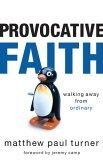
Book Review: Provocative Faith by Matthew Paul Turner


Every once in a while you read a book that you needed to read. I needed to read Provocative Faith at this time. From the first page of chapter 1 you know this is not your run of the mill Christian answer book. Right there, in black and white, at the bottom of page 31, Matthew boldly confesses his sin, his struggle with porn. His authenticity and transparency are disarming...and so refreshing.

This book relates Matthew's journey from ordinary, mundane Christian faith to passionate, provocative faith. Matthew challenges the reader to move from the "same ole same ole" faith to a faith that is "centered, stimulating, controversial, challenging, powerful, miraculous, vulnerable, frustrating, and fearful--in a word, provocative" (p. 21).

This book is full of great reminders and insights for all disciples. I am currently examing my call in light of several things that are happening at my two churches. So far, God has been silent. I'm learning to wait patiently as Matthew describes in his chapter "the burning bush isn't for everyone." I'm taking inventory, seeking to "participate in God's dream for (me)" (chapter 10). Is this call where God wants me? Matthew says it well,
If God has given you a dream, and chances are he has, it is imperative that you seek his will on how to make it a reality. Never lose focus on the truth that the dream is a blessing and a gift from Jesus. But in the end, don't you want to hear, "Well done, good and faithful servant"? I want to hear Jesus say to me, "Matthew, you took my dream in you and made it what I wanted it to be; good job!"

I too want to hear those words.

Matthew also reminded me of one way to tune into Jesus and his dream and will for me: meditation.
If you get one thing from this book, let it be this: meditation on Jesus will change your spiritual life. It will rejuvenate your faith like nothing else you will ever experience. More than a great sermon, more than listening to a radio teaching, more than reading this book, meditation on Christ--what he did, who he is, and what he wants of you--will give your life focus, and it will make your faith provocative. And you will begin to know him like never before.

I needed this book at this time. I needed the reminder to be authentic, transparent, and bold. I needed to be reminded to wait on God, that he is good, that he has a dream for me to achieve which he has uniquely gifted me for, and that he will share with me what it is if I'll just sit still, shut up, and listen.

Thanks to Paige Harvey of PS Media Relations for sending me a copy of this book to review! Paige, your sending me this book really ministered to me! Grace and peace!

9.27.2005

To Conserve Gas, President Calls for Less Driving - New York Times


A qoute from the article:
Mr. Bush's comments, while similar to remarks he made shortly after the disruption from Hurricane Katrina pushed gasoline prices sharply higher, were particularly notable because the administration has long emphasized new production over conservation. It has also opted not to impose higher mileage standards on automakers.

In 2001, Vice President Dick Cheney said, 'Conservation may be a sign of personal virtue, but it cannot be the basis of a sound energy policy.' Also that year, Ari Fleischer, then Mr. Bush's press secretary, responded to a question about reducing American energy consumption by saying 'that's a big no.'

'The president believes that it's an American way of life,' Mr. Fleischer said.

It finally appears that conservation is on the President's radar! Yet, what will truly cause people to conserve is the expense and not a plea from the government. Could it be that the American way of life is wrong? What do you think?

9.26.2005

Jesus Isn't Cool: Challenging Youth Ministry


Here is a fantastic article for all youth ministers to read! I know as a former youth minister I really struggled with the concepts in this article.
Religion may help teens find a sense of purpose, stay focused on schoolwork, avoid drugs, drive responsibly, and so on. These are good and important things and they are all part of the 'religious package,' but they are not the point. They are like the paper bag you get for free if you buy the groceries.

Sadly, so much of our ministry to youth (and adults!) can be summed up in trite t-shirt slogans. How far does the t-shirt slogan religion take a person?
After a particularly difficult night, I shared my struggles with a young woman interested in becoming a youth minister. "I'm not sure you want to get into this," I said. "There are other things you could do." She sat in a moment of stunned silence. Then she told me about her college years.

"My faith was no match for college," she said. "Youth group was fun, but no one taught me anything." She recalled those years marked by drugs, broken relationships, an eating disorder, sex, pregnancy and eventually abortion. Finally, with tear-filled eyes, she said, "Don't you see? If I had grown up in a youth group like yours, I would have had a fighting chance."

Christianity boiled down to a t-shirt slogan, no matter how cool or stylish will ever give our youth a fighting chance.

9.23.2005

Suddenly Single


This article reminded me of our friend Mel West (she's wearing the cowboy hat in the picture) who is walking the suddenly single road after her husband Ken died last year following a long, painful battle with cancer. We love you Mel and are praying for you!
'In most cases you’re dealing with the loss of someone close,' Grissom says. And whether or not it’s expected, the person is still going through a deep grieving process.

He says that when there’s a death, 'there’s an enormous amount of support around the funeral and maybe for a couple of weeks afterward, but then everyone around starts to resume their lives in a normal fashion; yet the person in grief is still trying to rebuild his or her life.'

LeadershipJournal.net - P*rn Sund*y


October 9 is National Porn Sunday. Below are some sobering statistics:
Every day, nearly 40 million people visit one or more of 4.2 million porn sites the internet. At $6.2 billion yearly, porn revenue exceeds the combined revenues of ABC, NBC, and CBS. According to statistics at XXXchurch.com, nearly 50 percent of Christians say that pornography is a major problem in the home.

Check out these links for help in dealing with addiction to pornography:

Porn Sunday
XXXChurch.com
Help for Porn Addicts
Covenant Eyes

9.20.2005

Book Review: Intercessory Prayer: How God Can Use Your Prayers to Move Heaven and Earth


I really wanted to like this book! This book was handed to me by a true prayer warrior, a woman in one of my churches that really spends serious time in prayer. I had great hopes for this book because of this.

However, I am really disappointed with this book. I found Sheets' style to be inauthentic and "preachy." It didn't feel real or vulnerable to me. Nearly every anecdote that is shared about prayer is miraculous and incredible in some way. Never is there a serious wrestling with unanswered prayer. Overall, if your prayers go unanswered it feels that Sheets' answer for you is that you are doing it wrong.

Sheets' also demonstrates an overall ignorance of biblical Greek and Hebrew. The only scholarly works cited are lexicons and concordances and not a single biblical commentary is mentioned for any passage he discusses. Sheets' does know his way around a Greek or Hebrew lexicon and Webster's Dictionary. Unfortunately this leads him down the path of many Exegetical Fallacies.

The most common fallacy of Sheets' is defined by D.A. Carson as "unwarranted adoption of an expanded semantic field." The following is what Carson means:

The fallacy in this instance lies in the supposition that the meaning of a word in a specific context is much broader than the context itself allows and may bring with it the word's entire semantic range. Exegetical Fallacies, p. 60.
Sheets' regularly brings to bear the word's entire semantic range even if the context does not allow this.

Another fallacy Sheets' falls into is "semantic anachronism".
This fallacy occurs when a late use of a word is read back into earlier literature. At the simplest level, it occurs within the same language, as when the Greek early church fathers use a word in a manner not demonstrably envisaged by the New Testament writers...But the problem has a second face when we also add a change of language. Our word dynamite is etymologically derived from dynamis (power, or even miracle). I do not know how many times I have heard preachers offer some such rendering of Romans 1:16 as this: "I am not ashamed of the gospel, for it is the dynamite of God unto salvation for everyone who believes" -- often with a knowing tilt of the head, as if something profound or even esoteric has been uttered. This is not just the old root fallacy revisited. It is worse: it is an appeal to a kind of reverse etymology, the root fallacy compounded by anachronism. Did Paul think of dynamite when he penned this word? Exegetical Fallacies, pp. 33-34

He probably didn't, seeing that dynamite had not yet been invented!
But here is another pastor committing this same fallacy! Sheets on pages 169-170 says,
On the other hand, we have weapons that are "divinely powerful" to pull down strongholds, if we would only realize it...The word "powerful" is dunatos and is actually one of the New Testament words for a miracle...And, of course, this is the Greek word from which we get the word dynamite. This stuff is explosive!

This dynamite is explosive for the "destruction of fortresses"...

Sadly and obviously these are not the word pictures the New Testament writers had in mind as they had no experience or understanding of dynamite.

I'll let Carson have the last word, as I believe many popular level books consumed by Christians are full of these "word-study fallacies":
But as important as word studies are, it is very doubtful if profound understanding of any text or of any theme is really possible by word studies alone.

Perhaps the principal reason why word studies constitute a particularly rich source for exegetical fallacies is that many preachers and Bible teachers know Greek only well enough to use concordances, or perhaps a little more. There is little feel for Greek as a language; and so there is a temptation to display what has been learned in study, which as often as not is a great deal of lexical information without the restraining influence of context. The solution, of course, is to learn more Greek, not less, and to gain at least a rudimentary knowledge of linguistics. Exegetical Fallacies, p. 64

9.19.2005

resettle.org


Here's another group trying to help the victims of hurricane Katrina.
A realistic and holistic solution for the victims of hurricane Katrina

Our Mission: To mobilize every community of 10,000 people within 1000 miles of the gulf coast to provide for the temporary resettlement of up to 10 families.

I have been reading about the aftermath of hurricane Katrina today online. This article at the Ooze by Jim Henderson is a difficult one for me to process. Yes, I believe that institutional racism exists and keeps people down. Yes, it is possible that the federal government's slow response was in part due to racism in our nation. But I struggle with the desire to reduce this catastrophe to one cause, namely racism.

One of the TV news shows the other night discussed other very possible catastrophes. These catastrophes included an influenza pandemic, a dirty bomb being denoted in New York city, and an earthquake in San Francisco. The overwhelming reality for all of these potential crises is that we are not prepared. We are not the masters of our world that we like to think we are. And each of these crises are color blind.

If any one of these other catastrophes hit us (actually more like when, since all experts agree it is only a matter of time until the big one hits San Francisco), which will come with no warning like hurricane Katrina, we will be caught flat-footed, scratching our heads, wondering how this could happen to Americans. And many of our nations poorest, the elderly, and the sick will suffer the most.

Sadly so many didn't leave the gulf coast. Sadly, many couldn't leave the gulf coast. Sadly, local, state, and federal officials did not prepare for the worse case scenario. Sadly, local officials did not use 100's of buses that ended up under flood waters to evacuate the poor.

And sadly, we aren't prepared for the worse case scenario in San Francisco, New York, or any number of other cities either. Makes you want to live out in the sticks doesn't it!

9.17.2005

Out in the sticks


I've just looked at my blog in Internet Explorer for the first time in I don't know how long. I've been using Firefox as my primary browser for a year or so. One question...does my blog look really weird in IE? The sidebar seems to be misplaced when I look at it.

Thanks for the input!

Steve

Brad Stine - Comedy - Arts - John Leland - New York Times


Here's an interesting article about Brad Stine a Christian stand-up comic.
In the competitive world of stand-up comedians, Mr. Stine, 45, has found a niche as a conservative Christian, riffing on topics like gay marriage, judicial activism and judges who cite precedents from foreign courts. If this seems like an unlikely route to the "Tonight" show, it has its rewards. After years in secular comedy clubs, where he made up to $1,500 a week, he now performs at basketball arenas and football stadiums for gatherings of the Promise Keepers, a ministry aimed at men. For less than an hour onstage, he earns $20,000.

$20,000 for one Promise Keepers gig! Wow! I should have been a comedian!