7.07.2005

The Matching Game : Match the church with the statement of faith!

Can you match each church with it's statement of faith?

The sole basis of our belief is the Bible, which is uniquely God-inspired, without error, and the final authority on all matters on which it bears. As the Bible teaches, there is one God, eternally existing in three persons — Father, Son, and Holy Spirit — each possessing all the attributes of Deity.

God created humans to have fellowship with Him, but they defied God by sinfully going their own way. As a result, we need God's saving grace to end our alienation from Him. Salvation comes only through God's saving grace — not human effort — and must be received personally by repentance and faith.

Jesus Christ, second Person of the Trinity, lived a sinless life on earth and voluntarily paid for our sin by dying on the cross as our substitute. This accomplishes salvation for all who receive grace by trusting in Him alone. He rose from the dead and is the only mediator between us and God. He will return to earth to consummate history.

The Holy Spirit draws sinners to Christ and equips believers for personal growth and service to the church. The church's role is to glorify God and serve those in need. At the end, everyone will experience bodily resurrection and the judgment. Those forgiven through Christ will enjoy eternal fellowship with God. For more details, please ask for our complete Statement of Faith at the information booth.


The Matching Game : Match the church with the statement of faith!
This statement of faith belongs to:
Willow Creek Community Church - Bill Hybels
Cedar Ridge Community Church - Brian McLaren
Saddleback Church - Rick Warren
Lakewood Church - Joel Olsteen
Thomas Road Baptist Church - Jerry Falwell
New Life Church - Ted Haggard
The Potter's House - T.D. Jakes
This Poll by hawkenstein
Click here to view results

7.06.2005

P.O.V. - Street Fight | PBS


Wow! Another great documentary on P.O.V. This one is just down right crazy! An excellent example of the old phrase "power corrupts!" Catch this if you can!

Wired News: Surviving the Digital TV Shift


Check out this quote from this article on digital TV:
Will people have to throw out their old TV sets when everything goes digital?

Not necessarily. Any TV set hooked up to cable or a satellite system is unaffected. However, any analog TV sets that use an antenna will no longer be able to receive programming over the air after the cut-off date -- unless it's hooked up to a cable or satellite system, or is set up with a digital converter. It's unclear how much those converters will cost when they become widely available at retail.

Sen. John McCain (R-Arizona) and Sen. Joe Lieberman (D-Connecticut) have already introduced a bill (.pdf) that would provide $468 million in subsidies for digital converters -- but only for low-income households.

We'd hate to have folks not have access to TV! I wonder how many books $468 million would buy? Or how many college educations for low-income households? If we are going to subsidize something for low-income households do we really think it should be digital converters for televisions?

7.05.2005

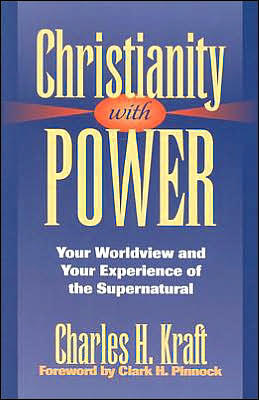
Christianity with Power by Charles H. Kraft


This book was published in 1989 but in my opinion it is extremely relevant to the discussion of the church today. In this work, Kraft shares his struggle to embrace a new worldview concerning miracles and a power ministry paradigm. He was skeptical at first but through cross-cultural missional experiences and classroom experiences with John Wimber as well as dialogue with Peter Wagner, Kraft overcame his reservations and has entered into Christianity with power.

I greatly appreciate this work. I too am often skeptical of much of Christianity that relies on power encounters. I struggle with actually believing that God desires to actually really heal people today. My western evangelical worldview has natural scientific explanations for things. I do not look for the spiritual reasons behind everyday occurances.

Further, I look to modern western solutions to my ills: when I am sick I go to the doctor, or take a drug; when I am emotionally troubled I see a psychologist. Prayer is often a last resort, when the other common sense remedies have failed to work.

Kraft points out that the western worldview is far different then the one of the Hebrews in Scripture. That doesn't make my worldview wrong but it does lead to some unique weaknesses.

As to the timeliness of this book, I kept feeling that this book is significant concerning the worldview shift that is occuring for many within our culture and in evangelicalism. The book autobiographically recounts much of Kraft's worldview transformation and then analyzes worldviews and transitions in worldviews from an anthropological standpoint (Kraft is professor of anthropology and intercultural communication at Fuller).

One of my favorite chapters in the book is called The "What We Think We Know" Problem. Here are some great quotes from this chapter (these appear especially relevant in light of the emerging church discussion):
"It is not so much what we don't know, but what we think we know that obstructs our vision", says Harvard theologian Krister Stendahl. This piece of wisdom has certainly described accurately quite a number of situations in human history. It also points ou the basic problem in a large number of conflicts that have taken place in the history of Christianity. Every time there is renewal, for example, the "what we think we know" problem arises. Typically, the traditionalists who think they know how God behaves become the opponents of the new things God wants to do...

The problem seems to be a human tendency to make rules for God. We learn certain things about how he works, arrive at the principles we think to be appropriate, and then impose those principles on those who seek to follow him as if God himself had endorsed them. We then virtually forbid him to work in any other way...

God simply refuses to be bound by "what we think we know," even if that knowledge is about him. For he knows the severe limitations of that knowledge. It is always constrained by our humanity and derived from our interpretations of but a small selection of God's acts. And all of those interpretations are influenced by our worldview, our experience, our predisposition, our sin, and all our other human limitations...

Our worldview paradigms of perspectives are precious to us. They are like our language, having been passed on to us by people in whom we have trusted over the years. So our first reaction is ordinarily to defend and protect them when they are challenged. This is especially true if we suspect that by changing a certain paradigm, we may run afoul of the opinions of our group. The potential of a loss of prestige is usually sufficient to keep us in line, especially if we are feeling socially insecure.

These thoughts really resonated with me as I continue to wrestle with the ongoing emerging church discussion. It causes me to wonder...how much of the controversy concerns truth, how much concerns the "what we think we know" problem, and how much concerns fear in changing a worldview?

Brian McLaren: D.A. Carson's book and responses


Interested in the ongoing controversy surrounding Brian McLaren and his work? Check out this quick response pointing you to several articles that critique Dr. D.A. Carson's book. Here's a quote from McLaren's post:
D. A. Carson has written a critical review of emergent, and of my work in particular. Dr. Al Mohler has effusively praised Carson's book in reviews and articles of his own. Both reviews are grossly inaccurate and they misrepresent and misjudge my writings, thinking, and beliefs.

7.02.2005

The Observer | UK News | Brainstorms turn to showers

The thought police strike again! And to think people get paid to do this!
David Brent would never approve. 'Brainstorming', the buzz term used by executives to generate ideas among their staff, has been deemed politically incorrect by civil servants because it is thought to be offensive to people with brain disorders.

Instead staff at the Department of Enterprise, Trade and Investment (DETI) in Belfast will use the term 'thought-showers' when they get together to think creatively. A spokeswoman said: 'The DETI does not use the term brainstorming on its training courses on the grounds that it may be deemed pejorative.'

7.01.2005

U.S. Churches' Recognition of Independence Day Varies Widely - Christianity Today Magazine


What is the church to do with Independence Day? Memorial Day? I've been thinking alot about this lately. Here's a quote from a Christianity Today article:
First Baptist Church in Euless, Texas, prides itself on its fiercely patriotic approach to the Fourth of July.

Last year, Marines rappelled into the sanctuary, church members in uniform stuck rifles and helmets into a Styrofoam grave site made by a Broadway set designer, and indoor fireworks exploded over a packed house in back-to-back services.

'It's just a big patriotic, feel-good moment,' said Robert Elkins, the church's music director.

First Covenant Church in Oakland, Calif., takes a different approach, allowing a salute to veterans but steering clear of any overtly patriotic messages. 'We want to be as inclusive as possible for all worshippers, whether they're red or blue,' said music director David Leestma.

Independence Day can be delicate for houses of worship. Many worshippers expect some recognition of the holiday, but appearing too nationalistic can alienate others who see God-and-country celebrations as political endorsements.

So what do you think churches should do?

The Mayberry Driven Church (Podcast)


This looks like a very promising podcast blog that I plan on paying a lot of attention to as I minister in Mayberry as well!
This website is for people in ministry who just need to be real and shed the "I AM PREFECT" image that we all get trapped into living. It's about ministry when your not Saddleback and you find yourself up a Willow Creek.


Also check out the George Vlosich III Etch-a-Sketch Art Gallery where I found the Mayberry pic.

MethodX | The Heavenly Banquet


Over the past few days I have been struck with the power of the Word of God. I am currently reading an excellent book called Blue Like Jazz which recounts several people coming to know God through reading the Bible.

God is the hound of heaven who is after us, relentlessly pursuing us. He shows up in the most amazing and unexpected places. Here's a quote from a great article demonstrating how God showed up through the Bible:
God was working with each person during that retreat. Both campers and staff, we were all touched by God's spirit through the words of scripture, through the hugs and smiles and words of one another, through the experiences of the week that affirmed life and love for all of God's people.

6.29.2005

My Web 2.0 BETA - Yahoo!

Haven't read or heard any buzz on this today. Give it a try!

LeadershipJournal.net - "I'm Losing My Focus"

This is an excellent article on the need to refocus. I have been trying to do this sometime using David Allen's term "weekly review". I have found this to be an invaluable tool! Burke's recommendations of a half-day away to dream and listen to God monthly as well as annual retreats for planning, personal growth, and refreshing your marriage relationship are great ideas.

Spirituality for All the Wrong Reasons - Eugene Peterson


I think relevance is a crock. I don't think people care a whole lot about what kind of music you have or how you shape the service. They want a place where God is taken seriously, where they're taken seriously, where there is no manipulation of their emotions or their consumer needs.


This strikes me as a strange quote from the author of the Message which is a translation of the Bible seeking to be relevant to our day and age. What is Peterson getting at here?

6.28.2005

The Word: John Medeski, the North Mississippi Allstars and Robert Randolph


Time to give some props to one of my favorite bands: Robert Randolph and the Family Band. Here's a review for the cd, The Word. My favorite quotes are in bold.
Jelly review: John Medeski, the North Mississippi Allstars and Robert Randolph: The first ever jam session must have occurred in a church. When the Spirit starts to move, nobody watches the clock. Keyboard player John Medeski, on break from his full time gig with Medeski, Martin & Wood, gathered together the North Mississippi Allstars and pedal steel player Robert Randolph for this high-stepping dance through a session of gospel blues.

Randolph is the real revelation here, as his pedal steel work steers a wide path away from the weeping willow-isms his instrument is usually associated with in the country realm for some squealing blues work. The hand-clapping Sunday service stomper 'Without God' is converted into a Southern rock powerhouse. On 'Waiting on My Wings,' Medeski's clip-clopping organ notes lead a funk workout worthy of the almighty Meters.

As nobody in this band steps up to the mike to sing, all ten tunes are completely instrumental. Without gospel's soul-deep lyrics, this recording sacrifices much of its spiritual impact. Unless you're already familiar with the sermon-in-song messages of these mostly traditional selections, you won't likely receive their originally intended blessings.

But if you want to hear what church might sound like if the Sabbath is ever moved from Sunday morning to Saturday night, this is your fantasy disc.


Here's a quote from the back cover on Live at the Wetlands:
On stage, Randolph is an energetic and inspiring presence, able to convert any beer-drenched, smoke-filled room into a temporary sanctuary. He's a time-stopping, trouble-erasing wizard who engages his listeners to march, press on, stomp their feet, clap their hands, scream. --Rolling Stone

I think this ties into the concept of jubilation that Dr. Platypus discusses in this post here. It'd be great to recover this in our churches. Fortunately great artists are doing it in "beer-drenched, smoke-filled rooms" around the country every Friday and Saturday night!

Encouragement in the church


praisebandchapelnamaan.JPG
Originally uploaded by Drpoulette.

This is an extended quote from an email newsletter I receive each week from worshipideas.com. This little newsletter pointed me to the Bose Personal Amplification system that each of my churches purchased for our PA system (and they sound incredible!).
[Joe Wood, this week's guest writer, leads the praise choir at one of upstate South Carolina's mega-churches, Brookwood Community Church. Brookwood has over 4,000 attendees each Sunday and is similar to Willow Creek.]

"We practiced for six hours and the director was still mad at us."

It was Father's Day, and I was eating at a breakfast that our church provided for the men singing in our once-a-year men's choir. I'd just told the guy next to me how great the group sounded, and that's when he said it. "Yeah, I can't believe we did it in one rehearsal. The last church I was in, we did this; and we practiced for six hours and the director was still mad at us." I was stunned, and really didn't know what to say.

You see, I used to be the same kind of director. I was old school. I was a "crack the whip" kind of director ...
hammering on all the flaws. I think I learned it that way.
After all, I studied music at a Christian college where you felt like you were in trouble all the time. We focused on flaws and "scored points" in finding them. But then, years later, I sang in a volunteer community choir directed by a Jerry Step, a local minister of music. Jerry's primary training tool was encouragement. I think his spiritual gift was encouragement. Jerry would gush over everything we did.
He would even gush over things that I didn't think deserved to be gushed over. It didn't take long for me to long to recognize, though, that Jerry's encouragement motivated us to work harder. His encouragement painted an image of what we could sound like. And before long, we sounded about as good as Jerry had been telling us we did. More importantly, it was fun singing in Jerry's choir. When rehearsal was over, we went home feeling good about what we'd accomplished and looking forward to our next rehearsal.

So I started trying out Jerry's method on the groups I directed. And it worked! I was amazed at how people responded to encouragement. Instead of listening for flaws, I started listening for things that the groups were doing right and pointing that out. When I found a flaw I tried to approach it in an encouraging way ... like complementing someone who was doing it right and explaining to the group what that person was doing. It was transformational! I discovered that my groups made much more progress in an encouraging environment than they had under my old school ways. In fact, they started getting better than I'd thought they could be.

That's when I started to become passionate about working with "average" musicians ... and it's one of the reasons that I'm so excited about the emergence of the Praise Choir in so many of our churches. If you put a bunch of regular people who love singing in a group, and give them encouragement, a vision, good coaching, and music that fits their voices, they can sound great. Mix in their love for God, and passion for worshipping Him, and they can be a powerful voice that encourages the church to worship!

I'm so glad that the guy I was talking with at breakfast had the experience that he had with us on Father's Day. I think now that he knows he has a voice that God can use; and he knows a little bit about how wonderful it is to serve God through praise. Maybe we can lure him into our regular Praise Choir...

How'd the guys do? It was amazing! We rehearsed for an hour and a half on Wednesday night, and about thirty minutes on Sunday morning. We didn't worry about parts. We let them sing melody or whatever part they could find. We just wanted them to sing their hearts. We kept the focus on the praise that we were doing ... not on the technical details of the music. The sound was awesome and the impact was powerful.
How could it be anything else? A men's chorus, passionately opening our services singing "Lord, Reign in Me." By the time we got to the closing chorus of "A Few Good Men" (three of our Praise Team guys sang the lead parts), our congregation couldn't stay in their seats! The choir was blessed. The congregation was blessed. I think God was blessed. And the director didn't even have to get mad.

Solar Death Ray


Very entertaining website! Check it out! (Also my first post trying out the new Blogger images feature).

Lessons in vegetarianism in the heart of cattle country

Vaughn at Icthus has a very interesting article on vegetarianism. Being a pastor in the heart of cattle country in a community that depends on agriculture I thought it only appropriate to share my thoughts with him. Here's his post followed by my comments.
Lessons in vegetarianism

Today for lunch, steamed vegetables and tofu over brown rice (with a splash of soy sauce). Yummy. So, this got me thinking more about vegetarianism. Why would I eat meat? Well, the answer is mostly because I am tempted to glutony and vanity. I desire to please my appetite and I rationalize that if I eat more protein I will look trimmer and sexy. But are glutony and vanity Christian virtues?

So, I'm beginning to think of vegetarianism as a compelling Christian practice. My recent thoughts on it are that it is a prophetic witness against consumerism, consumption, and capitalism-run-amok. Arguably the food industry has become less about food and more about money. Check this statistic:

In the US, animals raised for food are fed 70% of the corn, wheat, and other grains we grow. The world's cattle alone consume a quantity of food equal to the caloric needs of 8.7 billion people - more than the entire human population on Earth.

Its difficult to think about more food going to cattle than to those (esp. in 3rd world countries) who need it most. But the fact is that there is much money to be made by large corporations connected to the beef council. To be a vegetarian sends a compelling message to society that you will not participate in systems of over-consumption and gluttony (have you ever met an obese vegetarian?) in an age when millions of people live in extreme poverty without food.

Arguably there are other reasons to be vegetarian as well, but for now, lets consider the environment and economics.


Here is my comment:

Hey Vaughn-

Thanks for the interesting statistics. We live in the heart of cattle country out here in the sticks and I must say that the situation is more complex than those statistics suggest.

In Colorado alone, the federal government pays over $38 million a year to farmers to not farm their land! This keeps many farmers from bankruptcy. We have plenty of land to farm for both cattle and human consumption. I thik the greater problem is water.

Colorado, as you know, has experienced terrible drought the last several years. Water consumption to produce food for animals is probably one of the main uses of water in our country.

But to be consistent, growing a lawn in Colorado is extremely poor management of water resources as well.

I believe there are responsible ways to raise animals for consumption. But those days are long gone as we have moved away from the farm to the city. Most people in the city do not know where there food comes from. They do not know how or where or by whom it was raised. The last several cows I've eaten, I've known who raised it, what they fed it, and what it's name was! I also know the butcher.

The issue of beef production is huge in the U.S, but there are also dangers lurking in the resources used for our fruit and vegetables. Some of these questions are very difficult to answer morally. For instance, today because of technology, we have incredible hybrids of corn and other vegetables which are more disease and drought tolerant than ever before. Because of this, the yields we see in these hybrids are greater than ever before using fewer natural resources.

Hybrids can help us feed more people while using less natural resources. Yet the debate around frankenfood is heating up! Are these genetically modified foods safe for the long-term? What are the long-term effects of GMO's?

I think one of the main considerations in food consumption from a Christian viewpoint is to support local, sustainable, ecologically responsible farming practices. That is easy to do out in the sticks but very hard to do in the city! Here we live close to the land and the producers. We know them and how they operate. In the city you have to trust the supermarket or a co-op and their word regarding whether the food product is organic, non-GMO, natural, or what have you.

From this standpoint, should a vegetarian eat a banana or a kiwi or a coconut? These are not local produce (in Colorado) and vast amounts of natural resources are used to provide them for us here.

One last thing that demonstrates the reliance on others we have in our food production: I find it funny that the vegetarian starter kit lists Fritos as an ingredient in one of the recipes. I have heard anecdotal stories that cause me to avoid Fritos like the plaque! (Namely that Frito-lay regularly purchases corn that is unfit for cattle consumption!)

I agree that a Christian's relationship to food and the practices that produce food are very important, but I don't think being a vegetarian is the only moral answer for a thinking Christian.

Grace and peace,
Steve

Everything is Church especially during the summer months!

From Jason Clark's blog here are his thought on an issue I was processing this morning:
I was having a conversation with Fredrik, when I was in Sweden, about the growing popularity, of making 'private god spaces', of being post church, and making church something about not being church.

In this expression, we see a reaction to the idea that the church has so often seen sundays as the only valid space for God to be. In this paradigm, sundays are church, and the kingdom, only the sunday service is church.

So now we regale the congregation, and sundays, and see church as when I play golf, go shopping, play football. In this paradigm everything is church, and I don't need church anymore, I'm post church.

But in the old model where nothing is church, surely it's so restrictive that we have to say no! and find God elsewhere? And in the second model, where everything is church, then ultimately nothing is church, a kind of pantheistic ecclessiology.

A church that does not naturally lead to people connecting to God, in the places they work, and play, and live, isn't church at all. Conversely when church becomes just the place where I chose to connect with people who do just what I want, like football, I have stopped being church, just as completely.

In the reaction to church being so disconnected from the world, we think we are being radical by moving church outside of church, but we can end up not being church at all.

So where do I see church? What about the football guy, who finds God in his football sundays, and the water-skiing woman, who finds her time with God there. When they get together and ask, how are we going to talk about our faith, how are we going to celebrate christianity together - I hate football and you can't water ski - how are we going to connect together outside of our own exclusive narrow spheres of interest...then they get to start being church.

If sundays was all about me, jesus as my girlfriend worship, my blessing, my needs, lets not be fooled and think that church on my terms, on my interests, with fewer people is anything better, or different, it's just the modern church on steroids, hyper modern church.


Here are my thoughts I posted in a comment on his site. (I planned to blog about this today and his post was a great springboard for me!)

Thanks Jason for these much needed thoughts! I have been thinking about this today as my churchs' attendance is horrible in the summer. When I run into members in town they tell me of how busy there are and the many trips they have been on, the many personal projects there are pursuing. One woman today expressed surprise when I recognized her because it had been so long since she had been to church.

Her comment portrayed the bigger issue for me. Church attendance isn't the issue. Gather together in community, with others, with people who are different from us is the issue. How can we love our neighbor as our self (remember how Jesus defined neighbor) if we aren't around long enough to connect?

6.22.2005

CreativePastors Blog: Leadership Uncensored- Break it Up!

Very important reminder! Especially concerning the weekly sabbath for pastors.

Grokker


Grokker
Originally uploaded by hawkenstein.
Here's a fun site that gives you visual search results!

Private Warriors


Private Warriors
Originally uploaded by hawkenstein.
Also watch this fascinating Frontline report on PBS. If you get a chance, watch it!