8.31.2005

High-Tech Circuit Riders


Seacoast is one of almost 1,000 U.S. churches to embrace a multisite approach, according to the Leadership Network (www.leadnet.org). Sometimes called a 'satellite' or 'franchise' model, going multisite is seen by advocates as one of the leading innovations of the 21st century and by critics as a sign that the church has sold out to consumerism—becoming just another big-box retailer, selling salvation with convenient hours and a discount price. The answer, as usual, lies somewhere in between.


Currently in the PCUSA there are about 17 models of how to do ministry without a full time seminary trained pastor. There are so many models because there are so many small rural PCUSA churches that can't afford a full-time minister. This is true for many small, rural churches. Could the multisite approach work in the rural church context?

Pros:
1. If the rural churches used a DVD the cost of the technology is relatively inexpensive (especially compared to hiring a full time seminary trained minister!).

2. Most people in a rural church have a lot of ownership in the church and would be able to facilitate the business of the church on a daily basis.

3. The church could hire a part-time pastor who is gifted in visitation and building relationships to meet the daily needs of the congregation.

4. The church would receive better teaching and worship than is common in your typical small rural church.

5. Partnering small rural churches with large mega-churches would open them up to the resources and opportunities that mega-churches provide.

6. Something similar worked once before in a rural setting: Methodist circuit riders
Roger Finke, a Penn State sociologist and coauthor of The Churching of America, 1776-1990: Winners and Losers in Our Religious Economy, sees a parallel between the multisite or franchise approach and the Methodist circuit riders of the 19th century.

"The Methodist circuit rider was basically the pastor for multiple satellite churches," Finke told CT. "They tried to start up satellite congregations as quickly and as cheaply as possible. When the circuit rider was not there during the week, the satellite had a class leader or layperson who kept things going. Then the circuit rider would come in every once in a while and fire people up."


Cons:
1. Would mainline churches (which dominate in the rural context) buy into this model of ministry and be willing to partner with evangelical churches currently using this model?

2. Would small town folks accept the video teaching as a replacement for a pastor?

3. Would the video teaching connect with rural people and their lives and issues? (Many illustrations that work in the city don't connect in the rural context because they describe events or places that don't exist in the rural context.)

4. Would it all feel too fake and phoney to rural people?

5. Would it all feel too distant, too coerographed, too professional for rural people?

6 Would it draw the unchurched in rural areas?

7. Is something lost in worship with videotaped preaching?

At the very least I'm tempted to give this a try next time I'm out of town. Maybe I could videotape a sermon and they could watch it when I'm gone. Then I could get feedback and see what people think.

Those are my thoughts. What do you think?

8.20.2005

Luther: The daily gift of new life - Christian History

'In the morning, as soon as you get out of bed, you are to make the sign of the holy cross and say: 'God the Father, Son, and Holy Spirit watch over me. Amen.' Further directions follow: say the Apostles Creed, pray the Lord's Prayer. … Then 'you are to go to your work joyfully.'


Good simple advice on a daily spiritual discipline from Luther.

What I did on my summer vacation...

Sorry for the long delay inbetween posts. We have been on vacation and also to my wife's grandfather's funeral. Lots of miles on the van. But we are finally home.

7.29.2005

TIME Magazine -- Reworking Work -- Jul. 25, 2005

The transition required a lot of deprogramming of old attitudes, and it produced a lot of pain. Some employees break down and cry in ROWE training sessions. 'People in the baby-boom generation realize what they gave up to get ahead in the workplace, and a lot of times it's their families. They realize that it doesn't have to be that way,' says Ressler, her eyes tearing up. In particular, men thank her and Thompson, who run the sessions, for giving them permission to spend more time with their families. 'They know now they can do it and not be judged,' says Thompson.

This article reminds me of a great talk I heard Andy Stanley give at a Youth Specialties National Youthworker Conference several years ago. Andy Stanley said something along these lines: "Tell me, who was the youth pastor at your church before you? Will there be a youth pastor at your church after you leave? Now tell me, who was your spouse's spouse before you? Who was your children's parent before you? Who will be their spouse or parent after you are gone? In ministry we ask God to take care of our families when we know we are robbing them of time, of us so we can accomplish the work of ministry, the work of God. Maybe we have this backwards. Shouldn't we be present and available to our families and trust God to get the work of His ministry done?"

Sounds like Best Buy is leading the way in helping people get their priorities straight! How can the church assist? How can the church meaningfully challenge the priorities of our culture?

Book Review: Blue Like Jazz by Don Miller


Let's get right to the point: I love this book! It is funny, insightful, powerful. Miller's honesty and authenticity are so refreshing. Run out and start reading it today if you haven't already!

Some of the highlights include Miller's thoughts on attending Reed College, attending a Unitarian church in Colorado Springs, living as a fundamentalist Christian for a summer, and wrestling with how to love others.

I feel that it is probably the best book for handing seeks who want to learn more about Christian spirituality but aren't interested in the church. There are so many folks in my life that I want to give this book to!

Here's a great quote for the church to keep in mind:

"A friend of mine, a young pastor who recently started a church, talks to me from time to time about the new face of church in America--about the postmodern church. He says the new church will be different from the old one, that we will be relevant to culture and the human struggle. I don't think any church has ever been relevant to culture, to the human struggle, unless it believed in Jesus and the power of His gospel. If the supposed new church believes in trendy music and cool Web pages, then it is not relevant to culture either. It is just another tool of Satan to get people to be passionate about nothing." (p. 111)

I think this quote resonates so much with me because it's true. I know it to be true through my experience. Churches out in the sticks struggle with being relevant. Actually most of the time we don't even struggle! We just aren't relevant. We don't play all the latest greatest music. We sing hymns with an organ. Sometimes we sing some "newer" praise songs like "Lord I Lift Your Name On High" and "Shine, Jesus, Shine" but we sing them with organ accompaniment! We don't have a website. We don't market ourselves. We are far from relevant to the culture.

Yet people come. Young and old. And they are growing. Many tell me they are growing more than ever before in their lives! Why? Because I believe in Jesus and the power of His gospel. What could be more relevant than that?

7.28.2005

spamgourmet - free disposable email addresses, spam blocker

This looks like a great tool. I have been using Mailblocks for several years but have wanted a spamblocker for my gmail account. Enter spamgourmet! Depending on how well it works, I may not have to renew my Mailblocks subscription this year.

7.21.2005

Google Maps - 115 Federal Street Pittsburgh, PA 15212


Where are the Colorado Rockies playing tonight? PNC Park. I love baseball and Google maps with the satellite feature makes it really fun to explore all the great ball parks!

Speaking of Faith | The Religious Roots of American Democracy | Krista's Reflection

If you get a chance to hear this program, it sounds like it will be excellent and timely. From this brief quote, it is interesting how the founding father's defined terms like happiness and how most Americans today define it.

A few years ago I came across this fascinating observation by the Frenchman Alexis de Tocqueville from his famous report of 1831, Democracy in America:

"Religion in America takes no direct part in the government of society, but it must be regarded as the first of their political institutions. I do not know whether all Americans have a sincere faith and religion, for who can search the human heart? But I am certain that they hold it to be indispensable to the maintenance of republican institutions. This opinion is not peculiar to a class of citizens or to a party, but it belongs to the whole nation and to every rank of society."

These days, there is a new discussion building in our culture — in both public and private spaces — about the role of religion in American life. As we began to prepare this program on the religious roots in American democracy, I wanted to probe something de Tocqueville saw that I find underrepresented in our contemporary dynamics: a religious sensibility in the origins of our national ideals that goes deeper than our modern debates, and transcends them.

I found a modern de Tocqueville in philosopher Jacob Needleman, and our conversation felt like an adventure. Needleman spent several years tracing the spiritual and intellectual content of the American founders' thought. Spirit and intellect, he says, always worked in concert in the formulation of American democracy and the writing of the documents that define American identity even today. Rights implied duties. Happiness was an inalienable right, but it was not synonymous with pleasure, with having or acquiring what one wants. It meant "well-being." It was linked with conscience. In the "idea of America," Needleman asserts provocatively, democracy is not just a set of laws and societal structures. It is also inner work.

Needleman enlarges the notion of America's founders to include important thinkers who helped form the virtues of our republic beyond revolution and constitution. So in this week's program, alongside Thomas Jefferson and Thomas Paine, we have wonderful readings from Frederick Douglass and Walt Whitman. In the context of conversation with Needleman, I heard what each of them had to say with new interest and insight. I came away feeling that we can invoke the religious sensibility of the founders precisely as an antidote to the confusion and excesses of religion in American life today.


This serves to illustrate the need for careful hermenuetics. Whenever we are dealing with an historical text, we must seek to understand what the authors original intent was. We must define the words the way the authors did.

Perhaps we rely too much on reader response today.

The Matching Game update

Several days ago I posted the Matching Game quiz challenging players to match the church with the statement of faith. Here are the results. The correct answer was Willow Creek.


The Matching Game : Match the church with the statement of faith!
This statement of faith belongs to:
Willow Creek Community Church - Bill Hybels
3
Cedar Ridge Community Church - Brian McLaren
1
Saddleback Church - Rick Warren
2
Lakewood Church - Joel Olsteen
2
Thomas Road Baptist Church - Jerry Falwell
3
New Life Church - Ted Haggard
0
The Potter's House - T.D. Jakes
2
This Poll by hawkenstein
Click here to view current results

7.15.2005

The Constructive Curmudgeon

Dr. Groothuis from Denver Seminary is now blogging atThe Constructive Curmudgeon.

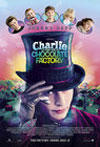
Reviews: Charlie and the Chocolate Factory - Christianity Today Movies


Charlie and the Chocolate Factory opens today. Here's part of a review from Christianity Today:
...it intrigued me to hear the new version of Dahl's book would be directed by Tim Burton and star Johnny Depp, two guys with a bit of a resumé in creepy, trippy, and weird. And so, I viewed Burton and Depp as the two biggest wild cards in whether this movie would be any good.

It turns out that the duo has each succeeded in creating a fable that is not creepy or trippy, but just possessing a gentle weirdness (just wait for the scene with the 'Small World' attraction) that is completely appropriate to Dahl's original book. In fact, Charlie and the Chocolate Factory is a charming, engrossing, and often laugh-out-loud funny fairy tale that captures the book's spirit while still marking its own territory.

Will it be a hit?

Out of Africa - Christianity Today Magazine


The power is shifting. The moral authority is shifting. This is a great article discussing the shift of power and authority in the church.
Philip Jenkins, in his groundbreaking The Next Christendom, wrote that a 'global perspective should make us think carefully before asserting 'what Christians believe' or 'how the church is changing.' All too often [such statements] refer only to what that ever-shrinking remnant of Western Christians and Catholics believe. Such assertions are outrageous today. … The era of Western Christianity has passed within our lifetimes, and the day of Southern Christianity is dawning.'

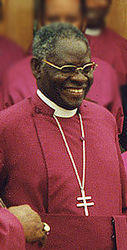
In the Anglican Communion, the third-largest Christian body in the world with more than 70 million adherents, there is no better representative of that shift than Nigerian Archbishop Peter Jasper Akinola.

Harry Beasts - Christianity and Harry Potter


The latest Harry Potter book goes on sale at midnight tonight. Thousands of young fans will line up. Media will cover the frenzy. And the debate among Christians will heat up once again. Here are some interesting quotes from John Granger's book Looking for God in Harry Potter as he takes a look at the animal symbols used in the books which point to Christian reality.
Does it seem odd that there are so many symbols of Christ? There is a big difference between symbols and allegorical figures. Allegories are stand-ins or story translations of a worldly character, quality, or event into an imaginative figure or story. There can be only one figure representing the other, consequently, or it's difficult to translate; I cannot have two Hitler figures if I'm writing an allegory of the Second World War, or the allegory fails.

Symbols, in contrast, can be stacked up. If I am telling a fantasy story with a Christian message, I can include characters and beasties and events that all point to the various qualities, actions, and promises of Christ. If the symbols correspond with these qualities, even if they are not consciously understood as Christ symbols, they open us up to an imaginative experience of those supernatural qualities. A variety of these symbols woven into a story that itself echoes the Great Story will powerfully stir the soul because the heart is made by God to be receptive to this message. Our soul radios are always tuned to the frequency of the message.

The Harry Potter stories, in their formulaic journeys that end every year with love's triumph over death in the presence of a Christ symbol, find their power and popularity in the resonance they create in our hearts. We connect with them because they point toward the Truth Myth that saves us. The gospel has rarely, if ever, been smuggled into the hearts and minds of readers so successfully and profoundly.

Sounds as though Granger is rather positive towards the books.

On the other hand, here's what the new pope apparently thinks of Harry Potter:
The Pope has said that the Harry Potter books "erode Christianity in the soul" of young people, a German writer claims.

Bavarian-based Roman Catholic Gabriele Kuby, who wrote a book criticising JK Rowling's blockbusters, said the then Cardinal Joseph Ratzinger made the comments in an exchange of letters two years ago.

In March 2003, Ratzinger wrote thanking her for sending him a copy of "your informative book". He said: "It is good that you are throwing light on Harry Potter, because these are subtle seductions that work imperceptibly, and because of that deeply, and erode Christianity in the soul before it can even grow properly."

What do you think?

7.07.2005

jason clark : As the bombs go off in london, we pray...


"As the bombs go off in london, we pray..."


Read the whole prayer here.

Jesus Creed: Post-Certainty

Excellent post from Scot McKnight on Emergent and truth
Therefore, what the Emergent Christian denies is not that there is truth but that our articulation of that truth is always limited. Truth is personal and therefore our knowledge of God as Person in Jesus Christ through the Spirit and the Church limits our grasp until the Eschaton. And, to compound the whole discussion, genuine truth is the story of God make known to us through Christ and the Spirit in the community where that story is performed in such a manner that humans can grasp the true story of the true gospel.

The Matching Game : Match the church with the statement of faith!

Can you match each church with it's statement of faith?

The sole basis of our belief is the Bible, which is uniquely God-inspired, without error, and the final authority on all matters on which it bears. As the Bible teaches, there is one God, eternally existing in three persons — Father, Son, and Holy Spirit — each possessing all the attributes of Deity.

God created humans to have fellowship with Him, but they defied God by sinfully going their own way. As a result, we need God's saving grace to end our alienation from Him. Salvation comes only through God's saving grace — not human effort — and must be received personally by repentance and faith.

Jesus Christ, second Person of the Trinity, lived a sinless life on earth and voluntarily paid for our sin by dying on the cross as our substitute. This accomplishes salvation for all who receive grace by trusting in Him alone. He rose from the dead and is the only mediator between us and God. He will return to earth to consummate history.

The Holy Spirit draws sinners to Christ and equips believers for personal growth and service to the church. The church's role is to glorify God and serve those in need. At the end, everyone will experience bodily resurrection and the judgment. Those forgiven through Christ will enjoy eternal fellowship with God. For more details, please ask for our complete Statement of Faith at the information booth.


The Matching Game : Match the church with the statement of faith!
This statement of faith belongs to:
Willow Creek Community Church - Bill Hybels
Cedar Ridge Community Church - Brian McLaren
Saddleback Church - Rick Warren
Lakewood Church - Joel Olsteen
Thomas Road Baptist Church - Jerry Falwell
New Life Church - Ted Haggard
The Potter's House - T.D. Jakes
This Poll by hawkenstein
Click here to view results

7.06.2005

P.O.V. - Street Fight | PBS


Wow! Another great documentary on P.O.V. This one is just down right crazy! An excellent example of the old phrase "power corrupts!" Catch this if you can!

Wired News: Surviving the Digital TV Shift


Check out this quote from this article on digital TV:
Will people have to throw out their old TV sets when everything goes digital?

Not necessarily. Any TV set hooked up to cable or a satellite system is unaffected. However, any analog TV sets that use an antenna will no longer be able to receive programming over the air after the cut-off date -- unless it's hooked up to a cable or satellite system, or is set up with a digital converter. It's unclear how much those converters will cost when they become widely available at retail.

Sen. John McCain (R-Arizona) and Sen. Joe Lieberman (D-Connecticut) have already introduced a bill (.pdf) that would provide $468 million in subsidies for digital converters -- but only for low-income households.

We'd hate to have folks not have access to TV! I wonder how many books $468 million would buy? Or how many college educations for low-income households? If we are going to subsidize something for low-income households do we really think it should be digital converters for televisions?

7.05.2005

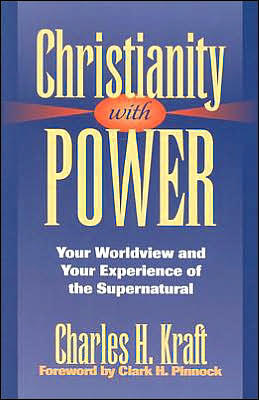
Christianity with Power by Charles H. Kraft


This book was published in 1989 but in my opinion it is extremely relevant to the discussion of the church today. In this work, Kraft shares his struggle to embrace a new worldview concerning miracles and a power ministry paradigm. He was skeptical at first but through cross-cultural missional experiences and classroom experiences with John Wimber as well as dialogue with Peter Wagner, Kraft overcame his reservations and has entered into Christianity with power.

I greatly appreciate this work. I too am often skeptical of much of Christianity that relies on power encounters. I struggle with actually believing that God desires to actually really heal people today. My western evangelical worldview has natural scientific explanations for things. I do not look for the spiritual reasons behind everyday occurances.

Further, I look to modern western solutions to my ills: when I am sick I go to the doctor, or take a drug; when I am emotionally troubled I see a psychologist. Prayer is often a last resort, when the other common sense remedies have failed to work.

Kraft points out that the western worldview is far different then the one of the Hebrews in Scripture. That doesn't make my worldview wrong but it does lead to some unique weaknesses.

As to the timeliness of this book, I kept feeling that this book is significant concerning the worldview shift that is occuring for many within our culture and in evangelicalism. The book autobiographically recounts much of Kraft's worldview transformation and then analyzes worldviews and transitions in worldviews from an anthropological standpoint (Kraft is professor of anthropology and intercultural communication at Fuller).

One of my favorite chapters in the book is called The "What We Think We Know" Problem. Here are some great quotes from this chapter (these appear especially relevant in light of the emerging church discussion):
"It is not so much what we don't know, but what we think we know that obstructs our vision", says Harvard theologian Krister Stendahl. This piece of wisdom has certainly described accurately quite a number of situations in human history. It also points ou the basic problem in a large number of conflicts that have taken place in the history of Christianity. Every time there is renewal, for example, the "what we think we know" problem arises. Typically, the traditionalists who think they know how God behaves become the opponents of the new things God wants to do...

The problem seems to be a human tendency to make rules for God. We learn certain things about how he works, arrive at the principles we think to be appropriate, and then impose those principles on those who seek to follow him as if God himself had endorsed them. We then virtually forbid him to work in any other way...

God simply refuses to be bound by "what we think we know," even if that knowledge is about him. For he knows the severe limitations of that knowledge. It is always constrained by our humanity and derived from our interpretations of but a small selection of God's acts. And all of those interpretations are influenced by our worldview, our experience, our predisposition, our sin, and all our other human limitations...

Our worldview paradigms of perspectives are precious to us. They are like our language, having been passed on to us by people in whom we have trusted over the years. So our first reaction is ordinarily to defend and protect them when they are challenged. This is especially true if we suspect that by changing a certain paradigm, we may run afoul of the opinions of our group. The potential of a loss of prestige is usually sufficient to keep us in line, especially if we are feeling socially insecure.

These thoughts really resonated with me as I continue to wrestle with the ongoing emerging church discussion. It causes me to wonder...how much of the controversy concerns truth, how much concerns the "what we think we know" problem, and how much concerns fear in changing a worldview?

Brian McLaren: D.A. Carson's book and responses


Interested in the ongoing controversy surrounding Brian McLaren and his work? Check out this quick response pointing you to several articles that critique Dr. D.A. Carson's book. Here's a quote from McLaren's post:
D. A. Carson has written a critical review of emergent, and of my work in particular. Dr. Al Mohler has effusively praised Carson's book in reviews and articles of his own. Both reviews are grossly inaccurate and they misrepresent and misjudge my writings, thinking, and beliefs.

7.02.2005

The Observer | UK News | Brainstorms turn to showers

The thought police strike again! And to think people get paid to do this!
David Brent would never approve. 'Brainstorming', the buzz term used by executives to generate ideas among their staff, has been deemed politically incorrect by civil servants because it is thought to be offensive to people with brain disorders.

Instead staff at the Department of Enterprise, Trade and Investment (DETI) in Belfast will use the term 'thought-showers' when they get together to think creatively. A spokeswoman said: 'The DETI does not use the term brainstorming on its training courses on the grounds that it may be deemed pejorative.'

7.01.2005

U.S. Churches' Recognition of Independence Day Varies Widely - Christianity Today Magazine


What is the church to do with Independence Day? Memorial Day? I've been thinking alot about this lately. Here's a quote from a Christianity Today article:
First Baptist Church in Euless, Texas, prides itself on its fiercely patriotic approach to the Fourth of July.

Last year, Marines rappelled into the sanctuary, church members in uniform stuck rifles and helmets into a Styrofoam grave site made by a Broadway set designer, and indoor fireworks exploded over a packed house in back-to-back services.

'It's just a big patriotic, feel-good moment,' said Robert Elkins, the church's music director.

First Covenant Church in Oakland, Calif., takes a different approach, allowing a salute to veterans but steering clear of any overtly patriotic messages. 'We want to be as inclusive as possible for all worshippers, whether they're red or blue,' said music director David Leestma.

Independence Day can be delicate for houses of worship. Many worshippers expect some recognition of the holiday, but appearing too nationalistic can alienate others who see God-and-country celebrations as political endorsements.

So what do you think churches should do?

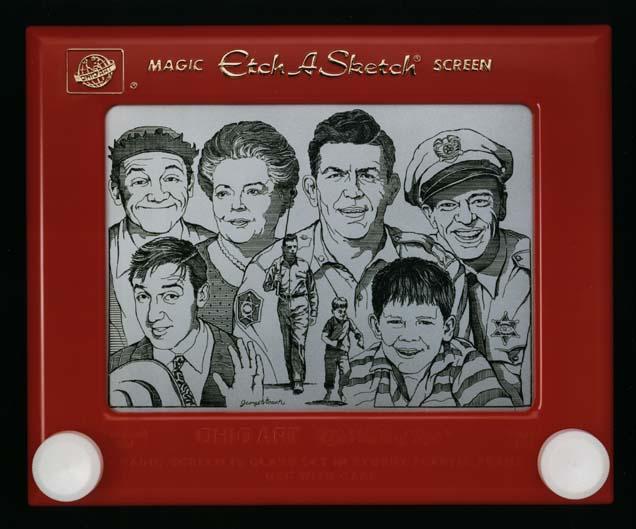
The Mayberry Driven Church (Podcast)


This looks like a very promising podcast blog that I plan on paying a lot of attention to as I minister in Mayberry as well!
This website is for people in ministry who just need to be real and shed the "I AM PREFECT" image that we all get trapped into living. It's about ministry when your not Saddleback and you find yourself up a Willow Creek.


Also check out the George Vlosich III Etch-a-Sketch Art Gallery where I found the Mayberry pic.

MethodX | The Heavenly Banquet


Over the past few days I have been struck with the power of the Word of God. I am currently reading an excellent book called Blue Like Jazz which recounts several people coming to know God through reading the Bible.

God is the hound of heaven who is after us, relentlessly pursuing us. He shows up in the most amazing and unexpected places. Here's a quote from a great article demonstrating how God showed up through the Bible:
God was working with each person during that retreat. Both campers and staff, we were all touched by God's spirit through the words of scripture, through the hugs and smiles and words of one another, through the experiences of the week that affirmed life and love for all of God's people.

6.29.2005

My Web 2.0 BETA - Yahoo!

Haven't read or heard any buzz on this today. Give it a try!

LeadershipJournal.net - "I'm Losing My Focus"

This is an excellent article on the need to refocus. I have been trying to do this sometime using David Allen's term "weekly review". I have found this to be an invaluable tool! Burke's recommendations of a half-day away to dream and listen to God monthly as well as annual retreats for planning, personal growth, and refreshing your marriage relationship are great ideas.

Spirituality for All the Wrong Reasons - Eugene Peterson


I think relevance is a crock. I don't think people care a whole lot about what kind of music you have or how you shape the service. They want a place where God is taken seriously, where they're taken seriously, where there is no manipulation of their emotions or their consumer needs.


This strikes me as a strange quote from the author of the Message which is a translation of the Bible seeking to be relevant to our day and age. What is Peterson getting at here?

6.28.2005

The Word: John Medeski, the North Mississippi Allstars and Robert Randolph


Time to give some props to one of my favorite bands: Robert Randolph and the Family Band. Here's a review for the cd, The Word. My favorite quotes are in bold.
Jelly review: John Medeski, the North Mississippi Allstars and Robert Randolph: The first ever jam session must have occurred in a church. When the Spirit starts to move, nobody watches the clock. Keyboard player John Medeski, on break from his full time gig with Medeski, Martin & Wood, gathered together the North Mississippi Allstars and pedal steel player Robert Randolph for this high-stepping dance through a session of gospel blues.

Randolph is the real revelation here, as his pedal steel work steers a wide path away from the weeping willow-isms his instrument is usually associated with in the country realm for some squealing blues work. The hand-clapping Sunday service stomper 'Without God' is converted into a Southern rock powerhouse. On 'Waiting on My Wings,' Medeski's clip-clopping organ notes lead a funk workout worthy of the almighty Meters.

As nobody in this band steps up to the mike to sing, all ten tunes are completely instrumental. Without gospel's soul-deep lyrics, this recording sacrifices much of its spiritual impact. Unless you're already familiar with the sermon-in-song messages of these mostly traditional selections, you won't likely receive their originally intended blessings.

But if you want to hear what church might sound like if the Sabbath is ever moved from Sunday morning to Saturday night, this is your fantasy disc.


Here's a quote from the back cover on Live at the Wetlands:
On stage, Randolph is an energetic and inspiring presence, able to convert any beer-drenched, smoke-filled room into a temporary sanctuary. He's a time-stopping, trouble-erasing wizard who engages his listeners to march, press on, stomp their feet, clap their hands, scream. --Rolling Stone

I think this ties into the concept of jubilation that Dr. Platypus discusses in this post here. It'd be great to recover this in our churches. Fortunately great artists are doing it in "beer-drenched, smoke-filled rooms" around the country every Friday and Saturday night!

Encouragement in the church


praisebandchapelnamaan.JPG
Originally uploaded by Drpoulette.

This is an extended quote from an email newsletter I receive each week from worshipideas.com. This little newsletter pointed me to the Bose Personal Amplification system that each of my churches purchased for our PA system (and they sound incredible!).
[Joe Wood, this week's guest writer, leads the praise choir at one of upstate South Carolina's mega-churches, Brookwood Community Church. Brookwood has over 4,000 attendees each Sunday and is similar to Willow Creek.]

"We practiced for six hours and the director was still mad at us."

It was Father's Day, and I was eating at a breakfast that our church provided for the men singing in our once-a-year men's choir. I'd just told the guy next to me how great the group sounded, and that's when he said it. "Yeah, I can't believe we did it in one rehearsal. The last church I was in, we did this; and we practiced for six hours and the director was still mad at us." I was stunned, and really didn't know what to say.

You see, I used to be the same kind of director. I was old school. I was a "crack the whip" kind of director ...
hammering on all the flaws. I think I learned it that way.
After all, I studied music at a Christian college where you felt like you were in trouble all the time. We focused on flaws and "scored points" in finding them. But then, years later, I sang in a volunteer community choir directed by a Jerry Step, a local minister of music. Jerry's primary training tool was encouragement. I think his spiritual gift was encouragement. Jerry would gush over everything we did.
He would even gush over things that I didn't think deserved to be gushed over. It didn't take long for me to long to recognize, though, that Jerry's encouragement motivated us to work harder. His encouragement painted an image of what we could sound like. And before long, we sounded about as good as Jerry had been telling us we did. More importantly, it was fun singing in Jerry's choir. When rehearsal was over, we went home feeling good about what we'd accomplished and looking forward to our next rehearsal.

So I started trying out Jerry's method on the groups I directed. And it worked! I was amazed at how people responded to encouragement. Instead of listening for flaws, I started listening for things that the groups were doing right and pointing that out. When I found a flaw I tried to approach it in an encouraging way ... like complementing someone who was doing it right and explaining to the group what that person was doing. It was transformational! I discovered that my groups made much more progress in an encouraging environment than they had under my old school ways. In fact, they started getting better than I'd thought they could be.

That's when I started to become passionate about working with "average" musicians ... and it's one of the reasons that I'm so excited about the emergence of the Praise Choir in so many of our churches. If you put a bunch of regular people who love singing in a group, and give them encouragement, a vision, good coaching, and music that fits their voices, they can sound great. Mix in their love for God, and passion for worshipping Him, and they can be a powerful voice that encourages the church to worship!

I'm so glad that the guy I was talking with at breakfast had the experience that he had with us on Father's Day. I think now that he knows he has a voice that God can use; and he knows a little bit about how wonderful it is to serve God through praise. Maybe we can lure him into our regular Praise Choir...

How'd the guys do? It was amazing! We rehearsed for an hour and a half on Wednesday night, and about thirty minutes on Sunday morning. We didn't worry about parts. We let them sing melody or whatever part they could find. We just wanted them to sing their hearts. We kept the focus on the praise that we were doing ... not on the technical details of the music. The sound was awesome and the impact was powerful.
How could it be anything else? A men's chorus, passionately opening our services singing "Lord, Reign in Me." By the time we got to the closing chorus of "A Few Good Men" (three of our Praise Team guys sang the lead parts), our congregation couldn't stay in their seats! The choir was blessed. The congregation was blessed. I think God was blessed. And the director didn't even have to get mad.

Solar Death Ray


Very entertaining website! Check it out! (Also my first post trying out the new Blogger images feature).

Lessons in vegetarianism in the heart of cattle country

Vaughn at Icthus has a very interesting article on vegetarianism. Being a pastor in the heart of cattle country in a community that depends on agriculture I thought it only appropriate to share my thoughts with him. Here's his post followed by my comments.
Lessons in vegetarianism

Today for lunch, steamed vegetables and tofu over brown rice (with a splash of soy sauce). Yummy. So, this got me thinking more about vegetarianism. Why would I eat meat? Well, the answer is mostly because I am tempted to glutony and vanity. I desire to please my appetite and I rationalize that if I eat more protein I will look trimmer and sexy. But are glutony and vanity Christian virtues?

So, I'm beginning to think of vegetarianism as a compelling Christian practice. My recent thoughts on it are that it is a prophetic witness against consumerism, consumption, and capitalism-run-amok. Arguably the food industry has become less about food and more about money. Check this statistic:

In the US, animals raised for food are fed 70% of the corn, wheat, and other grains we grow. The world's cattle alone consume a quantity of food equal to the caloric needs of 8.7 billion people - more than the entire human population on Earth.

Its difficult to think about more food going to cattle than to those (esp. in 3rd world countries) who need it most. But the fact is that there is much money to be made by large corporations connected to the beef council. To be a vegetarian sends a compelling message to society that you will not participate in systems of over-consumption and gluttony (have you ever met an obese vegetarian?) in an age when millions of people live in extreme poverty without food.

Arguably there are other reasons to be vegetarian as well, but for now, lets consider the environment and economics.


Here is my comment:

Hey Vaughn-

Thanks for the interesting statistics. We live in the heart of cattle country out here in the sticks and I must say that the situation is more complex than those statistics suggest.

In Colorado alone, the federal government pays over $38 million a year to farmers to not farm their land! This keeps many farmers from bankruptcy. We have plenty of land to farm for both cattle and human consumption. I thik the greater problem is water.

Colorado, as you know, has experienced terrible drought the last several years. Water consumption to produce food for animals is probably one of the main uses of water in our country.

But to be consistent, growing a lawn in Colorado is extremely poor management of water resources as well.

I believe there are responsible ways to raise animals for consumption. But those days are long gone as we have moved away from the farm to the city. Most people in the city do not know where there food comes from. They do not know how or where or by whom it was raised. The last several cows I've eaten, I've known who raised it, what they fed it, and what it's name was! I also know the butcher.

The issue of beef production is huge in the U.S, but there are also dangers lurking in the resources used for our fruit and vegetables. Some of these questions are very difficult to answer morally. For instance, today because of technology, we have incredible hybrids of corn and other vegetables which are more disease and drought tolerant than ever before. Because of this, the yields we see in these hybrids are greater than ever before using fewer natural resources.

Hybrids can help us feed more people while using less natural resources. Yet the debate around frankenfood is heating up! Are these genetically modified foods safe for the long-term? What are the long-term effects of GMO's?

I think one of the main considerations in food consumption from a Christian viewpoint is to support local, sustainable, ecologically responsible farming practices. That is easy to do out in the sticks but very hard to do in the city! Here we live close to the land and the producers. We know them and how they operate. In the city you have to trust the supermarket or a co-op and their word regarding whether the food product is organic, non-GMO, natural, or what have you.

From this standpoint, should a vegetarian eat a banana or a kiwi or a coconut? These are not local produce (in Colorado) and vast amounts of natural resources are used to provide them for us here.

One last thing that demonstrates the reliance on others we have in our food production: I find it funny that the vegetarian starter kit lists Fritos as an ingredient in one of the recipes. I have heard anecdotal stories that cause me to avoid Fritos like the plaque! (Namely that Frito-lay regularly purchases corn that is unfit for cattle consumption!)

I agree that a Christian's relationship to food and the practices that produce food are very important, but I don't think being a vegetarian is the only moral answer for a thinking Christian.

Grace and peace,
Steve

Everything is Church especially during the summer months!

From Jason Clark's blog here are his thought on an issue I was processing this morning:
I was having a conversation with Fredrik, when I was in Sweden, about the growing popularity, of making 'private god spaces', of being post church, and making church something about not being church.

In this expression, we see a reaction to the idea that the church has so often seen sundays as the only valid space for God to be. In this paradigm, sundays are church, and the kingdom, only the sunday service is church.

So now we regale the congregation, and sundays, and see church as when I play golf, go shopping, play football. In this paradigm everything is church, and I don't need church anymore, I'm post church.

But in the old model where nothing is church, surely it's so restrictive that we have to say no! and find God elsewhere? And in the second model, where everything is church, then ultimately nothing is church, a kind of pantheistic ecclessiology.

A church that does not naturally lead to people connecting to God, in the places they work, and play, and live, isn't church at all. Conversely when church becomes just the place where I chose to connect with people who do just what I want, like football, I have stopped being church, just as completely.

In the reaction to church being so disconnected from the world, we think we are being radical by moving church outside of church, but we can end up not being church at all.

So where do I see church? What about the football guy, who finds God in his football sundays, and the water-skiing woman, who finds her time with God there. When they get together and ask, how are we going to talk about our faith, how are we going to celebrate christianity together - I hate football and you can't water ski - how are we going to connect together outside of our own exclusive narrow spheres of interest...then they get to start being church.

If sundays was all about me, jesus as my girlfriend worship, my blessing, my needs, lets not be fooled and think that church on my terms, on my interests, with fewer people is anything better, or different, it's just the modern church on steroids, hyper modern church.


Here are my thoughts I posted in a comment on his site. (I planned to blog about this today and his post was a great springboard for me!)

Thanks Jason for these much needed thoughts! I have been thinking about this today as my churchs' attendance is horrible in the summer. When I run into members in town they tell me of how busy there are and the many trips they have been on, the many personal projects there are pursuing. One woman today expressed surprise when I recognized her because it had been so long since she had been to church.

Her comment portrayed the bigger issue for me. Church attendance isn't the issue. Gather together in community, with others, with people who are different from us is the issue. How can we love our neighbor as our self (remember how Jesus defined neighbor) if we aren't around long enough to connect?

6.22.2005

CreativePastors Blog: Leadership Uncensored- Break it Up!

Very important reminder! Especially concerning the weekly sabbath for pastors.

Grokker


Grokker
Originally uploaded by hawkenstein.
Here's a fun site that gives you visual search results!

Private Warriors


Private Warriors
Originally uploaded by hawkenstein.
Also watch this fascinating Frontline report on PBS. If you get a chance, watch it!

The Education of Shelby Knox


The Education of Shelby Knox
Originally uploaded by hawkenstein.
I caught this documentary last night. It is excellent and raises many interesting issues. If you get a chance, check it out!

6.20.2005

Emegergent Church: Filled with creative, energetic potential

Here's a quote from a great article by Alan Roxburgh on the emerging church.

At their best, these younger leaders want to challenge the North American church to a conversation about faith and mission in the midst of what they deem a postmodern transition. They want to engage in conversation about the philosophical, theological, methodological, and cultural challenges we face in our fast-changing world. At their worst, they become a new form of seeker-driven churches which use art, music, the digital revolution and the aesthetic pastiche of the moment to create new experiences.

At their best they courageously and joyfully enter the worlds of Goths and tattoo parlors to form Christian life in, with, beside and for people who would never be welcome in most congregations. At their worst they become the purveyors of more experiential, artsy, aesthetic forms of religious goods and services.

6.19.2005

TheBolgBlog: D. A. Carson: Becoming Conversant with the Emerging Church

Some good thoughts on Carson's book by Ryan Bolger a professor at Fuller.

6.17.2005

Monday Morning Insight Weblog: Using Mind Maps to Enhance Preaching

I've been using mind maps in my preaching and teaching for about half a year or so. I use software called Mindmanager and love it! It has revolutionized my preaching, teaching, and organization. To learn more about the use of mind maps read the Mindjet blog.

buzztracker

This website maps the news.

liveplasma

Check this out. Very cool!

Liveplasma is a new way to broaden your cultural horizons according to your taste in music and movies.

Look for your favorite bands, movies or directors to obtain a map that details other potential interests.

6.16.2005

ExChristianDotNet - encouraging ex-Christians Ex Christian Ex-Christian Xtian ExTian ExChristian

Here's a sobering and sad site.

Monday Morning Insight Weblog: Bill Gates on Church Attendance

Here's a quote by Bill Gates on religion in Time magazine:
Just in terms of allocation of time resources, religion is not very efficient. There's a lot more I could be doing on a Sunday morning.

Bill is absolutely right. Religion is not very efficient. It never has been and never will be. Efficiency is not the goal of religion. Efficiency is not the goal of a Sunday morning worship service (at least it shouldn't be!). To focus on efficiency or relevancy or any other thing besides God is to move away from the heart of worship.

I know that our society has gotten further and further from this concept but when Yahweh originally created Sabbath (which most Christians observe on Sunday, in theory) the goal was to move us from a mindset of production (efficiency) to rest (inefficiency).

Sadly, Gates and so many others don't see why religion is worth their time. What is worth Bill's time? What is worth our time? Is worshipping God worth our time despite how irrelevant and mundane it may be?

My two churches are far from being relevant to most in our town. We are far from being professional let alone great in our worship. We struggle to sing hymns with any real musicality. Our services are not powerful experiences were people leave knowing they have experienced God's presence. Yet we come together. We worship. At least we try. And I hope that is worth our time.

6.15.2005

What's your theological worldview? Now that's surprising!

Evangelical Holiness/Wesleyan

79%

Emergent/Postmodern

71%

Neo orthodox

71%

Roman Catholic

64%

Charismatic/Pentecostal

57%

Modern Liberal

54%

Reformed Evangelical

50%

Classical Liberal

43%

Fundamentalist

14%

What's your theological worldview?
created with QuizFarm.com


Thanks to Darrell for the link.

6.06.2005

No Wonder Emergent is Threatening to Evangelicalism!

Critical of the emergent church discussion? Maybe this will point out why.

Theoblogy: Official Response to Critics of Emergent

If you are critical of the emergent church discussion, please take the time to read this official response.

6.02.2005

Jerry Rice


JERRY RICE
Originally uploaded by hawkenstein.
The G.O.A.T. is now playing for the Broncos. I think this is a great move as the veteran will bring a lot of knowledge and experience to share with the young receivers of the Broncos.

He'll also help them out in the red zone where the Broncos struggled last year.

Doubt: A History


Doubt: A History
Originally uploaded by hawkenstein.
This sounds like a fascinating program and book. There's also a quiz by the author. Here are some interesting quotes from the Speaking of Faith newsletter.

We examine the contribution of skeptics, cynics, and others who have followed the human impulse to challenge given wisdom, and to doubt. Poet and historian Jennifer Michael Hecht has published a sweeping, lyrical history of the world's great doubters, and she shows that the act of questioning, as much as the act of believing, has changed the world.

The joy of creating this program lies, in part, in having my own imagination about "faith" expanded. This week, Jennifer Michael Hecht provides a luminous account of how our common imagination about doubt, and its symbiotic relationship with faith, begs for investigation.

Hecht's subject matter, the history of doubt, is daunting. She defines doubt generously, broadly addressing the human impulse to question what is given in order to invest one's days with meaning. She counts Socrates and Jesus, Thomas Jefferson and Emily Dickinson, among history's great doubters. She loves the ideas her work examines, and recounts their origins and the individuals who championed them as though she is recalling the adventures of friends:

You have to be a little bold and a little brave in most periods of time to be a doubter. And I liked them. I also was surprised by them because the dominant history basically suggests that doubt is very modern and that we have few doubters in the ancient world, but I kept seeing it everywhere. And so I just wanted to tell that story, to sketch it out. I found it was much more cohesive and self-knowing than I had ever dreamed.


How many Christians would acknowledge that there is a symbiotic relationship between faith and doubt?

6.01.2005

TallSkinnyKiwi: The Emergent Heresy Test

Go take the emergent heresy test! Also check out the results.

5.31.2005

Another great quote from Dr. Fernando's article

According to the famous evangelist John Wesley, you have a healthy job when there is a certain percentage of things you like to do, a percentage of things you don’t mind doing and a percentage of things you don’t like to do at all – but you choose to do them anyway!


This is excellent advice for all of us young pastors who want to work our way out of all the "have to's" of ministry.

Panda's Ponderings [Out of this World Dutchman]: Ajith Fernando: Servant Leadership

Tertullian wrote, 'It is our care for the helpless, our practice of loving-kindness, that brands us in the eyes of many of our opponents. 'Only look,' they say, 'how they love one another.'

The Body grows not only through preaching but through kindness in and outside the church. So this is a leader’s role: foster a joyful and patient community where people tolerate each other and are kind to each other.


This is a powerful article by a wonderful disciple and scholar. I thoroughly enjoyed his commentary on Acts and find these thoughts especially challenging as a pastor. The quote above is what I am finding to be the number 1 challenge of pastoring in a small town. The lack of joyful, patient community is destroying so many small churches.

5.24.2005

Tornado warning


Tornado warning
Originally uploaded by hawkenstein.
Wray is in the center of that big red spot on the radar! We are under a severe tornado warning this evening!

Megachurch google sightseeing: First Presbyterian Church


First Pres Colorado Springs
Originally uploaded by hawkenstein.
This is First Presbyterian Church (PCUSA) in Colorado Springs, Colorado. Here's a little from their website:

Welcome to First Presbyterian Church located downtown at the corner of Nevada and Bijou Streets in the heart of Colorado Springs.

Our Church is committed to being more than the geographic heart of the city. We want to be Christ’s heart as well.

Since the founding of the Church in 1872, God has blessed this congregation with the presence of His Holy Spirit and has called this congregation to serve Him in a unique way—challenging us to provide a Christ-centered, biblically energized witness to Colorado Springs and the surrounding area.

An abundance of people-oriented ministries and programs are provided here to meet human need in whatever form it takes.

Whatever your age or circumstance in life, we have a place for you in the family of God at First Presbyterian Church.

The doors of our Church and the doors of our hearts are open to you.

Brian McLaren: A Brotherly Critique and Response to "A Generous Orthodoxy"

Here's a great but brief discussion concerening "A Generous Orthodoxy". One thing I greatly admire in the emerging church movement is the willingness and desire to dialogue about issues. Too often in the church we are tempted to say "my way or the highway" without allowing people to process the issues openly and honestly.

5.23.2005

4 Ways Blogging Can Change Your Church

This is an idea I have had for some time:
Blogging will help to develop sermons and classes
Now, a preacher will be able to post a sermon idea at the beginning of the week and have the congregation respond so that when he delivers the sermon he will have brought many along for the ride. They will be actively engaged in the process and be able to share ideas and thoughts. Soon a preacher that does not blog with his congregation will be out of touch and behind the pack. Just note: blogging will change how preaching is done!

I would love to experiment with this. Sadly most of my congregation doesn't know what a blog is! Would any of you enjoy participating in something like this?

Crosswalk.com - United States Has More Megachurches Than Previously Thought

It's going to take me much longer than I thought to Google sightsee all of the megachurches in the U.S!

Westling in church for outreach


Wrestler
Originally uploaded by hawkenstein.
St. Philip's Anglican Church in Winnipeg has some guts!

St. Philip's Anglican Church hosted its first post-service match on Sunday, hoping to attract new members with a more hip program that included a two-match show with six local wrestlers, most of them Christians.

The colourfully clad wrestlers presented a WWE-style program complete with smackdowns and headlocks.

Many in the congregation of about 40 regular members find wrestling a natural fit with religion because of the theme of good versus evil.

Yet when I read it was "Christian-themed wrestling matches" I was hoping for something along the lines of MTV's Celebrity Deathmatch with pairings of biblical characters or even modern day Christians. Next up Jerry Falwell vs. Pat Robertson. I bet more people would come to see that then a bunch of WWE style wrestlers who are mostly Christians!

5.19.2005

A Generous Orthodoxy


A Generous Orthodoxy
Originally uploaded by hawkenstein.
I finished this book yesterday. In my opinion it is a great read.

Yes, it is provocative. Yes, many will find it troubling.

But if we are truly generous with the author and seek to understand his intentions (which I believe are to make us think rather than answer every question we might have) then I think we can all greatly profit from this book.

Coming from an evangelical background (and still making a transition to a post-evangelical understanding) many of his remarks concerning evangelicals and their relationship to the world and sinners stung particularly bad.

Also helpful are McLaren's discussion of the Bible, missional/incarnational theology, and the environment.

In seminary I took an excellent class from Dr. Danny Carroll called Reading the Bible from the 2/3rds World. This class was the first time someone ripped the lenses I read the Bible with out from in front of my eyes. I found that my interpretation of Scripture and what I believed to be biblical where greatly influenced by my presuppositions, tradition, culture, gender, and so on.

McLaren's book, if you will allow it, will do the same for you. It will remove the spectacles you see Christianity, Jesus, liberals, conservatives, God, the Bible, etc. from your face. And though it may seem scary or impossible now, you may actually like the view better.

Creativity, Innovation, Team Building, Leadership, Brainstorming, Idea Champions


homepage-graphic-left
Originally uploaded by hawkenstein.
This is a great website full of content to get you thinking. I've got to go to lunch and get some visitation done today, but I hope to do more with this tomorrow.

ICTHUS: Calvin College Faculty to George Bush - NO

Vaughn at Icthus has posted a great letter written by the Calvin College Faculty to George Bush. Check it out.

Wray Eagles


Wray Eagles
Originally uploaded by hawkenstein.
The joys of small town life...our high school baseball team and track teams are participating in the state tournaments this weekend. Here's a sign of support as you enter town heading east on HWY 34.

5.17.2005

Megachurch google sightseeing: Faith Bible Chapel


Faith Bible Chapel
Originally uploaded by hawkenstein.
This is a large church with a couple of campuses. They also have a school (K-12 I think). Here's a little about them in their own words:
We are a family of faith with a single purpose; we want to honor God.

The purpose of Faith Bible Chapel is to honor God by:

Acknowledging the Holy Spirit in all we do -
We value prayer and continually ask God to lead us in our planning. He shows us the needs of people, the opportunities for service to Him and gives us specific ideas to keep our church active and fresh. It is His church and we want Him to shepherd us all.


Bringing people to Jesus and to membership in His family -
We have been blessed by God. God loves us and will give us His life! We work to share the good news with our next door neighbors and with people around the world. We want to be a blessing to others and to help people find a relationship with Him for themselves.


Celebrating His presence through worship -
It is refreshing and energizing to express joyful praise to God together. We encourage active participation in singing and other expressions of worship to God as a key part of each of our meetings as a church family.


Developing people into Christ-like maturity through the Word of God -
The highest goal for a person is to grow continually into the character of God Who made us to be like Himself. We study the Bible for practical advice on how to continue to change so that we fulfill His purposes more completely. We want to be fresh in our experience of His life in us.


Equipping people for their ministry in the church and life mission in the world -
We each have unique gifts that we can offer to enrich the experience of God by every member of our church family. We share a common mission to reach others with a clear message of God's love and power so that they can enjoy being in God's family also. Training and opportunities for everyone to serve God actively are always present.

Frodo the leader


Frodo
Originally uploaded by hawkenstein.
This is a great article on leadership in the emerging postmodern world. I must say that this is so refreshing for me to read. I have been involved in megachurches with corporate, top down leadership, clear vision, hierarchy, the whole nine yards. I always felt I fell far short compared to these men (and I do!). But there is hope for the Frodo's and Dorothy's!
The leadership style that once dominated our culture is becoming passe. Instead of the Lone Ranger, we have Frodo: the Clint Eastwoods and Sylvester Stallones are replaced by ordinary men. Frodo, Aragorn and Neo (the Matrix) are self-questioning types who rely on those around them for strength, clarity and purpose. Indeed, while they have a sense of the need and a willingness to sacrifice themselves, they may not even know the first step on the journey.

5.16.2005

Jean-Luc Picard was my favorite!

Picard
Captain Jean-Luc Picard- You are the thinking
person's captain. You contemplate everything
before putting it into action. While you are
indecisive at times, you do so to insure an
equatable solution no matter what the cost.


Which Star Trek Captain are you?
brought to you by Quizilla

Reverend Mike's House of Homiletic Hash: Yet Another Thing I Wish I'd Said First

This is a great quote I found at Mike's blog. I think this is the issue the emerging church is pushing for us to deal with.
I don't claim to have a full understanding of all of these transitions, but I am convinced that as one moves toward such an understanding, one begins to see that postmodernism is not merely an epistemological shift from objectivity to subjectivity, from reason to emotion, from certainty to probability. Much more is involved, more than I can relate here. But what I must note here is the fact that insofar as postmodernism is more than a shift in epistemology, it is not exactly a set of ideas that one can choose for or against. [Emphasis added.] The issue before us is not whether or not we agree with postmodernism. That is like asking whether or not we agree with the year 2004. The question before us is the same question that faces Christians in every age: how should we then live? Given the fact of the postmodern cultural transitions of the last half-century, how should we live out our Christian faith? Answering this question will of course involve critically agreeing or disagreeing with the responses to our cultural context put forward by others, but it will also require serious self-criticism and a willingness to think creatively in directions not explored by Christians in previous eras. Doubtless, this is a task fraught with difficulty and danger, but I take it to be central to a life of faith that is lived out in truth and love in its actual context.

5.12.2005

Megachurch google sightseeing: Woodman Valley Chapel


Woodman Valley
Originally uploaded by hawkenstein.
Woodman Valley Chapel is in Colorado Springs, Colorado the hub of the evangelical community in many a person's mind. Here's a description from their website:

Woodmen Valley Chapel was founded in 1980 as a nondenominational, evangelical fellowship of believers.

Today, we strive to be an authentic community where people can experience God, be encouraged in their spiritual journey and empowered for service as they entrust a legacy to others. Located in northwest Colorado Springs--not far from the U.S. Air Force Academy--our campus highlights a spacious and modern worship center, designed in true local mountain style and surrounded by a 500-seat chapel and small prayer chapel. Our western architecture blends well with the backdrop of the rugged foothills of the Rocky Mountains' Front Range and majestic Pikes Peak. As we work together to become fully developed followers of Jesus Christ, Woodmen Valley Chapel strives to reach out to believers and non-believers who are single, couples, families or retired. Each weekend, we serve nearly 6,000 worshipers who attend one of the four services (one Saturday, two Sunday). A comprehensive education program is available for children of all ages on WVC's worship campus and in the spacious Windchime Center nearby.

Our strong global commitment sends many members of WVC and more than 10% of our budget to support God's work beyond the walls of the church. Our missionary partners are at work across the world in countries including South Africa, Russia and Brazil and include affiliations with such organizations as New Hope International, Habitat for Humanity and many others.

Woodmen Valley Chapel is a member of the Evangelical Council for Financial Accountability (ECFA) and the Willow Creek Association.

5.11.2005

Megachurch google sightseeing: Cherry Hills Community Church


CHCC1
Originally uploaded by hawkenstein.
This is the church I grew up at (though I never attended it at it's current location). My parents still attend this church and Dr. Jim Dixon is a wonderful speaker.

Here's a blurb from their website:

At Cherry Hills Community Church, we’re committed to serving the greater Denver community. And we’re a true community of Christian faith, including people from a variety of backgrounds—Presbyterian, Catholic, Lutheran, Baptist, Methodist, Pentecostal and those who are exploring Christianity for the first time.

5.10.2005

Megachurch google sightseeing: New Life Church


New Life Church
Originally uploaded by hawkenstein.
The Google Sightseeing blog has inspired me to find satellite images of megachurches throughout the world. Here's the first: New Life Church in Colorado Springs, Colorado pastored by Ted Haggard.

Here's a little blurb about the church from their website:

It has been said that New Life Church is the smallest big church in the country.

Though we number 11,000, we are a close family. We don't just meet together on Sundays -- we spend the whole week together, too. Through small groups that meet all over the region, New Lifers get together each week to have meals, pray, study, play, and serve the city of Colorado Springs.

New Life Church services occur four times each weekend in our sanctuary, called the Living Room. Our weekend gatherings are our lifeblood -- they are more like a family reunion than a traditional church service. We worship God and study the Bible in a lively but relaxed atmosphere. We catch up with each other and talk and laugh. We take care of one another. We give life to one another, and we learn what it really means to be a church.

Google Sightseeing


stealthb2
Originally uploaded by hawkenstein.
That's a B2 stealth bomber courtesy of Google Sightseeing. Check out this great fun blog! Lots of cool satellite images!

5.05.2005

Phil Mitchell and CU - The outing of a conservative

Dr. Mitchell spoke at our National Day of Prayer breakfast. Perhaps you have heard or read about him. If not, start here with this article from the Denver Post written by David Harsanyi who is according to Dr. Mitchell a Jewish Republican.

Betsy Hoffman's self-serving and phony warning about 'McCarthyism' at CU - in the middle of what should be an impartial investigation of Ward Churchill - was disgraceful.

But if the University of Colorado president needs a genuine case of discrimination at her school, here's one:

Beyond Foundationalism


Beyond Foundationalism
Originally uploaded by hawkenstein.
Wow! This is quite the book.

It took me quite awhile to get through this one as it is written for the academy.

In this book, Grenz and Franke attempt to create a model for doing theology that is non-foundational. This is necessary because of the influence of postmodernism on our philosophy and world. Many people in a vast array of disciplines are questioning foundationalism and many modernist notions concerning how we know what we know.

One of the most convincing arguments in the book concerns the supposed objectivity we have as a result of foundationalism. We are finite beings often times incapable of ture objectivity. Our readings of scripture are influenced by our traditions, our backgrounds, our education, etc.

Though I found the book to be interesting and helpful, I can't say that I am convinced that the author's have truly moved beyond foundationalism. In some ways it felt like they are arguing for a new foundationalism. Perhaps this is my misunderstanding.

Most helpful in the book is the historical discussion concerning many of the developments in theology, the critique of modernism, the reminder of how much tradition and culture influence our theologizing, and the desire to do theology in the context of community, the trinity, and eschatology.

I'd love to hear what my cousin Phil has to say about this book if he's read it.

Richard Foster on SermonCentral.com


Nathan
Originally uploaded by joshaidan.
Here's a great quote from Richard Foster on preparing to preach for spiritual formation.

Studying with our head. Studying with our heart. Studying with our life. All three are essential approaches to Scripture if we are to preach the Bible for spiritual formation.
For my preaching, I ususally begin meditating on the scripture passage. I quiet myself with a Taize style service, listening to music from Taize and John Michael Talbot. After quieting myself, I practice Lectio Divina with the text that I will be preaching from. I have found that this time often is the best time for me in my sermon preparation. There have been numerous times the Spirit has spoken to me through the word as I meditate on the text I am preaching. Sadly, I did not learn this in seminary. After this meaningful time, I turn to the mind and studying commentaries and asking further questions of the text. Following this, I create a mindmap of what I am going to say. For those of you who preach how do you prepare your sermons?

5.04.2005

Rice and beans and National Day of Prayer


almoco
Originally uploaded by heliascheppa.
Tomorrow is the National Day of Prayer here in the states. This is the National holiday of confusing Christianity with America.

Hopefully this picture will give us some of the least of these to keep in mind as we pray tomorrow for our national security, our leaders, baseball, and apple pie.

5.01.2005

Worship set and what music does to your body


Worship Set
Originally uploaded by Godverbs.
This article shares how researchers have recently discovered that music acts as a painkiller. "Music can help us transcend pain."

The article also says:
What music does: It makes listeners more optimistic, joyful, friendly, relaxed, and calm, and helps vanish feelings of pessimism and sadness.

Perhaps this is why music is such an important part of worship for most people. And it seems the key to the effectiveness of the music is based on the individual's preference.

It seems it would be safe to assume that worship music functions the same way, helping us manage the pain in our lives and altering our moods. Sadly, many churches don't offer music that provides this for people. Many people are stuck with a style of worship that has been baptized as the correct or right style of worship. It would appear that someone's clamoring for a musical style in worship that is one which they prefer is valid. Worship is suppose to be an endurance test. It is not meant to test our character or our ability to stick with something that is boring, out of touch, and meaningless. It is meant to connect us with God, focus our attention on him, help us through the pain in our life. Is it an overstatement to say that only when we enjoy what we are hearing and singing do we truly reap the benefits of worship?