Very entertaining website! Check it out! (Also my first post trying out the new Blogger images feature).
Lessons in vegetarianism
Today for lunch, steamed vegetables and tofu over brown rice (with a splash of soy sauce). Yummy. So, this got me thinking more about vegetarianism. Why would I eat meat? Well, the answer is mostly because I am tempted to glutony and vanity. I desire to please my appetite and I rationalize that if I eat more protein I will look trimmer and sexy. But are glutony and vanity Christian virtues?
So, I'm beginning to think of vegetarianism as a compelling Christian practice. My recent thoughts on it are that it is a prophetic witness against consumerism, consumption, and capitalism-run-amok. Arguably the food industry has become less about food and more about money. Check this statistic:
In the US, animals raised for food are fed 70% of the corn, wheat, and other grains we grow. The world's cattle alone consume a quantity of food equal to the caloric needs of 8.7 billion people - more than the entire human population on Earth.
Its difficult to think about more food going to cattle than to those (esp. in 3rd world countries) who need it most. But the fact is that there is much money to be made by large corporations connected to the beef council. To be a vegetarian sends a compelling message to society that you will not participate in systems of over-consumption and gluttony (have you ever met an obese vegetarian?) in an age when millions of people live in extreme poverty without food.
Arguably there are other reasons to be vegetarian as well, but for now, lets consider the environment and economics.
Hey Vaughn-
Thanks for the interesting statistics. We live in the heart of cattle country out here in the sticks and I must say that the situation is more complex than those statistics suggest.
In Colorado alone, the federal government pays over $38 million a year to farmers to not farm their land! This keeps many farmers from bankruptcy. We have plenty of land to farm for both cattle and human consumption. I thik the greater problem is water.
Colorado, as you know, has experienced terrible drought the last several years. Water consumption to produce food for animals is probably one of the main uses of water in our country.
But to be consistent, growing a lawn in Colorado is extremely poor management of water resources as well.
I believe there are responsible ways to raise animals for consumption. But those days are long gone as we have moved away from the farm to the city. Most people in the city do not know where there food comes from. They do not know how or where or by whom it was raised. The last several cows I've eaten, I've known who raised it, what they fed it, and what it's name was! I also know the butcher.
The issue of beef production is huge in the U.S, but there are also dangers lurking in the resources used for our fruit and vegetables. Some of these questions are very difficult to answer morally. For instance, today because of technology, we have incredible hybrids of corn and other vegetables which are more disease and drought tolerant than ever before. Because of this, the yields we see in these hybrids are greater than ever before using fewer natural resources.
Hybrids can help us feed more people while using less natural resources. Yet the debate around frankenfood is heating up! Are these genetically modified foods safe for the long-term? What are the long-term effects of GMO's?
I think one of the main considerations in food consumption from a Christian viewpoint is to support local, sustainable, ecologically responsible farming practices. That is easy to do out in the sticks but very hard to do in the city! Here we live close to the land and the producers. We know them and how they operate. In the city you have to trust the supermarket or a co-op and their word regarding whether the food product is organic, non-GMO, natural, or what have you.
From this standpoint, should a vegetarian eat a banana or a kiwi or a coconut? These are not local produce (in Colorado) and vast amounts of natural resources are used to provide them for us here.
One last thing that demonstrates the reliance on others we have in our food production: I find it funny that the vegetarian starter kit lists Fritos as an ingredient in one of the recipes. I have heard anecdotal stories that cause me to avoid Fritos like the plaque! (Namely that Frito-lay regularly purchases corn that is unfit for cattle consumption!)
I agree that a Christian's relationship to food and the practices that produce food are very important, but I don't think being a vegetarian is the only moral answer for a thinking Christian.
Grace and peace,
Steve
I was having a conversation with Fredrik, when I was in Sweden, about the growing popularity, of making 'private god spaces', of being post church, and making church something about not being church.
In this expression, we see a reaction to the idea that the church has so often seen sundays as the only valid space for God to be. In this paradigm, sundays are church, and the kingdom, only the sunday service is church.
So now we regale the congregation, and sundays, and see church as when I play golf, go shopping, play football. In this paradigm everything is church, and I don't need church anymore, I'm post church.
But in the old model where nothing is church, surely it's so restrictive that we have to say no! and find God elsewhere? And in the second model, where everything is church, then ultimately nothing is church, a kind of pantheistic ecclessiology.
A church that does not naturally lead to people connecting to God, in the places they work, and play, and live, isn't church at all. Conversely when church becomes just the place where I chose to connect with people who do just what I want, like football, I have stopped being church, just as completely.
In the reaction to church being so disconnected from the world, we think we are being radical by moving church outside of church, but we can end up not being church at all.
So where do I see church? What about the football guy, who finds God in his football sundays, and the water-skiing woman, who finds her time with God there. When they get together and ask, how are we going to talk about our faith, how are we going to celebrate christianity together - I hate football and you can't water ski - how are we going to connect together outside of our own exclusive narrow spheres of interest...then they get to start being church.
If sundays was all about me, jesus as my girlfriend worship, my blessing, my needs, lets not be fooled and think that church on my terms, on my interests, with fewer people is anything better, or different, it's just the modern church on steroids, hyper modern church.
Thanks Jason for these much needed thoughts! I have been thinking about this today as my churchs' attendance is horrible in the summer. When I run into members in town they tell me of how busy there are and the many trips they have been on, the many personal projects there are pursuing. One woman today expressed surprise when I recognized her because it had been so long since she had been to church.
Her comment portrayed the bigger issue for me. Church attendance isn't the issue. Gather together in community, with others, with people who are different from us is the issue. How can we love our neighbor as our self (remember how Jesus defined neighbor) if we aren't around long enough to connect?
At their best, these younger leaders want to challenge the North American church to a conversation about faith and mission in the midst of what they deem a postmodern transition. They want to engage in conversation about the philosophical, theological, methodological, and cultural challenges we face in our fast-changing world. At their worst, they become a new form of seeker-driven churches which use art, music, the digital revolution and the aesthetic pastiche of the moment to create new experiences.
At their best they courageously and joyfully enter the worlds of Goths and tattoo parlors to form Christian life in, with, beside and for people who would never be welcome in most congregations. At their worst they become the purveyors of more experiential, artsy, aesthetic forms of religious goods and services.
Liveplasma is a new way to broaden your cultural horizons according to your taste in music and movies.
Look for your favorite bands, movies or directors to obtain a map that details other potential interests.
Just in terms of allocation of time resources, religion is not very efficient. There's a lot more I could be doing on a Sunday morning.
What's your theological worldview? created with QuizFarm.com |
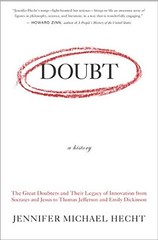
We examine the contribution of skeptics, cynics, and others who have followed the human impulse to challenge given wisdom, and to doubt. Poet and historian Jennifer Michael Hecht has published a sweeping, lyrical history of the world's great doubters, and she shows that the act of questioning, as much as the act of believing, has changed the world.
The joy of creating this program lies, in part, in having my own imagination about "faith" expanded. This week, Jennifer Michael Hecht provides a luminous account of how our common imagination about doubt, and its symbiotic relationship with faith, begs for investigation.
Hecht's subject matter, the history of doubt, is daunting. She defines doubt generously, broadly addressing the human impulse to question what is given in order to invest one's days with meaning. She counts Socrates and Jesus, Thomas Jefferson and Emily Dickinson, among history's great doubters. She loves the ideas her work examines, and recounts their origins and the individuals who championed them as though she is recalling the adventures of friends:
You have to be a little bold and a little brave in most periods of time to be a doubter. And I liked them. I also was surprised by them because the dominant history basically suggests that doubt is very modern and that we have few doubters in the ancient world, but I kept seeing it everywhere. And so I just wanted to tell that story, to sketch it out. I found it was much more cohesive and self-knowing than I had ever dreamed.